
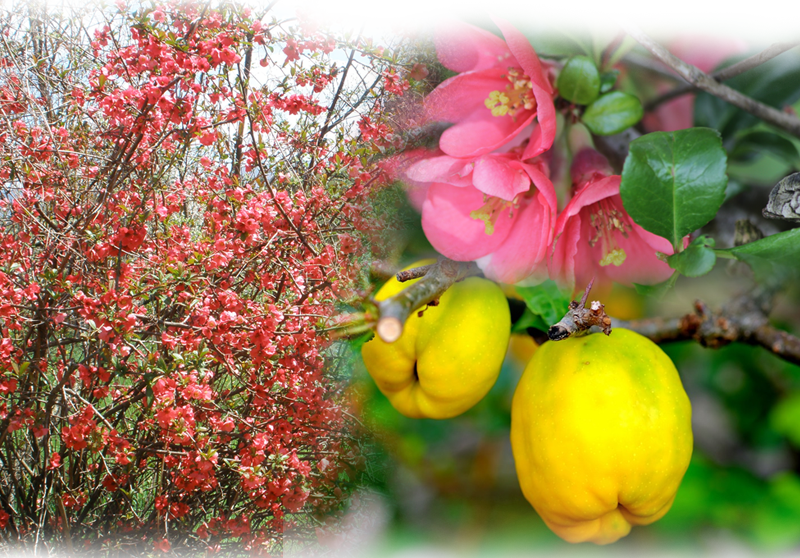
Japanese flowering quince
 7
7 5
5 6
6Will it grow where I live?
Japanese flowering quince is hardy to zone 5 – that covers all of Central Europe and the British Isles, and every USDA zone from 5 upwards.
Or check it for your location right here:
Profile
- Family
- Rosaceae
- Habit
- Shrub
- Height
- 1.4 m
- Spread
- 2 m
- Growth
- fast
- Lifespan
- 80 years
- First yield
- after 3 years
- Yield per plant
- up to 6 kg a year
- Yield in cultivation
- up to 10 t/ha
- Energy yield
- 600 kcal per m² a year
- Hardiness
- zone 5–8
- Shade tolerance
- full shade
- Soil
- Sand, Silt, Loam, Clay
- Soil moisture
- dry – very moist
- pH
- 6 – 8
- Synonyms
- Zierquitte, Scheinquitte
Flowering & harvest
| J | F | M | A | M | J | J | A | S | O | N | D | |
|---|---|---|---|---|---|---|---|---|---|---|---|---|
| Flowering | ||||||||||||
| Fruit harvest |
Varieties (1)
1 varieties of Japanese flowering quince are listed in the Permaplans variety finder — each with its own page: taste, ripening time, disease resistance, parentage and use.
Uses
Edible: Fruit - raw or cooked. It is very sharp and sour when raw, but fragrant when cooked, giving jams and jellies a strong pleasant taste, especially delicious when cooked with apples in apple pie. The fruit is apple-shaped and has a diameter of about 4 cm. The rich aromatic juice, as tart as a lemon, is pressed and used for culinary purposes.
Other uses: The shoots sprawl across the ground and root where they touch — hence the commonest secondary use: dense, impenetrable ground cover on banks, where Chaenomeles holds the soil and discourages access. Set about a metre apart it closes within a few years. The lower form C. japonica alpina stays roughly half the size and suits bed edging and narrow strips. Because the fruits scent strongly and pleasantly for months, they were traditionally laid in the linen chest in East Asia; they will perfume a room for weeks without spoiling. Its thorns and its indifference to urban air have made it a standard low-maintenance buffer planting in public green space.
Growing
Site: Chaenomeles tolerates shade but crops meaningfully only in sun — that is the decisive judgement before planting. It is strictly self-incompatible: without a second cultivar or a seedling within reach the shrub stays fruitless, so two different cultivars are obligatory. The shoots are thorny and sprawl across the ground; beside paths, seating and play areas that becomes a trip and scratch hazard, while as a low impenetrable hedge or underplanting beneath larger woody plants it is precisely the point. It suckers and spreads slowly outward — keep it clear of perennial beds or set an edging. On strongly calcareous soil it goes chlorotic; urban air and roadsides trouble it not at all, which also suits it to roof gardens and containers. Care: The shrub is hardy to about -25 °C and needs no winter protection. Pruning is what matters: fruit forms mainly on wood three years old and more, so routine cutting back costs the crop. Prune sparingly and straight after flowering, taking out old, exhausted stems at the base and leaving the rest. Feeding is barely needed; compost in spring is enough. Cut suckers away in spring before they travel far from the bush. The fruits ripen in October, stay rock hard and are inedible raw; harvest late, and stored cool they keep for months while scenting strongly. Birds take them only once frost has softened them.
Propagation
Raising from seed is straightforward but gives no true-to-type plants: extract the pips from ripe fruit in autumn, wash them and sow at once into a seedbed or an outdoor pot. Winter cold provides the stratification and seedlings emerge in spring; seed stored dry needs eight to twelve weeks of cold in moist sand instead. Since the species is self-incompatible, seedlings are always crosses and come up variable — in commercial plantings they serve mainly as pollinators. True-to-type increase is easiest from the freely produced suckers, lifted with a root ball in spring, and from semi-ripe cuttings in summer. Layering is equally reliable, since the shoots lie on the ground anyway.
Value for wildlife
Chaenomeles flowers in March and April, long before most fruit trees break, making it one of the first dependable nectar sources of the year. NaturaDB records 30 species of wild bee on it — mining, furrow and mason bees along with bumblebees — none of them specialised. Pollen value is rated high (3 of 4) and nectar value moderate (2 of 4); for early-flying bumblebee queens it is the pollen that counts. A second value lies in structure: the low, straggling, thorny growth makes excellent bird cover in which small songbirds nest under protection. The hard fruits hang into winter and are taken only once frost has softened them. As an East Asian newcomer the species has no caterpillars tied to it in Central Europe.
Notable
Special features: forms runners; best fruit formation on 3-year-old shoots; commercially grown in Latvia on >100ha; Yield varieties are: 'Cido' !'Nivalis', 'Rasa', and various hybrids (C. x superba) 'Fusion', then best to use 2 different varieties for a secure yield; can be grafted onto pear or mountain ash rootstocks;
Origin & habitat
East Asia: Japan and the Korean Peninsula. In Japan the species grows on Honshu, Shikoku and Kyushu from hill country up into the montane zone. It reached Europe in 1874 as an ornamental and has been ubiquitous in gardens and parks ever since; as an escape it turns up only sporadically on banks and woodland edges, without establishing itself as a problem neophyte. It has, surprisingly, gained commercial importance in Latvia, where it has been grown as a fruit crop in its own right on more than a hundred hectares since the 1990s and processed into juice, syrup and concentrate.
Open mountain and hill forest, woodland margins, scrub and rocky slopes in the Japanese uplands, mostly on fresh, free-draining and rather acid soils. As a low, straggling shrub of 80 to 150 centimetres the species occupies the transition between closed woodland and open ground, holding its place through suckering. It is remarkably adaptable: heavy clay, urban air pollution and deep shade are all tolerated, and only strongly alkaline soils bring on chlorosis. For fruit set, however, it needs considerably more light than its shade tolerance would suggest.
⚠️ Hazards
Although this type does not have a specific mention, it belongs to a genus where most, if not all members, produce cyanohydrin, a toxin that gives almonds their characteristic flavor. This toxin is mainly found in the leaves and seeds, easily recognizable by its bitter taste. While usually present in small amounts that do not cause harm, very bitter seeds or fruits should not be consumed. However, excessive amounts can lead to respiratory failure and even death.
Frequently asked questions
Japanese flowering quince: how big does it get?
Japanese flowering quince (Chaenomeles japonica) grows as a Shrub and reaches roughly 1.4 m in height when mature, with a spread of about 2 m. Growth is fast.
Japanese flowering quince: what site does it need?
Japanese flowering quince tolerates full shade. Suitable soils are Sand, Silt, Loam, Clay. Soil moisture should be in the range dry – very moist. The pH may lie between 6 and 8.
Japanese flowering quince: is it hardy?
Japanese flowering quince is listed as hardy in zone 5–8 and survives normal winters outdoors there.
Japanese flowering quince: will it grow in Central Europe?
Japanese flowering quince is hardy to zone 5 – that covers all of Central Europe and the British Isles, and every USDA zone from 5 upwards.
Japanese flowering quince: when does it flower?
In a temperate northern-hemisphere climate it flowers in April.
Japanese flowering quince: when is it harvested?
In a temperate northern-hemisphere climate the fruit ripens in November.
Japanese flowering quince: when does it start cropping, and how much?
Japanese flowering quince first crops after 3 years. A mature plant gives up to 6 kg a year, in cultivation up to 10 t per hectare. Figures assume a good site; variety, soil and climate shift them considerably.
Japanese flowering quince: is it poisonous?
Individual parts of Japanese flowering quince are noted as mildly problematic — the plant does not count as poisonous. With wild plants, never rely on a database alone, only on a confident identification.
Japanese flowering quince: what is it used for?
Rated on a scale up to 10: Edible 7/10, Medicinal 5/10, Other uses 6/10.
Which Japanese flowering quince varieties are there?
The Permaplans variety finder lists 1 varieties of Japanese flowering quince, including Cido. Each variety has its own page with taste, ripening time, disease resistance and parentage.
Plan this plant into your own garden
Permaplans plans your garden to scale on the map — with a site check, harvest calendar and over 1,000 plants. Free for iPhone, Android, Mac, Windows & Linux.
Will this plant grow where you live? → Check your site
Community experience
No first-hand reports for this plant yet.
Growing it? Write in the app what works for you – your post will show up here.
💬 Get the app and join in