
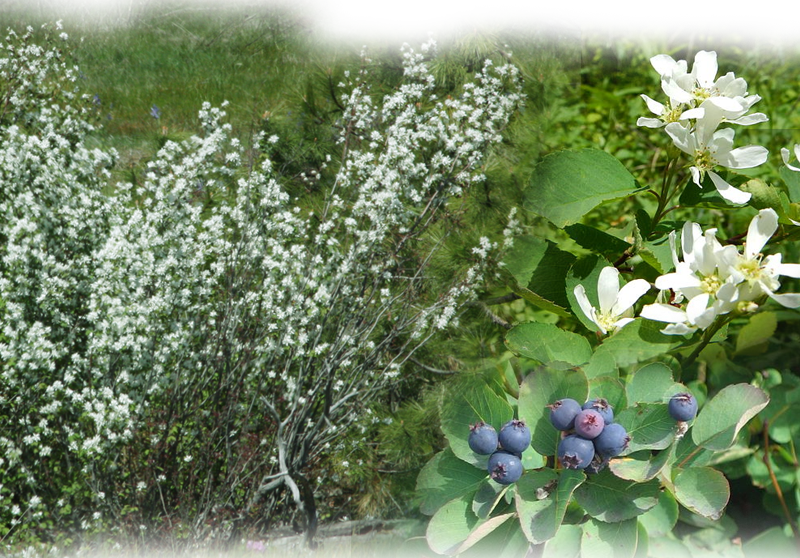
Alder-leafed serviceberry
 8
8 5
5 8
8Will it grow where I live?
Alder-leafed serviceberry is hardy to zone 2 – that covers all of Central Europe and the British Isles, and every USDA zone from 2 upwards.
Or check it for your location right here:
Profile
- Family
- Rosaceae
- Habit
- Shrub
- Height
- 4 m
- Spread
- 3 m
- Growth
- medium
- Lifespan
- 50 years
- First yield
- after 4 years
- Full yield
- after 12–25 years
- Productive years
- 30–50 years
- Yield per plant
- up to 8 kg a year
- Yield in cultivation
- up to 10 t/ha
- Energy yield
- 850 kcal per m² a year
- Hardiness
- zone 2–7
- Shade tolerance
- partial shade
- Soil
- Sand, Silt, Loam, Clay
- Soil moisture
- semi-dry – very wet
- pH
- 5.5 – 8
- Synonyms
- Saskatoon, Junibeere, Felsenbirne
- Planned in gardens
- 6×
Flowering & harvest
| J | F | M | A | M | J | J | A | S | O | N | D | |
|---|---|---|---|---|---|---|---|---|---|---|---|---|
| Flowering | ||||||||||||
| Fruit harvest |
Varieties (7)
7 varieties of Alder-leafed serviceberry are listed in the Permaplans variety finder — each with its own page: taste, ripening time, disease resistance, parentage and use.
- BallerinaOrnamental small tree with abundant blossom and edible berries.
- Greatberry GardenCompact garden selection with large, sweet berries.
- Martin Saskatoon selection with large, firm berries.
- Northline Reliably high-yielding Saskatoon cultivar from Beaverlodge.
- Smokey
- Smoky Proven, productive standard Saskatoon cultivar from Alberta.
- Thiessen Early Saskatoon cultivar with especially large berries.
Uses
Edible: The fruit ripens in midsummer, offering a sweet aroma reminiscent of apples. It is soft, juicy, and contains a few small seeds in the center. About the size of a blackcurrant, the fruit grows in small clusters, with the finest wild varieties reaching a diameter of 15 mm. The fruits can be consumed raw, dried for raisins, or processed into pemmican. They are high in iron and copper. The leaves can serve as a substitute for tea.
Medicinal: A decoction of the bark is applied externally to treat swellings and body aches.
Other uses: Plants have an expanding, absorbing root system and are utilized for erosion control in windbreaks. Young branches can be twisted into a rope. The wood is hard, straight-grained, and tough, commonly employed for tool handles. Heating it over a fire can further harden it, allowing for easy shaping while hot. Young stems are used in crafting edges, handles, and for reinforcement in basket making.
Growing
Site: The saskatoon throws short suckers and forms loose stands over the years; keeping it as a single bush means cutting those suckers away regularly. The limiting factor is not cultivation but birds: the fruit is often stripped before it is fully ripe, so anyone wanting a harvest needs netting or has to share. As a bird-feeding shrub that is precisely its value, and around 30 wild bee species visit the flowers. Late frosts into May can catch the bloom, which rules out frost hollows. A bush fruits for 30 years and more, so the position should be a lasting one. Care: It is self-fertile and undemanding, adapting well to both site and climate, and its frost hardiness of about -34 °C is exceptional. It needs plenty of sun above all for ripening; in shade both yield and sugar content fall away. It is tolerant about soil as long as drainage is good: avoid heavy, poorly drained clay lacking organic matter, and avoid shallow ground. It takes lime well, thriving on anything from weakly acidic to distinctly chalky ground. Little pruning is required — take out old, bare shoots at ground level so younger ones can follow on.
Propagation
Because species in this genus hybridise freely, seedlings often come out variable; anyone wanting to keep a particular cultivar propagates vegetatively. The simplest route is dividing the suckers in late winter, but only once they have stood for two years and formed roots of their own. They can then be set straight into their final position. Layering also works but takes around 18 months to root. For seed, harvest it green, once fully formed but while the coat is still soft, and sow at once outdoors; hardened seed otherwise takes 18 months or longer to germinate. Plants true to type can also be grafted onto seedlings of Amelanchier lamarckii or onto rowan.
Value for wildlife
The white flowers open in April and are well visited; around 30 wild bee species have been recorded on saskatoon, none of them specialists. Its greatest value, however, lies in the fruit: the pomes ripening in summer are so sought after by blackbirds, thrushes, starlings and other frugivores that they are often stripped before they can be picked, and the birds disperse the seed in their droppings. In its North American homeland the shrub additionally serves several swallowtail species as a larval food plant, while deer, elk and hares browse the foliage. The dense, multi-stemmed habit gives small birds cover and nesting sites.
Notable
Special features: suitable for calcareous and clay soils; Mainly cultivated for yield is A. alnifolia (Saskatoon). A. ovalis is the common Juneberry, and A. laevis also has productive varieties and can reach a height of 6-8m. There are also hybrids; popular with birds; The most productive and sweetest variety is 'Smoky'. Maximum yield is achieved after 12-15 years (15kg).
Origin & habitat
Western North America: Alaska to California and Utah. The natural range of the saskatoon lies in western North America. It extends from subarctic Alaska across much of western Canada and southward to California and Utah, reaching east into the northern Great Plains. The species covers a remarkably wide altitudinal band, from sea level to around 3,400 metres in the Rocky Mountains, and tolerates correspondingly hard winters. It does not occur wild in Central Europe, where it is planted as a fruit and ornamental shrub and escapes from cultivation only occasionally. In Canada and the northern Midwest of the United States it is additionally grown as a commercial fruit crop.
In its North American homeland the saskatoon grows in floodplains and along watercourses, in the understorey of open, species-poor woodland, and in canyons. It occupies moderately dry to fresh, sandy, gravelly or loamy and often quite nutrient-rich soils on sunny to lightly shaded, cool to cold sites. Its altitudinal span is remarkable: in the north of the range it grows at sea level, while in the Rocky Mountains it climbs into high montane country. The species is correspondingly frost-hardy. It avoids waterlogged and shallow soils, particularly where the water table is high or erratic.
Frequently asked questions
Alder-leafed serviceberry: how big does it get?
Alder-leafed serviceberry (Amelanchier alnifolia) grows as a Shrub and reaches roughly 4 m in height when mature, with a spread of about 3 m. Growth is medium.
Alder-leafed serviceberry: what site does it need?
Alder-leafed serviceberry tolerates partial shade. Suitable soils are Sand, Silt, Loam, Clay. Soil moisture should be in the range semi-dry – very wet. The pH may lie between 5.5 and 8.
Alder-leafed serviceberry: is it hardy?
Alder-leafed serviceberry is listed as hardy in zone 2–7 and survives normal winters outdoors there.
Alder-leafed serviceberry: will it grow in Central Europe?
Alder-leafed serviceberry is hardy to zone 2 – that covers all of Central Europe and the British Isles, and every USDA zone from 2 upwards.
Alder-leafed serviceberry: when does it flower?
In a temperate northern-hemisphere climate it flowers in May.
Alder-leafed serviceberry: when is it harvested?
In a temperate northern-hemisphere climate the fruit ripens in July.
Alder-leafed serviceberry: when does it start cropping, and how much?
Alder-leafed serviceberry first crops after 4 years. Full yield comes after 12–25 years. A mature plant gives up to 8 kg a year, in cultivation up to 10 t per hectare. The productive period lasts about 30–50 years. Figures assume a good site; variety, soil and climate shift them considerably.
Alder-leafed serviceberry: is it poisonous?
No toxicity is recorded for Alder-leafed serviceberry. With wild plants, never rely on a database alone — only on a confident identification.
Alder-leafed serviceberry: what is it used for?
Rated on a scale up to 10: Edible 8/10, Medicinal 5/10, Other uses 8/10.
Which Alder-leafed serviceberry varieties are there?
The Permaplans variety finder lists 7 varieties of Alder-leafed serviceberry, including Ballerina, Greatberry Garden, Martin, Northline, Smokey, Smoky, Thiessen. Each variety has its own page with taste, ripening time, disease resistance and parentage.
Plan this plant into your own garden
Permaplans plans your garden to scale on the map — with a site check, harvest calendar and over 1,000 plants. Free for iPhone, Android, Mac, Windows & Linux.
Will this plant grow where you live? → Check your site
Community experience
What Permaplans users wrote about this plant – taken from the app as is. 1 post.
super leckere Früchte vom Wegesrand. Es ist jedes Jahr eine Freude wenn der Mensch noch welche bekommt, die vögel lieben sie aber auch sehr.
Growing it? Write in the app what works for you – your post will show up here.
💬 Get the app and join in