
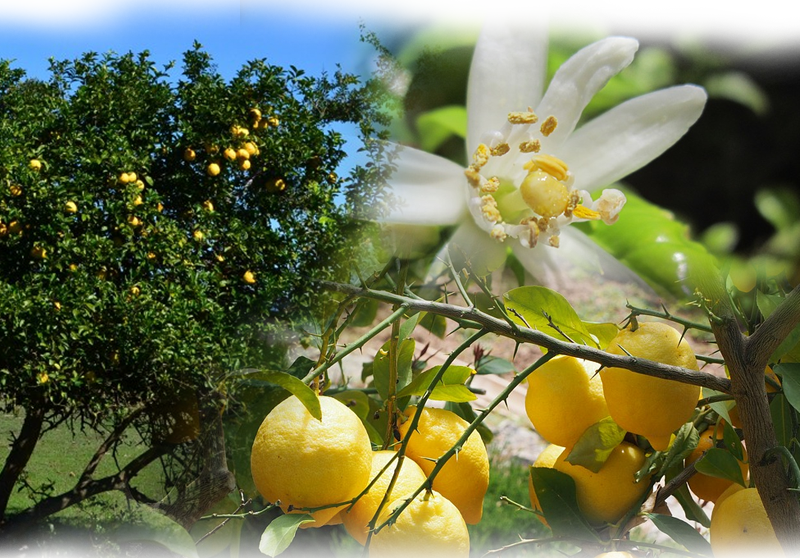
Lemon
 9
9 8
8 7
7Will it grow where I live?
Lemon is not winter-hardy in Central Europe (zone 10): outdoors from spring to autumn only, otherwise a container plant overwintered frost-free. It also needs warm summers – in Central Europe that means wine-growing regions, cities or a sheltered south-facing wall.
Or check it for your location right here:
Profile
- Family
- Rutaceae
- Habit
- Shrub
- Height
- 6 m
- Spread
- 4 m
- Growth
- medium
- Lifespan
- 70 years
- First yield
- after 6 years
- Yield per plant
- up to 100 kg a year
- Yield in cultivation
- up to 20 t/ha
- Energy yield
- 400 kcal per m² a year
- Hardiness
- zone 10–12
- Shade tolerance
- full sun
- Soil
- Sand, Silt, Loam
- Soil moisture
- dry – very moist
- pH
- 5.5 – 6.5
- Synonyms
- Citrus × limon, Lemon-tree, Mandarin lime
Flowering & harvest
| J | F | M | A | M | J | J | A | S | O | N | D | |
|---|---|---|---|---|---|---|---|---|---|---|---|---|
| Flowering | ||||||||||||
| Fruit harvest |
Varieties (13)
13 varieties of Lemon are listed in the Permaplans variety finder — each with its own page: taste, ripening time, disease resistance, parentage and use.
- Bearss Florida's oil-rich lemon – high juice content and aromatic peel for kitchen and oil.
- Eureka The Californian world-standard lemon – nearly thornless, few seeds and fruiting almost year-round.
- Femminello Siracusano The classic Sicilian lemon – highly aromatic, multiple-flowering and basis of the Limone di Siracusa PGI.
- Fino Spain's early winter classic – thin-skinned, juicy and the opener of the commercial lemon season.
- Genoa Italian-origin, bushy lemon with excellent fruit quality – basis of much of Chile's production.
- Interdonato The very early, elongated lemon – smooth-skinned, seedless and market leader at season start.
- Lisbon Vigorous, thorny commercial lemon – hardier and more productive than 'Eureka', with dense foliage.
- Meyer Mild, sweet-aromatic hybrid lemon with thin skin – the favourite for pots and gourmets.
- Monachello The mal-secco-tolerant Sicilian lemon – robust in cultivation though less juicy.
- Sfusato Amalfitano The aromatic Amalfi lemon – elongated, thick-skinned, few-seeded and the heart of limoncello.
- Verna Spain's late summer lemon – large, thick-skinned fruit extending the season into summer.
- Villafranca Robust Eureka-type lemon that historically shaped Florida and the subtropics.
- Yen Ben The leading lemon of Australia and New Zealand – thin-skinned, few-seeded and intensely aromatic.
Uses
Edible: Fruits are utilized in beverages for their sour taste and to flavor foods, containing essential oils in the skin. They can also be used in salad dressings and preservation. Yields can reach 10–40 tons per hectare, offering around 400–1600 calories per square meter. Dried leaves are employed to add flavor to tea.
Medicinal: Fruit juice has antibacterial properties, is highly alkalizing, and packed with vitamin C. It can assist with sore throats, fever (e.g., in malaria), rheumatic diseases, varicose veins, bruises, and enhances tanning. The essential oil derived from the fruit is stimulating and is known for its refreshing qualities in aromatherapy. The stem bark of the fruit is bitter, provides strength, and aids digestion.
Other uses: Use seed oil soap, dried fruit peel with 0.4% oil and aroma, insect repellent, fruit juice, and skin and hair wash for polishing bronze and metals, removing stains, bleaching, and caring for wood.
Notable
Special features: roots 1-2m deep, so plant early enough in a deep pot (pot culture): in winter between 4-10°C, in summer sunny and sheltered from the wind; water abundantly, allowing the root ball to dry out in between; indoor cultivation must be pollinated by hand; fruit ripens after 4-12 months, can remain ripe for another 6 months.
Origin & habitat
The plant's original habitat is unknown, but it is likely a hybrid of C. limon x C. sinensis.
Riverbanks, sand, open forests, forest edges, and rocky slopes are impacted by erosion.
Frequently asked questions
Lemon: how big does it get?
Lemon (Citrus x limon) grows as a Shrub and reaches roughly 6 m in height when mature, with a spread of about 4 m. Growth is medium.
Lemon: what site does it need?
Lemon tolerates full sun. Suitable soils are Sand, Silt, Loam. Soil moisture should be in the range dry – very moist. The pH may lie between 5.5 and 6.5.
Lemon: is it hardy?
Lemon is listed as hardy in zone 10–12 and survives normal winters outdoors there.
Lemon: will it grow in Central Europe?
Lemon is not winter-hardy in Central Europe (zone 10): outdoors from spring to autumn only, otherwise a container plant overwintered frost-free. It also needs warm summers – in Central Europe that means wine-growing regions, cities or a sheltered south-facing wall.
Lemon: when does it flower?
In a temperate northern-hemisphere climate it flowers from April to October.
Lemon: when is it harvested?
In a temperate northern-hemisphere climate the fruit ripens in March.
Lemon: when does it start cropping, and how much?
Lemon first crops after 6 years. A mature plant gives up to 100 kg a year, in cultivation up to 20 t per hectare. Figures assume a good site; variety, soil and climate shift them considerably.
Lemon: is it poisonous?
No toxicity is recorded for Lemon. With wild plants, never rely on a database alone — only on a confident identification.
Lemon: what is it used for?
Rated on a scale up to 10: Edible 9/10, Medicinal 8/10, Other uses 7/10.
Which Lemon varieties are there?
The Permaplans variety finder lists 13 varieties of Lemon, including Bearss, Eureka, Femminello Siracusano, Fino, Genoa, Interdonato, Lisbon, Meyer, Monachello, Sfusato Amalfitano, Verna, Villafranca and 1 more. Each variety has its own page with taste, ripening time, disease resistance and parentage.
Plan this plant into your own garden
Permaplans plans your garden to scale on the map — with a site check, harvest calendar and over 1,000 plants. Free for iPhone, Android, Mac, Windows & Linux.
Will this plant grow where you live? → Check your site
Community experience
No first-hand reports for this plant yet.
Growing it? Write in the app what works for you – your post will show up here.
💬 Get the app and join in