
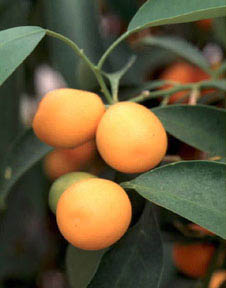
Round kumquat
 8
8 3
3Will it grow where I live?
Round kumquat is only hardy to zone 8, so outdoors year-round it needs the mildest spots in Central Europe – wine-growing regions, the Rhine valley, coasts, Lake Constance, Ticino – or a container overwintered under cover. Most of the British Isles and the Pacific coast of North America qualify. The summer heat it needs to ripen is out of reach outdoors in Central Europe – greenhouse or conservatory.
Or check it for your location right here:
Profile
- Family
- Rutaceae
- Habit
- Tree
- Height
- 3 m
- Spread
- 2.5 m
- Growth
- slow
- Lifespan
- 50 years
- First yield
- after 3 years
- Full yield
- after 7 years
- Yield per plant
- up to 10 kg a year
- Yield in cultivation
- up to 10 t/ha
- Energy yield
- 700 kcal per m² a year
- Hardiness
- zone 8–12
- Shade tolerance
- full sun
- Soil
- Sand, Silt
- Soil moisture
- dry – moist
- pH
- 5.5 – 7
Flowering & harvest
| J | F | M | A | M | J | J | A | S | O | N | D | |
|---|---|---|---|---|---|---|---|---|---|---|---|---|
| Flowering | ||||||||||||
| Fruit harvest |
Uses
Other uses: Use in agroforestry: Kumquats can be used as a hedge or ornamental plant. They are also useful in permaculture systems, as they attract pollinators and bear fruit. 1. Nectar – nectar- and pollen-rich flowers: Yes – Kumquat flowers produce nectar and pollen and so attract pollinators such as bees and other beneficial insects. 2. Wildlife – food (fruit, seeds, leaf litter, shelter, nesting site, roost): Yes – The fruits of kumquats are eaten by birds and mammals. The dense foliage provides good cover and can offer shelter to small animals or birds. It can also provide limited nesting opportunities for small birds. 3. Shelter for invertebrates (overwintering sites, leaf litter, ground cover): Yes – The tree can provide shelter to some invertebrates, while its leaf litter provides overwintering sites for insects. 4. Pest confuser (scent): Yes – The strong citrus scent of kumquat leaves and fruits can naturally deter certain pests and is therefore a useful means of pest confusion in the garden.
Growing
Sonniger, geschützter Standort mit durchlässigem, leicht saurem Boden; in kühleren Regionen als Kübelpflanze frostfrei überwintern. Mäßig gießen und im Sommer düngen.
Frequently asked questions
Round kumquat: how big does it get?
Round kumquat (Citrus japonica) grows as a Tree and reaches roughly 3 m in height when mature, with a spread of about 2.5 m. Growth is slow.
Round kumquat: what site does it need?
Round kumquat tolerates full sun. Suitable soils are Sand, Silt. Soil moisture should be in the range dry – moist. The pH may lie between 5.5 and 7.
Round kumquat: is it hardy?
Round kumquat is listed as hardy in zone 8–12 and survives normal winters outdoors there.
Round kumquat: will it grow in Central Europe?
Round kumquat is only hardy to zone 8, so outdoors year-round it needs the mildest spots in Central Europe – wine-growing regions, the Rhine valley, coasts, Lake Constance, Ticino – or a container overwintered under cover. Most of the British Isles and the Pacific coast of North America qualify. The summer heat it needs to ripen is out of reach outdoors in Central Europe – greenhouse or conservatory.
Round kumquat: when does it flower?
In a temperate northern-hemisphere climate it flowers from June to July.
Round kumquat: when is it harvested?
In a temperate northern-hemisphere climate the fruit ripens from November to March.
Round kumquat: when does it start cropping, and how much?
Round kumquat first crops after 3 years. Full yield comes after 7 years. A mature plant gives up to 10 kg a year, in cultivation up to 10 t per hectare. Figures assume a good site; variety, soil and climate shift them considerably.
Round kumquat: is it poisonous?
No toxicity is recorded for Round kumquat. With wild plants, never rely on a database alone — only on a confident identification.
Round kumquat: what is it used for?
Rated on a scale up to 10: Edible 8/10, Other uses 3/10.
Plan this plant into your own garden
Permaplans plans your garden to scale on the map — with a site check, harvest calendar and over 1,000 plants. Free for iPhone, Android, Mac, Windows & Linux.
Will this plant grow where you live? → Check your site
Community experience
No first-hand reports for this plant yet.
Growing it? Write in the app what works for you – your post will show up here.
💬 Get the app and join in