
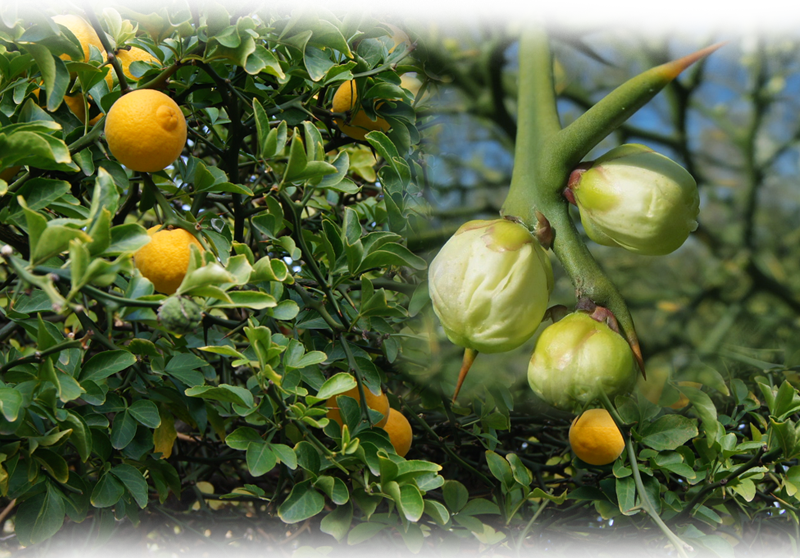
Trifoliate orange
 5
5 6
6 5
5Will it grow where I live?
Trifoliate orange is hardy to zone 6, which covers nearly all of Central Europe and the British Isles; only harsh upland sites (Alps, high ridges) call for winter protection.
Or check it for your location right here:
Profile
- Family
- Rutaceae
- Habit
- Shrub
- Height
- 3.5 m
- Spread
- 4 m
- Growth
- slow
- Lifespan
- 35 years
- First yield
- after 5 years
- Yield per plant
- up to 14 kg a year
- Yield in cultivation
- up to 9 t/ha
- Energy yield
- 360 kcal per m² a year
- Hardiness
- zone 6–9
- Shade tolerance
- partial shade
- Soil
- Sand, Silt, Loam
- Soil moisture
- semi-dry – very moist
- pH
- 5.5 – 6.5
Flowering & harvest
| J | F | M | A | M | J | J | A | S | O | N | D | |
|---|---|---|---|---|---|---|---|---|---|---|---|---|
| Flowering | ||||||||||||
| Fruit harvest |
Uses
Edible: The fruit of the fruit tree can be cooked and has a bitter and sharp taste. It is suitable for making jam and refreshing drinks. Freshly picked fruits have little juice, but after storage for 2 weeks, about 20% juice rich in Vitamin C can be obtained. In America, yields of up to 14 kilograms of fruit per plant have been achieved. The fruit is 2-3 cm wide, with most of the mass coming from the skin. The fruit peel can be used as a flavoring. Young leaves can also be cooked.
Other uses: Used as an understock for citrus varieties, providing an additional cold resistance of 3°C. The plant is highly thorny, forming an impenetrable barrier or hedge, although not very dense. Highly tolerant to pruning, it is best trimmed in early summer shortly after flowering.
Growing
An easy-to-grow plant that thrives in ordinary garden soil, preferably well-draining but ideally in a fertile, light sandy soil in a sunny location. It grows and produces well in lightly shaded forests at the Cambridge Botanical Garden. These plants dislike soil disturbance near their roots and should either be well mulched to prevent weed growth or hand weeded. They also thrive in poor acidic and chalky soils. The bitter orange hybridizes with citrus species and could potentially be used in breeding programs to produce more robust forms of oranges, lemons, etc. It may also be valuable in imparting resistance to diseases, tolerance to poorer soils, and dwarfing characteristics. Flowers are formed on the previous year's wood. The entire plant, especially the flowers, is highly aromatic. A highly decorative plant that bears abundant fruit in Southwest England. A hedge shrub in Wisley in a semi-shaded location bears plentiful fruit most years. Another source suggests that warm autumn days are necessary for the plant to bear abundant fruit. Fertile seeds are produced after warm summers. The plants are relatively short-lived and deteriorate after about 25 years.
Notable
Characteristics: prefers sandy and fertile soil; The utilization of the fruits is challenging due to their many seeds and little flesh; after 2 weeks of storage, they yield 20% more juice; a warm summer/autumn is necessary for the fruits to ripen; the bitter taste diminishes when mixed with other fruits.
Origin & habitat
East Asia - Central and South China, Korea.
Sandy heaths and moors, sometimes found in open forests and frequently near the coast. Strongly avoiding calcareous soils.
Frequently asked questions
Trifoliate orange: how big does it get?
Trifoliate orange (Poncirus trifoliata) grows as a Shrub and reaches roughly 3.5 m in height when mature, with a spread of about 4 m. Growth is slow.
Trifoliate orange: what site does it need?
Trifoliate orange tolerates partial shade. Suitable soils are Sand, Silt, Loam. Soil moisture should be in the range semi-dry – very moist. The pH may lie between 5.5 and 6.5.
Trifoliate orange: is it hardy?
Trifoliate orange is listed as hardy in zone 6–9 and survives normal winters outdoors there.
Trifoliate orange: will it grow in Central Europe?
Trifoliate orange is hardy to zone 6, which covers nearly all of Central Europe and the British Isles; only harsh upland sites (Alps, high ridges) call for winter protection.
Trifoliate orange: when does it flower?
In a temperate northern-hemisphere climate it flowers in May.
Trifoliate orange: when is it harvested?
In a temperate northern-hemisphere climate the fruit ripens in November.
Trifoliate orange: when does it start cropping, and how much?
Trifoliate orange first crops after 5 years. A mature plant gives up to 14 kg a year, in cultivation up to 9 t per hectare. Figures assume a good site; variety, soil and climate shift them considerably.
Trifoliate orange: is it poisonous?
No toxicity is recorded for Trifoliate orange. With wild plants, never rely on a database alone — only on a confident identification.
Trifoliate orange: what is it used for?
Rated on a scale up to 10: Edible 5/10, Medicinal 6/10, Other uses 5/10.
Plan this plant into your own garden
Permaplans plans your garden to scale on the map — with a site check, harvest calendar and over 1,000 plants. Free for iPhone, Android, Mac, Windows & Linux.
Will this plant grow where you live? → Check your site
Community experience
No first-hand reports for this plant yet.
Growing it? Write in the app what works for you – your post will show up here.
💬 Get the app and join in