
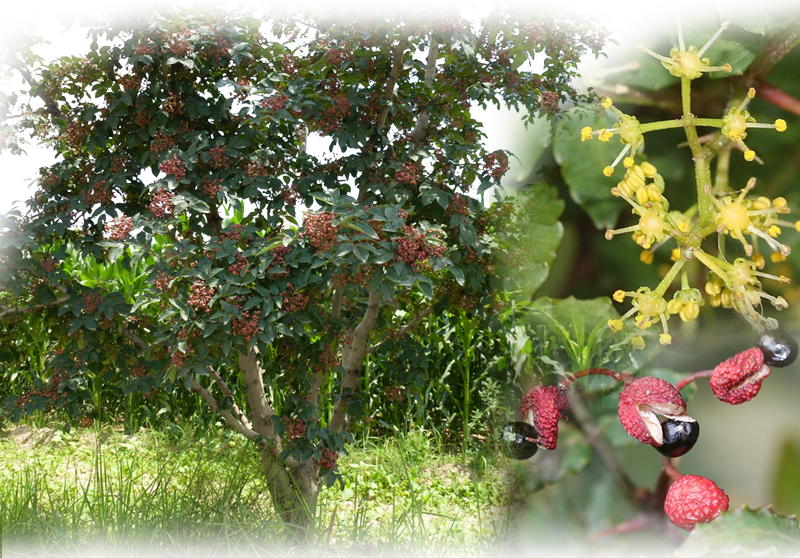
Szechuan pepper
 6
6 6
6 4
4Will it grow where I live?
Szechuan pepper is hardy to zone 6, which covers nearly all of Central Europe and the British Isles; only harsh upland sites (Alps, high ridges) call for winter protection.
Or check it for your location right here:
Profile
- Family
- Rutaceae
- Habit
- Shrub
- Height
- 2 m
- Spread
- 2 m
- Growth
- medium
- Lifespan
- 120 years
- First yield
- after 3 years
- Yield per plant
- up to 0.5 kg a year
- Yield in cultivation
- up to 0 t/ha
- Hardiness
- zone 6–9
- Shade tolerance
- partial shade
- Soil
- Sand, Silt, Loam
- Soil moisture
- dry – very moist
- pH
- 5 – 7.5
- Synonyms
- Szechuan-Pfeffer
Flowering & harvest
| J | F | M | A | M | J | J | A | S | O | N | D | |
|---|---|---|---|---|---|---|---|---|---|---|---|---|
| Flowering | ||||||||||||
| Fruit harvest |
Uses
Edible: Seeds are purchased and ground into a powder used as a spice, similar to pepper. The fruit can also be utilized. The spice is often heated to enhance its full flavor and can be mixed with salt as a table seasoning. The ground and dry-roasted fruit is part of the Chinese "Five-Spice Powder." Bark and leaves are also used as spices. Young leaves can be used raw or cooked in soups or salads for flavor.
Medicinal: Antiperiodic, antitussive, carminative, diuretic, parasiticidal, stimulant. The fruit contains an essential oil, flavonoids, and isoquinoline alkaloids, providing anthelmintic, antibacterial, antifungal, and stomach-strengthening properties. Additionally, it inhibits prostaglandin synthesis and can be toxic to the central nervous system in higher doses. In Korea, it is used to treat tuberculosis, dyspepsia, and internal parasites. The resin found in the bark and especially in the roots is highly stimulating and invigorating.
Other uses: The dense, heavy wood of Japanese pepper is turned into surikogi in Japan, the wooden pestles used with the ridged suribachi grinding bowl. They impart a fine peppery aroma to whatever is ground in them — and have grown rarer since food processors took over the work. In Korea the crushed fruits were traditionally used for fishing: thrown into the water they stun small fish, which are then easily gathered. The strong paired thorns of the wild form make it a serviceable impenetrable hedge plant; for cultivation, by contrast, the thornless variety inerme was selected, whose Asakura type is far easier to harvest. With its fine pinnate foliage, strongly scented when brushed against, the shrub is also an ornamental for small gardens and containers.
Growing
Site: Two things decide where it goes. First, the shrub is dioecious: anyone wanting a crop of husks needs a male and a female plant within sight of each other, while anyone using only the leaves as a herb can manage with one. Second, the thorns — the wild form carries paired, very sharp spines along its twigs and therefore does not belong beside paths, seating areas or play spaces. For gardens with children the thornless Asakura selection is worth the money. The shrub stays small at two to three metres, but throws root suckers and creeps slowly outwards. It needs moist, humus-rich, free-draining soil in sun to partial shade, sheltered from wind and free of waterlogging. It is hardy to about minus fifteen degrees; in harsh areas container culture or a spot against a south wall works better. Care: Prune little, because the flowers form on wood several years old — after harvest, remove only dead and crossing wood and thin the bush out. A mulch of leaves or bark humus keeps the soil evenly moist and largely replaces feeding; summer drought stress makes the fine pinnate leaves drop early. Cut suckers off while they are young. Pick young leaves from May onwards and the husks in late summer while still green and aromatic, or after they split in autumn. In a container the plant overwinters cool and light, and the rootball must not freeze through. Young shoots suffer occasionally from aphids; no serious diseases are known in Central Europe.
Propagation
The seeds are oily and lose viability quickly if they dry out, so they are sown straight after ripening in autumn and kept cool and moist over winter. Stored seed should be given about three months of cold stratification, with the expectation that some will come up only after twelve months; the hard oily coat can be lightly abraded beforehand. For the garden, vegetative propagation is more practical: the shrub throws root suckers that can be severed with a piece of root in spring and replanted at once. Root cuttings in winter work too. Semi-ripe summer cuttings root reliably only under mist. Propagating vegetatively has a second advantage: the sex of a seedling shows only at first flowering, and the thornless Asakura selection can be kept true no other way.
Value for wildlife
In Central Europe Japanese pepper is an introduction with no documented specialists — the animals that use it at home are absent here. In Japan and Korea it is a larval food plant of the Asian swallowtail Papilio xuthus, which like our native swallowtails depends on rue and carrot family plants. The small yellow-green flowers open in May in inconspicuous umbels and offer moderate nectar and pollen; they are worked by short-tongued wild bees, hoverflies and beetles that cannot reach into deeper flowers. Its clearest contribution in the garden is structure: the thorny, densely branched growth gives small birds a cat-proof perch and nest site, and the black seeds hang on into winter after the husks split.
Notable
Special characteristics: thrives in deep-fertile soil but also grows in poor soil; Only the seed capsule/pericarp/fruit husk contains the flavor and mildly numbing effect like fizz on the tongue (lollipop). The spice aroma lasts 2-3 years at room temperature; Zant. simulans grows up to 4m tall and is more shade and cold tolerant.
Origin & habitat
East Asia: Japan, South Korea and adjacent China. Japanese pepper occurs naturally across the main Japanese islands from Hokkaido to Kyushu — the Ryukyus excepted — as well as on the southern Korean peninsula and in parts of mainland China. In Japan cultivation has diverged into regional lineages named after their area of origin: Asakura, Arima and Takahara, alongside the Budou lineage distinguished by growth form. In Europe the species is found only as a garden and container plant and has naturalised nowhere. One point matters for placing it: the spice sold commercially as Sichuan pepper comes mostly from the Chinese relatives Zanthoxylum bungeanum and Z. simulans, whereas this species yields Japanese sansho.
Japanese pepper is a shrub of thickets, woodland margins and open mountain forest. In Japan it grows in hill and mountain country along tracks, in hedges and at forest edges, often in the shade of larger broadleaf trees; on the Korean peninsula it occupies mountain woodland above all. It prefers evenly moist, humus-rich, free-draining soil and avoids waterlogging as much as permanently dry, shallow ground. As an understorey shrub it takes partial shade well, but flowers and fruits far more heavily in full sun. Because the species is dioecious, male and female bushes stand mixed in natural stands — a single plant is never alone there.
⚠️ Hazards
Injury from thorns, mucous membrane irritation The wild form carries paired, very sharp spines along its twigs — gloves are sensible when harvesting and pruning, and the thornless Asakura selection avoids the problem altogether. The spice itself is not toxic, but the sanshool it contains produces a tingling numbness on the lips and tongue that some people find unpleasant.
Frequently asked questions
Szechuan pepper: how big does it get?
Szechuan pepper (Zanthoxylum piperitum) grows as a Shrub and reaches roughly 2 m in height when mature, with a spread of about 2 m. Growth is medium.
Szechuan pepper: what site does it need?
Szechuan pepper tolerates partial shade. Suitable soils are Sand, Silt, Loam. Soil moisture should be in the range dry – very moist. The pH may lie between 5 and 7.5.
Szechuan pepper: is it hardy?
Szechuan pepper is listed as hardy in zone 6–9 and survives normal winters outdoors there.
Szechuan pepper: will it grow in Central Europe?
Szechuan pepper is hardy to zone 6, which covers nearly all of Central Europe and the British Isles; only harsh upland sites (Alps, high ridges) call for winter protection.
Szechuan pepper: when does it flower?
In a temperate northern-hemisphere climate it flowers in May.
Szechuan pepper: when is it harvested?
In a temperate northern-hemisphere climate the fruit ripens in October.
Szechuan pepper: when does it start cropping, and how much?
Szechuan pepper first crops after 3 years. A mature plant gives up to 0.5 kg a year, in cultivation up to 0 t per hectare. Figures assume a good site; variety, soil and climate shift them considerably.
Szechuan pepper: is it poisonous?
No toxicity is recorded for Szechuan pepper. With wild plants, never rely on a database alone — only on a confident identification.
Szechuan pepper: what is it used for?
Rated on a scale up to 10: Edible 6/10, Medicinal 6/10, Other uses 4/10.
Plan this plant into your own garden
Permaplans plans your garden to scale on the map — with a site check, harvest calendar and over 1,000 plants. Free for iPhone, Android, Mac, Windows & Linux.
Will this plant grow where you live? → Check your site
Community experience
No first-hand reports for this plant yet.
Growing it? Write in the app what works for you – your post will show up here.
💬 Get the app and join in