
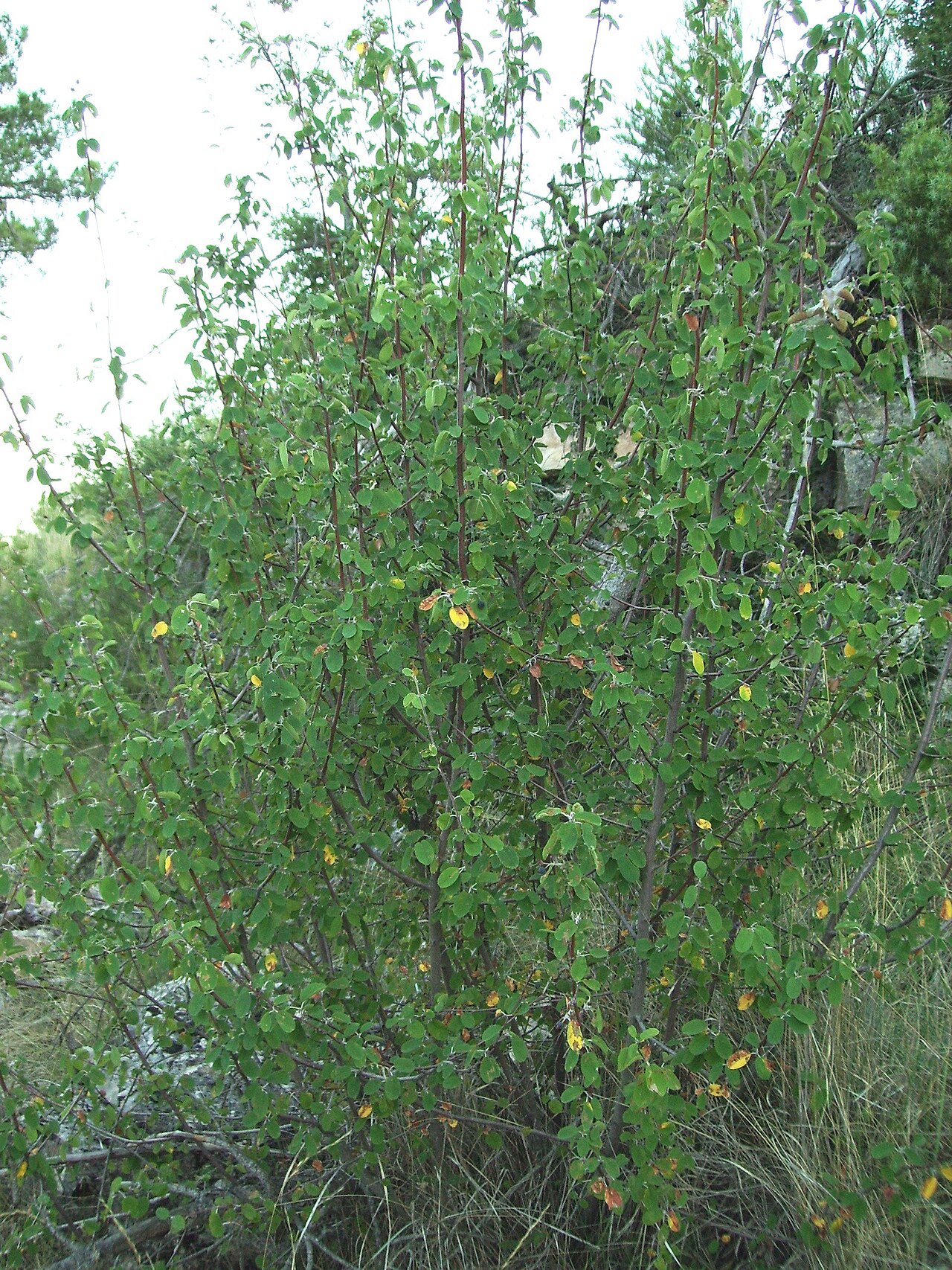
Snowy mespilus
 4
4 1
1Will it grow where I live?
Snowy mespilus is hardy to zone 5 – that covers all of Central Europe and the British Isles, and every USDA zone from 5 upwards.
Or check it for your location right here:
Profile
- Family
- Rosaceae
- Habit
- Shrub
- Height
- 5 m
- Spread
- 6 m
- Growth
- very slow
- Lifespan
- 60 years
- First yield
- after 3 years
- Hardiness
- zone 5–7
- Shade tolerance
- full sun
- Soil
- Sand, Silt, Loam, Clay
- Soil moisture
- semi-dry – very wet
- pH
- 5.6 – 7.6
Flowering & harvest
| J | F | M | A | M | J | J | A | S | O | N | D | |
|---|---|---|---|---|---|---|---|---|---|---|---|---|
| Flowering | ||||||||||||
| Fruit harvest |
Uses
Edible: The blue-black, bloomed fruits are about eight to twelve millimetres across, juicy and mealy-sweet but without pronounced aroma — pleasant nibbling fruit rather than a flavour experience. They ripen early, usually in July, and can be eaten raw, cooked into jam and jelly, dried, or made into juice and liqueur; dried they resemble currants. The skin is somewhat tougher than that of Amelanchier lamarckii. Because the shrub stays small at two to three metres, harvesting needs no ladder — provided you get there before the birds. There are no dedicated fruiting cultivars of Amelanchier ovalis; the roughly thirty cultivars in commercial fruit growing almost all descend from the North American Amelanchier alnifolia. Of the native species only the free-flowering ornamental forms 'Helvetica' and 'Edelweiß' are offered.
Other uses: Commercial use of snowy mespilus is slight, its garden value high. The wood is hard and fairly heavy, but because of the shrub's small size it is available only in small quantities and is used at most for turnery and small tools. The real value is the shrub itself: since the 16th century it has been planted as an ornamental in gardens and public plantings — for its white-felted new growth, its white flower racemes in spring and its strong autumn colour. As a crevice-rooter and raw-soil pioneer it suits the greening and stabilising of rock, gravel and lean embankments where other shrubs will not take. In a wildlife garden it serves as shelter and food planting for birds; in small gardens and on roof terraces it is one of the few fruit-bearing shrubs that tolerate a container.
Growing
Site: Sun to half shade and free-draining, preferably calcareous soil; waterlogging is the one site fault that genuinely harms it. At two to three metres high and as much across, the shrub stays small and open — which makes it suitable for front gardens and large containers, where bigger serviceberries fail. The blue-black fruit stains: do not place it directly over a terrace, paving or parking space, all the more since birds harvest it and drop it beneath. As a member of the rose family it is a host plant for fireblight; near orchards and in outbreak areas, settle that question before planting. In the trade the naturalised Amelanchier x spicata is frequently supplied under this name — check the provenance, or you end up with a self-seeding, bitter-tasting shrub. Flowering in April/May and early fruit make it a beneficial-insect shrub at the edge of the productive garden. Care: The first years are the critical ones: protect young plants over winter with wire mesh against hares and roe deer. Do not fertilise; the species comes from lean rock sites. Pruning is unnecessary, since the growth stays open and picturesque of its own accord; if you do intervene, thin early and regularly by taking out the oldest shoots at the base — that keeps the lower crown from going bare. Save rejuvenation pruning for old shrubs. Apart from fireblight, diseases and pests barely matter. In full winter dormancy it is extremely frost-hardy; because it flowers only from late April into May, late frosts are rarely a problem — but frost into the already open blossom cuts the fruit set sharply. Harvest is in July, and anyone who wants a share must beat the birds to it or net the bush.
Propagation
Serviceberries are easily raised from seed. Collect the fruit shortly before full ripeness, let it rot briefly, wash it out and stratify the pips; sow from February onwards. Since the seed needs cold, an autumn sowing outdoors handles the stratification by itself. Softwood cuttings in early summer work just as well. Layering and division of older plants are possible, because the species also shoots from root suckers. Cultivars have to be propagated vegetatively, since seedlings segregate — usual methods are softwood cuttings or summer bud grafting (chip or shield budding) onto hawthorn, rowan or whitebeam. Fruiting begins at two to three years of age, worthwhile yields only after seven to eight years; the productive period extends over thirty to fifty years.
Value for wildlife
It flowers early in the year and is therefore a valuable pollen and nectar shrub for native insects, including specialist species; the fruit and the cover offered by its low, dense growth benefit birds and other animals. It counts as one of the few species that combines ecological value with usefulness as a fruiting shrub.
Notable
Special: The true species is almost impossible to obtain in the European trade — what runs under its name is usually the naturalised, bitter-tasting Amelanchier x spicata, which is easier to propagate; the autumn foliage betrays the soil: orange-red on lime-poor ground, bright yellow on strongly calcareous; folk names Fluhbirne, Gamsbeere, Herrgottsbirli, Edelweißstrauch; an ornamental since the 16th century.
Origin & habitat
Europe, western Asia and North Africa. The centre of gravity lies in the mountains of central, southern and eastern Europe; northwards the range reaches Belgium and central Germany, eastwards Poland and Romania, with further occurrences in western Asia and North Africa. In the Alps it climbs to about 2000 metres — recorded to 1945 metres in the Allgäu Alps — and grows equally in the lowlands. In Germany it is not a widespread woodland plant but tied to limestone country: the Swabian and Franconian Jura, the Jura proper, the Middle Rhine valley and the Alpine fringe.
Snowy mespilus is a shrub of sunny, dry, extreme sites. It grows on steep slopes, in rock swards, along the margins of semi-dry grassland and in open oak and pine woodland, almost always over lime-rich rock on south-facing ground. As a crevice-rooter it pushes into rock fissures and holds on where there is barely any fine soil; at the same time it is a raw-soil pioneer, colonising open, quickly warming ground. Phytosociologically it counts as a character species of the snowy-mespilus scrub. The lime content of the soil even shows in the autumn colour: on lime-poor soils the leaves turn orange-red, on strongly calcareous ones a bright yellow. It avoids shade and permanently moist, heavy soils.
⚠️ Hazards
Hydrogen cyanide in seeds and leaves Leaves and seeds contain cyanogenic glycosides that release hydrogen cyanide when chewed. Seeds swallowed whole pass through the gut unchanged; chewing a few seeds is not expected to produce symptoms of poisoning. The quantity becomes relevant only with larger portions of unripe fruit, or with processing that breaks the pips open — gastrointestinal complaints have been described in that case.
Frequently asked questions
Snowy mespilus: how big does it get?
Snowy mespilus (Amelanchier ovalis) grows as a Shrub and reaches roughly 5 m in height when mature, with a spread of about 6 m. Growth is very slow.
Snowy mespilus: what site does it need?
Snowy mespilus tolerates full sun. Suitable soils are Sand, Silt, Loam, Clay. Soil moisture should be in the range semi-dry – very wet. The pH may lie between 5.6 and 7.6.
Snowy mespilus: is it hardy?
Snowy mespilus is listed as hardy in zone 5–7 and survives normal winters outdoors there.
Snowy mespilus: will it grow in Central Europe?
Snowy mespilus is hardy to zone 5 – that covers all of Central Europe and the British Isles, and every USDA zone from 5 upwards.
Snowy mespilus: when does it flower?
In a temperate northern-hemisphere climate it flowers in April.
Snowy mespilus: when is it harvested?
In a temperate northern-hemisphere climate the fruit ripens in July.
Snowy mespilus: is it poisonous?
Individual parts of Snowy mespilus are noted as mildly problematic — the plant does not count as poisonous. With wild plants, never rely on a database alone, only on a confident identification.
Snowy mespilus: what is it used for?
Rated on a scale up to 10: Edible 4/10, Other uses 1/10.
Plan this plant into your own garden
Permaplans plans your garden to scale on the map — with a site check, harvest calendar and over 1,000 plants. Free for iPhone, Android, Mac, Windows & Linux.
Will this plant grow where you live? → Check your site
Community experience
No first-hand reports for this plant yet.
Growing it? Write in the app what works for you – your post will show up here.
💬 Get the app and join in