
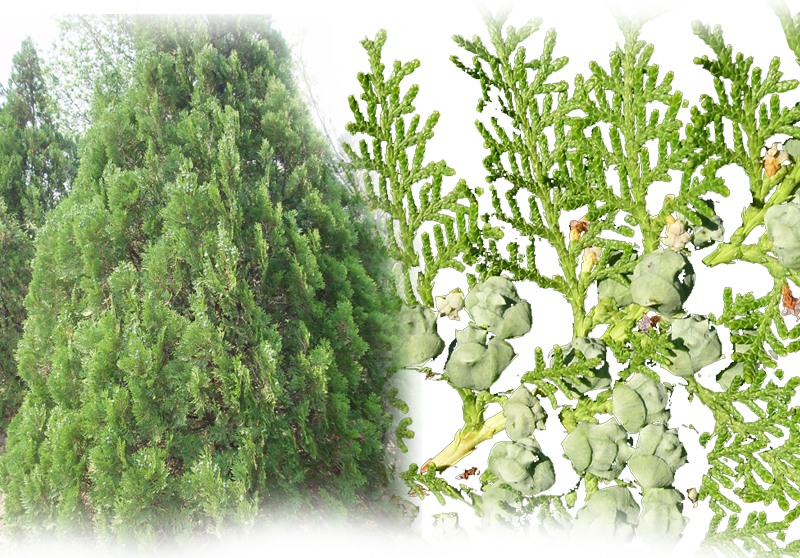
Chinese arborvitae
 1
1 7
7 7
7Will it grow where I live?
Chinese arborvitae is hardy to zone 6, which covers nearly all of Central Europe and the British Isles; only harsh upland sites (Alps, high ridges) call for winter protection.
Or check it for your location right here:
Profile
- Family
- Cupressaceae
- Habit
- Tree
- Height
- 15 m
- Spread
- 5 m
- Growth
- very slow
- Lifespan
- 1000 years
- First yield
- after 6 years
- Hardiness
- zone 6–8
- Shade tolerance
- partial shade
- Soil
- Sand, Silt, Loam
- Soil moisture
- dry – very moist
- pH
- 6 – 8
- Synonyms
- P. stricta. Biota orientalis. Thuja orientalis. L.
Flowering & harvest
| J | F | M | A | M | J | J | A | S | O | N | D | |
|---|---|---|---|---|---|---|---|---|---|---|---|---|
| Flowering | ||||||||||||
| Fruit harvest |
Uses
Edible: Seeds - after removing the bitterness. The bitterness in seeds is usually removed by leaching in water or thorough boiling.
Medicinal: This plant is commonly used in traditional Chinese medicine as one of the 50 essential herbs. Its leaves have various medicinal properties such as antibacterial, antipyretic, and expectorant. They are utilized to address conditions like coughs, bronchitis, and skin infections. The plant's seeds are known for their soothing and sedative effects, beneficial for treating insomnia and nervous disorders. Additionally, the root bark is applied to heal burns, while the stems are used for coughs and rheumatism.
Other uses: Tolerates frequent trimming to be grown as a thick hedge. Young branches yield a yellow dye. The wood is long-lasting in the ground, moderately hard, with a fine to coarse grain, lightweight, soft, and fragile. It is utilized in building, carpentry, and barrel-making.
Growing
Thrives in moist, loamy soil and prefers dry, well-drained, often alkaline locations. Grows well on old building rubble, tolerates dry, dusty areas and urban pollution, and prefers a sunny, sheltered spot. Easy to transplant. Numerous named cultivars chosen for their decorative appeal. Produces seeds abundantly when cultivated. A slow-growing tree that struggles, especially in the western regions. Best specimens are in urban areas like Oxford and gardens with highly-drained soils. Unable to regenerate from old wood, pruning is generally unnecessary, and if needed, should be done cautiously. Susceptible to attack by the honey fungus.
Notable
Special features: opaque and very tolerant to cutting, except in old wood; tolerates dry and dusty locations and air pollution: also good on rubble; easy to transplant; prefers steep, fresh south-facing slopes at an altitude of 300 - 3000m in warm, light forests and bushes; There are small-growing varieties for rock gardens: 'Aurea Nana' (2.5m) and 'Sieboldii' (2m);
Origin & habitat
East Asia - Western China, North Korea. There is also a small population of these animals in the northeast of Iran.
Swamps and cold, rocky stream edges create thick forests that are nearly impossible to navigate. These plants thrive on rocky terrains with neutral to alkaline calcareous soils.
⚠️ Hazards
The plant's leaves are toxic when ingested and can trigger skin irritations in those with sensitivities.
Frequently asked questions
Chinese arborvitae: how big does it get?
Chinese arborvitae (Thuja orientalis) grows as a Tree and reaches roughly 15 m in height when mature, with a spread of about 5 m. Growth is very slow.
Chinese arborvitae: what site does it need?
Chinese arborvitae tolerates partial shade. Suitable soils are Sand, Silt, Loam. Soil moisture should be in the range dry – very moist. The pH may lie between 6 and 8.
Chinese arborvitae: is it hardy?
Chinese arborvitae is listed as hardy in zone 6–8 and survives normal winters outdoors there.
Chinese arborvitae: will it grow in Central Europe?
Chinese arborvitae is hardy to zone 6, which covers nearly all of Central Europe and the British Isles; only harsh upland sites (Alps, high ridges) call for winter protection.
Chinese arborvitae: when does it flower?
In a temperate northern-hemisphere climate it flowers in April.
Chinese arborvitae: when is it harvested?
In a temperate northern-hemisphere climate the fruit ripens in October.
Chinese arborvitae: is it poisonous?
Individual parts of Chinese arborvitae are noted as mildly problematic — the plant does not count as poisonous. With wild plants, never rely on a database alone, only on a confident identification.
Chinese arborvitae: what is it used for?
Rated on a scale up to 10: Edible 1/10, Medicinal 7/10, Other uses 7/10.
Plan this plant into your own garden
Permaplans plans your garden to scale on the map — with a site check, harvest calendar and over 1,000 plants. Free for iPhone, Android, Mac, Windows & Linux.
Will this plant grow where you live? → Check your site
Community experience
No first-hand reports for this plant yet.
Growing it? Write in the app what works for you – your post will show up here.
💬 Get the app and join in