
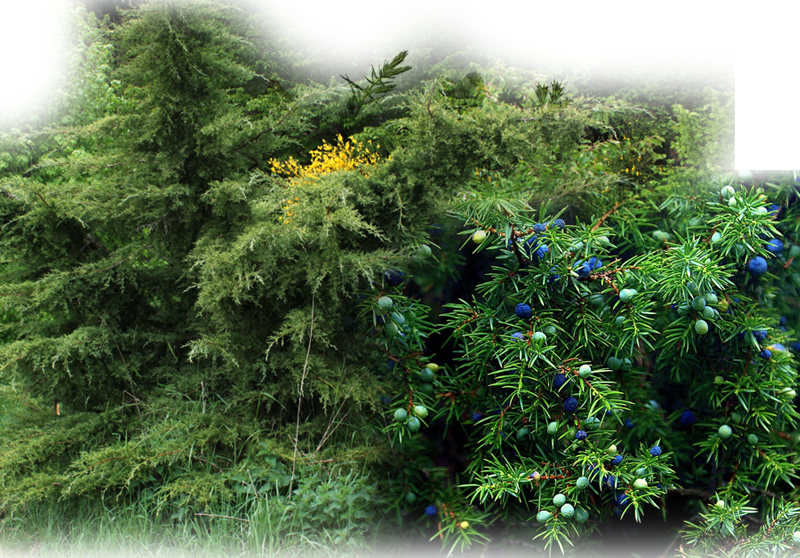
Juniper
 3
3 7
7 7
7Will it grow where I live?
Juniper is hardy to zone 3 – that covers all of Central Europe and the British Isles, and every USDA zone from 3 upwards.
Or check it for your location right here:
Profile
- Family
- Cupressaceae
- Habit
- Shrub
- Height
- 10.5 m
- Spread
- 4 m
- Growth
- very slow
- Lifespan
- 800 years
- First yield
- after 8 years
- Yield per plant
- up to 1 kg a year
- Yield in cultivation
- up to 0.1 t/ha
- Hardiness
- zone 3–10
- Shade tolerance
- light shade
- Soil
- Sand, Silt, Loam, Clay
- Soil moisture
- very dry – moist
- pH
- 5.5 – 7.5
Flowering & harvest
| J | F | M | A | M | J | J | A | S | O | N | D | |
|---|---|---|---|---|---|---|---|---|---|---|---|---|
| Flowering | ||||||||||||
| Fruit harvest |
Uses
Edible: Fruit can be consumed raw or cooked, typically harvested in autumn when fully ripe and then dried for future use. It has a soft, mealy, sweet, resinous pulp and is commonly utilized as a flavoring in various dishes like sauerkraut, stuffings, and vegetable pies. It is a key component in gin production and is known to serve as a substitute for pepper due to its aromatic properties. The fruit can also be distilled to extract essential oil for flavoring purposes, with average yields at around 1%. The cones, measuring about 4–8 mm in diameter, require 2–3 years to mature. Care should be taken when handling the fruit due to potential toxicity concerns. The roasted seeds can be used as a coffee alternative, while boiling the leaves and stems produces a tea. Berries can also be used to make a tea with a spicy, gin-like taste.
Medicinal: Juniper berries are among the longest-documented medicinal drugs of central Europe. The use accepted today concerns digestive complaints and flushing of the urinary tract; the dried cones are taken as tea or in prepared products. The essential oil is applied externally in rubs for rheumatic complaints. Because of its irritant effect on the kidneys, use is limited in duration and is not acceptable with existing kidney disease or in pregnancy. Traditional, without present-day proof of effect: five to ten dried berries before a meal were long regarded as an appetite stimulant. Juniper spirit was rubbed in for gout and sciatica, and oil obtained from the wood applied to skin conditions. The Germanic peoples burned juniper brushwood at cremations, and the resin traded as "German sandarac" served as a substitute incense; into modern times juniper was burned to purify rooms and ward off plague and evil.
Other uses: A decoction of juniper branches is utilized as a shampoo to combat dandruff, while the essential oil from the fruit is employed in perfumes with spicy fragrances. In warmer regions, the resin 'sandarac' is obtained by making cuts in the trunk and is utilized for producing a white varnish. The plant's stems were historically used as a room freshener. Juniper branches, whether fresh or dried, are effective as insect repellents. Various types of juniper plants are suitable for ground cover in sunny areas, such as 'Depressa Aurea', 'Dumosa', 'Effusa', and 'Repanda'. The wood of the juniper plant is sturdy, aromatic, and long-lasting when in contact with the ground, making it an excellent source of fuel.
Growing
Site: Juniper needs full sun and free-draining, preferably sandy or gravelly ground — shade is the one site factor that reliably kills it, so do not put it under or beside shade-casting trees. It grows extremely slowly, often only a few centimetres a year, but lives for centuries: plant it as permanent structure, not as a quick fix. Its needles are sharply pointed and it is unpleasant beside narrow paths and in play areas. Anyone wanting berries needs male and female plants, as the species is dioecious. Two neighbourhoods deserve thought: common juniper hosts the hawthorn-juniper rust, which argues for some distance from hawthorn and serviceberry — the much-feared European pear rust, by contrast, is carried not by this species but by savin and Chinese juniper. And that poisonous savin should not be growing as ground cover in the same garden if you intend to harvest. Always buy nursery stock; taking plants from the wild is prohibited. Care: Do not fertilise, and once established do not water either — drought it takes in its stride, waterlogging kills it. Pruning is unnecessary and risky: juniper does not resprout from old, unfoliated wood, so work only in young growth or accept a permanent gap. The berry-like cones take two to three years to ripen, so green and ripe cones always sit side by side on one plant; harvest only the blue-black bloomed ones between September and December, in dry weather and wearing gloves. After-drying belongs in the shade, never in the sun. Diseases are rare; juniper bark beetle occasionally attacks weakened plants. Sheep and goats avoid it, which makes it a useful shrub within grazed areas.
Propagation
Raising juniper from seed is possible but demands patience: fully ripe seed usually germinates only in the second spring after harvest, because the hard seed coat must pass through a warm and then a cold phase. There is a trick, though — if the berry-like cones are picked before full ripeness, between August and November while still green, the seed often germinates the following spring. Crush the cones, clean the seed of pulp and keep it moist and cool. Vegetative routes are more reliable and quicker: prostrate branches root of their own accord and can be lifted as layers, and heel cuttings are struck in late summer and autumn, occasionally in spring. Selected garden and columnar forms are grafted. Note that most ornamental forms set few cones or none at all — only the wild form is worth growing for a harvest.
Value for wildlife
Juniper is a textbook case that flowers are not everything: it is wind-pollinated and has nothing to offer wild bees. Its value lies in its cones and its build. Around 43 bird species eat the resinous, sweetish cones — fieldfare, mistle thrush, waxwing, robin and black grouse among them — and disperse the seed over long distances in the process. Some fourteen moth species live on the needles, ten of them dependent on juniper alone, such as the juniper carpet and the juniper leaf miner, plus the juniper bark beetle. Decisive, however, is the evergreen, dense and tangled crown: it gives cover from wind and raptors in winter when deciduous growth stands bare, and serves dunnock, whitethroat and red-backed shrike as a sheltered nest site. Juniper heaths are among the most species-rich open habitats in central Europe.
Notable
Special features: drought-resistant, urban climate + high altitudes + cutting-compatible; previously planted on graves as a watchman + guardian of the threshold (life/death); also used as a cleansing (smoked) + protection against plague + evil, avoided by sheep → forestation of pastures, fruit ripening takes 2-3 years, closely related to the Sade tree / stinking juniper, which has a strong abortifacient effect
Origin & habitat
Circumpolar: Europe, northern Asia, North America and North Africa. Common juniper has the largest natural range of any woody plant. It spans the entire northern hemisphere from Iceland and Scandinavia across central Europe, Siberia and Mongolia to Japan, plus the whole of North America from Alaska to the Appalachians, with southern outliers in the mountains of North Africa, Asia Minor and the Himalaya. It is native throughout central Europe but has declined sharply since the end of transhumant sheep grazing; in Germany it is specially protected under the Federal Species Protection Ordinance.
Juniper grows on poor, open, fully sunlit ground: on calcareous and siliceous dry grassland, sandy heath, mat-grass swards, in open pine and birch woodland, at the edges of raised bogs, and as a prostrate subspecies in subalpine dwarf-shrub heath at high altitude. The juniper heaths typical of central Europe are not natural landscape but the product of centuries of sheep and goat grazing: because the prickly shrub was avoided, it remained standing while everything else was eaten down. They now count among the protected habitat types of the EU Habitats Directive and scrub over quickly without grazing or management. Soil type and lime content matter little to juniper, as long as the ground is free-draining and no shade falls on it.
⚠️ Hazards
Mucous membrane irritation, skin irritation on contact, risk of injury from needles, risk of confusion Juniper berries are harmless in culinary amounts, but larger quantities irritate the kidneys; avoid them in pregnancy and with existing kidney disease. Skin contact with the resin and the essential oil can cause inflammation and blistering. The needles are sharp and prick during harvest. The most important danger is confusion with savin (Juniperus sabina), all parts of which are strongly poisonous and which is commonly planted as ground cover in gardens; such contamination has in the past even been detected in gin.
Frequently asked questions
Juniper: how big does it get?
Juniper (Juniperus communis) grows as a Shrub and reaches roughly 10.5 m in height when mature, with a spread of about 4 m. Growth is very slow.
Juniper: what site does it need?
Juniper tolerates light shade. Suitable soils are Sand, Silt, Loam, Clay. Soil moisture should be in the range very dry – moist. The pH may lie between 5.5 and 7.5.
Juniper: is it hardy?
Juniper is listed as hardy in zone 3–10 and survives normal winters outdoors there.
Juniper: will it grow in Central Europe?
Juniper is hardy to zone 3 – that covers all of Central Europe and the British Isles, and every USDA zone from 3 upwards.
Juniper: when does it flower?
In a temperate northern-hemisphere climate it flowers in May.
Juniper: when is it harvested?
In a temperate northern-hemisphere climate the fruit ripens from October to November.
Juniper: when does it start cropping, and how much?
Juniper first crops after 8 years. A mature plant gives up to 1 kg a year, in cultivation up to 0.1 t per hectare. Figures assume a good site; variety, soil and climate shift them considerably.
Juniper: is it poisonous?
Individual parts of Juniper are noted as mildly problematic — the plant does not count as poisonous. With wild plants, never rely on a database alone, only on a confident identification.
Juniper: what is it used for?
Rated on a scale up to 10: Edible 3/10, Medicinal 7/10, Other uses 7/10.
Plan this plant into your own garden
Permaplans plans your garden to scale on the map — with a site check, harvest calendar and over 1,000 plants. Free for iPhone, Android, Mac, Windows & Linux.
Will this plant grow where you live? → Check your site
Community experience
No first-hand reports for this plant yet.
Growing it? Write in the app what works for you – your post will show up here.
💬 Get the app and join in