
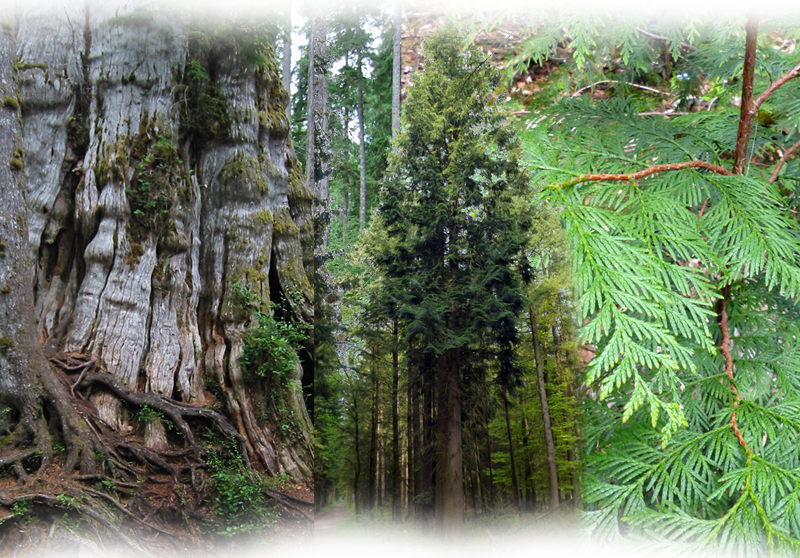
Western red cedar
 2
2 8
8 9
9Will it grow where I live?
Western red cedar is hardy to zone 5 – that covers all of Central Europe and the British Isles, and every USDA zone from 5 upwards.
Or check it for your location right here:
Profile
- Family
- Cupressaceae
- Habit
- Tree
- Height
- 50 m
- Spread
- 12 m
- Growth
- fast
- Lifespan
- 1000 years
- First yield
- after 10 years
- Hardiness
- zone 5–8
- Shade tolerance
- partial shade
- Soil
- Sand, Silt, Loam, Clay
- Soil moisture
- semi-dry – very wet
- pH
- 6 – 8
Flowering & harvest
| J | F | M | A | M | J | J | A | S | O | N | D | |
|---|---|---|---|---|---|---|---|---|---|---|---|---|
| Flowering | ||||||||||||
| Fruit harvest |
Uses
Edible: Inner bark can be used fresh or dried, ground into powder for thickening soups or mixed with grains in bread baking. Chewing gum has been made from pitch extracted from the trunk.
Medicinal: Western red cedar was traditionally utilized by several Native American tribes in North America for medicinal purposes. The leaves were brewed into a tea to alleviate stomachaches and diarrhea, and a leaf decoction was believed to provide relief from colds. Chewing on the buds was a remedy for toothaches and lung pain, while a bud decoction was used as a gargle. Small twigs were employed to address coughs, colds, and tuberculosis, and a poultice made from crushed branch tips and oil was beneficial for bronchitis, rheumatism, stomach aches, and swollen necks. The bark and twigs were applied to treat various conditions like kidney problems, fever, and menstrual cramps. The inner bark was used as a skin irritant and applied to carbuncles, while the soft bark was utilized for wound care and as a cauterizing agent.
Other uses: This plant can withstand light pruning and needs sufficient sunlight, making it ideal for hedging or as part of a windbreak. A decoction made from the branches is effective in treating dandruff and scalp infections. The tough inner bark has multiple uses like scrubbing dishes, creating coarse textiles, blankets, mats, ropes, and even sanitary pads. Additionally, the bark is suitable for crafting waterproof headwear, capes, pants, skirts, and more. Its roots are utilized in weaving baskets and making nets, while the branches yield high-quality rope. The aromatic, lightweight, and durable wood of this plant has been traditionally employed by various indigenous North American groups for crafting canoes, dwellings, totem poles, utensils, and tools. Presently, the wood is also favored for constructing greenhouses and serves as a reliable, low-smoke fuel.
Notable
Special features: opaque and prunable, except into old wood; tolerates salt winds; young plants require at least partial shade; thickest trunk diameter 6m; needle litter has an alkaline effect on the soil, unlike spruce; wood from fallen trees stays healthy for at least 100 years → shingles; needle scent → apples/pineapples → perfume; likes 500-5000mm of rainfall.
Origin & habitat
Western North America - British Columbia to California.
Wächst einzeln und in kleinen Gruppen auf feuchten bis sumpfigen Böden, normalerweise in schattigen Wäldern, von Meereshöhe bis zu 1350 Metern.
⚠️ Hazards
The oils found in the wood, cones, and branch tips are poisonous and can irritate the digestive system, potentially leading to liver and kidney damage. Skin contact with the plant may also result in irritation and can be deadly for numerous animals.
Frequently asked questions
Western red cedar: how big does it get?
Western red cedar (Thuja plicata) grows as a Tree and reaches roughly 50 m in height when mature, with a spread of about 12 m. Growth is fast.
Western red cedar: what site does it need?
Western red cedar tolerates partial shade. Suitable soils are Sand, Silt, Loam, Clay. Soil moisture should be in the range semi-dry – very wet. The pH may lie between 6 and 8.
Western red cedar: is it hardy?
Western red cedar is listed as hardy in zone 5–8 and survives normal winters outdoors there.
Western red cedar: will it grow in Central Europe?
Western red cedar is hardy to zone 5 – that covers all of Central Europe and the British Isles, and every USDA zone from 5 upwards.
Western red cedar: when does it flower?
In a temperate northern-hemisphere climate it flowers in April.
Western red cedar: when is it harvested?
In a temperate northern-hemisphere climate the fruit ripens in October.
Western red cedar: is it poisonous?
Individual parts of Western red cedar are noted as mildly problematic — the plant does not count as poisonous. With wild plants, never rely on a database alone, only on a confident identification.
Western red cedar: what is it used for?
Rated on a scale up to 10: Edible 2/10, Medicinal 8/10, Other uses 9/10.
Plan this plant into your own garden
Permaplans plans your garden to scale on the map — with a site check, harvest calendar and over 1,000 plants. Free for iPhone, Android, Mac, Windows & Linux.
Will this plant grow where you live? → Check your site
Community experience
No first-hand reports for this plant yet.
Growing it? Write in the app what works for you – your post will show up here.
💬 Get the app and join in