
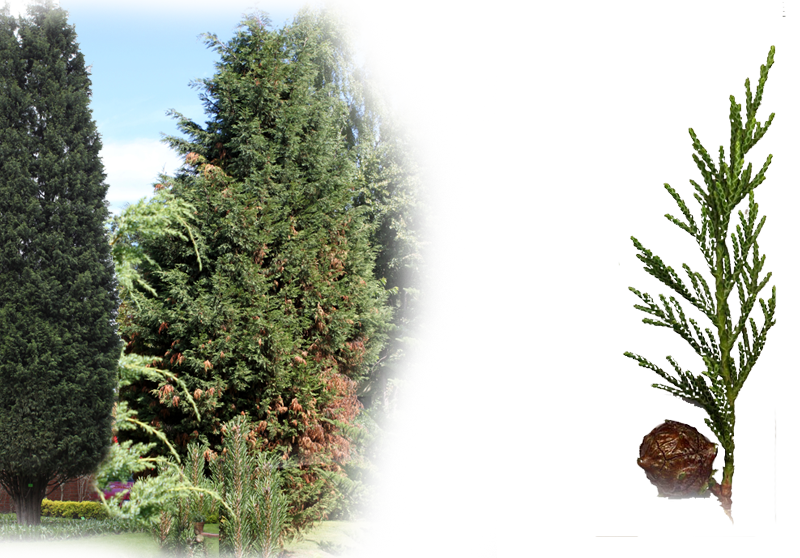
Leyland cypress
 1
1 6
6Will it grow where I live?
Leyland cypress is hardy to zone 6, which covers nearly all of Central Europe and the British Isles; only harsh upland sites (Alps, high ridges) call for winter protection.
Or check it for your location right here:
Profile
- Family
- Cupressaceae
- Habit
- Tree
- Height
- 40 m
- Spread
- 8 m
- Growth
- very fast
- Lifespan
- 70 years
- First yield
- after 6 years
- Hardiness
- zone 6–10
- Shade tolerance
- partial shade
- Soil
- Sand, Silt, Loam, Clay
- Soil moisture
- semi-dry – very moist
- pH
- 5.5 – 8.5
- Synonyms
- Zypresse
Flowering & harvest
| J | F | M | A | M | J | J | A | S | O | N | D | |
|---|---|---|---|---|---|---|---|---|---|---|---|---|
| Flowering | ||||||||||||
| Fruit harvest |
Uses
Medicinal: The fruits have skin-cleansing and moisturizing properties, and can also help treat burns and grazes. The flowers act as expectorants and emetics. The fruit may be hard to digest. The seeds help with coughs, digestion, fever, and act as an anthelmintic. To deworm, the seeds are ground into flour, mixed with water to create an emulsion, and ingested. A douche is necessary to eliminate parasites from the body. The root has diuretic and emetic effects.
Other uses: The practical value of the Leyland cypress lies almost entirely in its speed. It produces an opaque evergreen wall faster than any other hardy woody plant and is therefore planted for screening, shelter belts and boundaries; in wind-exposed positions and near the coast it proves itself because it takes salt air well. Its high annual growth also makes it a crop for Christmas trees. The timber is pale, light and not durable, and matters only regionally as building and fencing material. The reverse side of that speed should be weighed: what gives screening in three years then demands cutting twice a year, permanently. For small gardens the species is, despite its popularity, usually the wrong choice.
Growing
Site: The most important decision comes before purchase: this hedge grows up to a metre a year and does not stop of its own accord. Left uncut, a screening planting becomes twenty-metre trees within fifteen years, shading neighbouring properties — high-hedge disputes between neighbours are a recognised legal category in several countries for exactly this reason. Calculate the statutory boundary distance for the actual final height, not the intended one. The roots are shallow and dense and strip water and nutrients from the surrounding soil, leaving a dead strip along the hedge; beds, lawn and neighbouring plantings do not belong immediately beside it. For wildlife it does almost nothing: no flowers for insects, no fruit, merely cover and nest sites in the dense interior. Anyone wanting screening and ecological value together is better served by hornbeam, privet or a mixed hedge. Care: Cut twice a year, in early and late summer, and do so consistently from the start. The crucial point: a cut into old, needleless wood will not reshoot — a brown patch stays there permanently. The hedge must therefore be held at its target height and width from the beginning, as taking it back later fails. Taper it slightly towards the top so the lower part receives light and does not go bare. Water in dry spells, since drought stress increases susceptibility to fungal disease and to the cypress aphid, whose feeding can brown out whole sections of branch; cut affected parts out. After severe storms wind scorch appears, from which the plants usually recover. For exposed positions use only young, non-pot-bound stock, otherwise it will never stand firm.
Propagation
The Leyland cypress is propagated vegetatively only. This is not a matter of cultivar preference but of necessity: as a cross between two genera it sets barely any viable seed, and what does germinate is variable and fails to pass on the cultivar's characteristics. Propagation is therefore by cuttings. Semi-ripe wood is taken from side shoots, about seven to ten centimetres long and pulled off with a heel of bark; the time is late summer, or alternatively early spring before growth begins. Insert into sandy, free-draining substrate at high humidity under film or in a closed case. Rooting is reliable but takes some months depending on cultivar; the yellow-leaved selections are known to root rather more slowly. For later stability it is important to pot the young plants on in good time, before the roots begin to circle.
Value for wildlife
For native wildlife the Leyland cypress does almost nothing, and that is the main objection to it. As a garden hybrid with no natural range it has no species adapted to it: it offers no flowers of value, practically no fruit, and is no larval food plant, while its acid needle litter impoverishes the soil fauna beneath it. What remains is structure, and that is not nothing. The dense evergreen interior of a hedge not clipped too hard gives blackbird, dunnock, woodpigeon and collared dove cover from raptors, shelter from wind and a frost-proof nest site at a season when deciduous hedges stand bare; as a winter roost it is regularly taken up. Anyone after that structural effect alone will get it from yew or a mixed hedge with incomparably more food on offer.
Notable
Special features: opaque and very tolerant to cutting, except in the old wood; natural cross first created in 1888 from fast-growing Californian Monterrey cypress with cold-resistant Nootka/Alaska cedar, although it does not tolerate a lot of heat, wet snow or extreme temperatures well; Grows about 1m a year, therefore also used as a Christmas tree culture;
Origin & habitat
No natural range — the Leyland cypress is a garden hybrid. It arose in 1888 at Leighton Hall in Wales as a chance cross between two species whose ranges never meet in North America: the warmth-loving Monterey cypress (Cupressus macrocarpa) of the Californian coast and the cold-hardy Nootka cypress (Xanthocyparis nootkatensis) of the Pacific Northwest. Every cultivar descends from that single find and a few later repeat crosses, among them the grey-green Haggerston Grey and the yellow-leaved Castlewellan Gold, Gold Rider and Robinson's Gold. Today it is found wherever fast screening hedges are wanted: in western and central Europe, especially Britain, and in New Zealand and the Pacific Northwest. Naturalised populations do not exist.
As a hybrid of garden origin the Leyland cypress has no natural habitat; it occurs nowhere in the wild and does not naturalise. Its site requirements can only be inferred from its parents, and those contradict one another: the Monterey cypress comes from the fog-moist, nearly frost-free Californian coast, the Nootka cypress from the cool, high-rainfall coastal mountains of Alaska and British Columbia. The hybrid inherits from this an indifference to soil and a high tolerance of wind and salt air, but also a weakness for extremes: prolonged summer heat with drought troubles it as much as wet heavy snow and hard bare frost. In Central Europe it is therefore purely a plant of cultivation, seldom long-lived without care.
⚠️ Hazards
Like other similar species, likely toxic because of its essential oils.
Frequently asked questions
Leyland cypress: how big does it get?
Leyland cypress (Cupressocyparis leylandii) grows as a Tree and reaches roughly 40 m in height when mature, with a spread of about 8 m. Growth is very fast.
Leyland cypress: what site does it need?
Leyland cypress tolerates partial shade. Suitable soils are Sand, Silt, Loam, Clay. Soil moisture should be in the range semi-dry – very moist. The pH may lie between 5.5 and 8.5.
Leyland cypress: is it hardy?
Leyland cypress is listed as hardy in zone 6–10 and survives normal winters outdoors there.
Leyland cypress: will it grow in Central Europe?
Leyland cypress is hardy to zone 6, which covers nearly all of Central Europe and the British Isles; only harsh upland sites (Alps, high ridges) call for winter protection.
Leyland cypress: when does it flower?
In a temperate northern-hemisphere climate it flowers in April.
Leyland cypress: when is it harvested?
In a temperate northern-hemisphere climate the fruit ripens from October to November.
Leyland cypress: is it poisonous?
Individual parts of Leyland cypress are noted as mildly problematic — the plant does not count as poisonous. With wild plants, never rely on a database alone, only on a confident identification.
Leyland cypress: what is it used for?
Rated on a scale up to 10: Medicinal 1/10, Other uses 6/10.
Plan this plant into your own garden
Permaplans plans your garden to scale on the map — with a site check, harvest calendar and over 1,000 plants. Free for iPhone, Android, Mac, Windows & Linux.
Will this plant grow where you live? → Check your site
Community experience
No first-hand reports for this plant yet.
Growing it? Write in the app what works for you – your post will show up here.
💬 Get the app and join in