
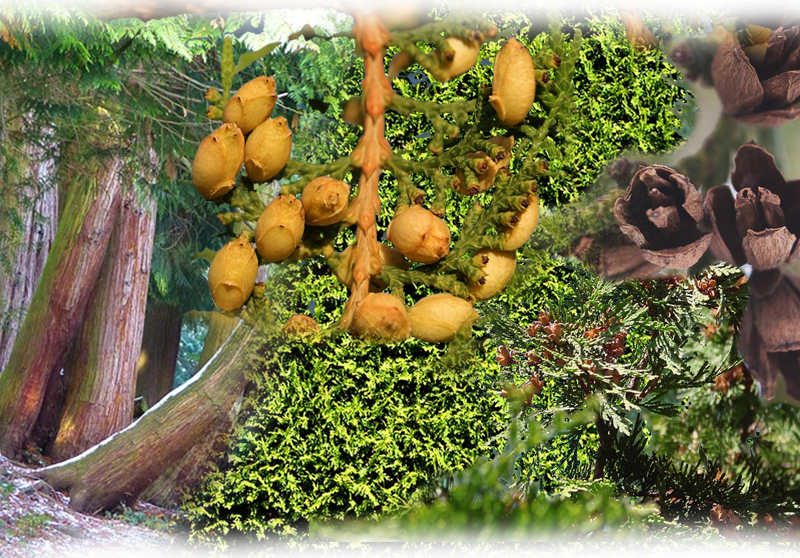
Eastern white cedar
 2
2 6
6 9
9Will it grow where I live?
Eastern white cedar is hardy to zone 3 – that covers all of Central Europe and the British Isles, and every USDA zone from 3 upwards.
Or check it for your location right here:
Profile
- Family
- Cupressaceae
- Habit
- Tree
- Height
- 17.5 m
- Spread
- 5 m
- Growth
- medium
- Lifespan
- 500 years
- First yield
- after 6 years
- Hardiness
- zone 3–8
- Shade tolerance
- partial shade
- Soil
- Sand, Silt, Loam, Clay
- Soil moisture
- semi-dry – very wet
- pH
- 6 – 8
- Synonyms
- Thuja
- Planned in gardens
- 11×
Flowering & harvest
| J | F | M | A | M | J | J | A | S | O | N | D | |
|---|---|---|---|---|---|---|---|---|---|---|---|---|
| Flowering | ||||||||||||
| Fruit harvest |
Uses
Edible: The tender part of new shoots is cooked and can be included in soups, offering a mildly sweet taste, commonly serving as a soup base. The inner bark is reserved for emergencies or shortages, dried and powdered for making bread, biscuits, and various dishes. Leafy branches serve as a tea alternative, providing a fragrant taste and a rich vitamin C content. Pregnant women might consider avoiding this tea.
Medicinal: The American arborvitae was traditionally used by various Native North American tribes for medicinal purposes, treating conditions like fever, cough, headaches, swollen hands, and rheumatic issues. It is known for its antiviral properties and is commonly employed in the treatment of warts and polyps, both internally and externally. Pregnant women are advised against consuming the plant due to its potential to induce menstruation. The freshly dried young branches of the American arborvitae offer several health benefits, including anti-inflammatory, antiseptic, diuretic, and diaphoretic properties. It has historical applications in cancer treatment, particularly uterine cancer. A tea brewed from the leaves is utilized to alleviate bronchitis, respiratory problems, colds, and headaches. The plant's diuretic qualities also make it effective in managing acute cystitis and childhood bedwetting. Externally, the leaves of the American arborvitae can be used as a wash for swollen feet and burns. Leaf extracts serve as a counter-irritant for sore joints or muscles, enhancing local blood circulation and alleviating pain. A tea derived from the inner bark is employed to stimulate menstruation and address consumption and coughs. Essential oil extracted from the American arborvitae leaves possesses antiseptic, expectorant, and reddening properties. However, caution is advised as the oil is toxic and can cause cramps in high doses, necessitating supervision by a qualified physician. A homeopathic remedy made from the leaves and twigs is available for treating conditions like warts and others.
Other uses: The bay hedge can be pruned regularly, but avoid cutting into the old wood. It serves well as a hedge, and the fresh branches are suitable for making brooms. The plant's aromatic fragrance helps freshen the house when used for sweeping. Historically, the leaves were utilized for perfume, incense, and repelling insects, as well as for making incense. An essential oil derived from the leaves and branches is valuable in perfumery and medicine, but it is toxic if consumed. Additionally, it possesses insect-repelling qualities. The sturdy bark was formerly employed in crafting fiber sacks and as a tannin source. Bay wood is lightweight, soft, not very strong, brittle, coarse-grained, and highly durable. It is easily manageable and resistant to warping.
Growing
Site: It likes deep, moist ground best and tolerates dry places only in shade. More important than the soil is the neighbourhood: all parts are toxic, so it does not belong beside pasture, runs or small-animal enclosures — nor do the clippings. As a dense hedge it takes water and light from adjoining beds, but in winter it provides exactly the cover that blackbirds, pigeons and dunnocks lack once the deciduous shrubs stand bare. For an opaque screen reckon on 20 to 40 cm of growth a year. Care: Cut only young, needled wood — it never breaks again from old bare wood, so a cut made too deep leaves a permanent gap. Clipping twice a year keeps the hedge dense. Water without fail in dry spells: dried-out interior growth stays brown. Drought stress also attracts the arborvitae bark beetle, which attacks weakened plants. Deer readily take the soft winter foliage, so young hedges need browsing protection.
Propagation
Cultivars are propagated vegetatively only, since seedlings do not come true. Cuttings are the usual route: in late autumn or winter, semi-ripe side shoots are taken with a small heel of bark, inserted into free-draining, evenly moist compost and kept cool and shaded. Rooting takes months. The choice of shoot matters: side shoots often continue to grow crookedly, while upright leading shoots give better plants. The species itself can be raised from seed collected in autumn and stratified cold and moist over winter; germination is irregular and early growth slow. For hedge planting, seed therefore plays no part.
Value for wildlife
The white cedar contributes almost nothing to the native insect fauna: as a North American neophyte it has built up few ties here, its flowers supply neither appreciable nectar nor usable pollen, and essentially only the cedar bark beetle is recorded on it. Its value lies elsewhere — and it is real. The dense evergreen growth offers cover and nest sites at a time when deciduous shrubs are still bare: wood pigeons and collared doves nest in thuja regularly, as do blackbirds, dunnocks and greenfinches. In winter the hedges serve as roosts and as shelter from wind and birds of prey, something otherwise missing from leafless gardens. Native flowering and larval food plants are needed alongside it; as a shrub for cover and structure, though, thuja is not replaced by them.
Notable
Special features: opaque and very tolerant of pruning, except into old wood; smoked to retrieve soul fragments/cleanse foreign energies; the name tree of life comes from sailors who used it to cure their scurvy; large selection of varieties: (small: 'Smaragd' & 'Rheingold' 4m tall, fast: 'Brabant' up to 20m tall, as a hedge untrimmed up to 8m tall);
Origin & habitat
Eastern North America, centred on the Great Lakes. Northern white cedar is native to eastern Canada and the north-eastern United States. Its continuous range runs from south-eastern Manitoba across the Great Lakes region into Ontario, Quebec and the Maritime provinces. Southwards there are outlying occurrences as far as Massachusetts, Connecticut, Ohio and Illinois, and along the Appalachians through Pennsylvania, Maryland, Virginia and West Virginia to Kentucky, Tennessee and North Carolina. It favours cool climates with July means between 16 and 22 °C and growing seasons of 90 to 180 days. In Europe it has been cultivated since the sixteenth century and is now ubiquitous as a hedging plant, though it rarely escapes.
In the wild, northern white cedar grows in wet forests and is particularly abundant in coniferous swamps, where larger and faster-growing trees cannot keep up. Its second characteristic habitat is cliff faces and rock ledges — likewise extreme sites with little competition. Both show the same pattern: the species prevails not through vigour but by enduring where others fail. On cliffs it therefore reaches an extraordinary age; the oldest known living specimen was about 1,141 years old in 2008, and 1,653 growth rings were counted on a dead one. It prefers deep, moist, usually calcareous soils. In cultivation it grows best on wet ground but tolerates dry sites as well, provided they are shaded.
⚠️ Hazards
All parts of the plant are toxic; the wood and shoot tips contain thujone. Skin contact can cause dermatitis, so gloves are advisable when clipping hedges. Ingestion causes irritation of the mucous membranes along with gastrointestinal upset, nausea and diarrhoea; for grazing livestock and small animals it can be fatal. Clippings therefore do not belong on pasture or in small-animal enclosures. During pregnancy any internal use should be avoided.
Frequently asked questions
Eastern white cedar: how big does it get?
Eastern white cedar (Thuja occidentalis) grows as a Tree and reaches roughly 17.5 m in height when mature, with a spread of about 5 m. Growth is medium.
Eastern white cedar: what site does it need?
Eastern white cedar tolerates partial shade. Suitable soils are Sand, Silt, Loam, Clay. Soil moisture should be in the range semi-dry – very wet. The pH may lie between 6 and 8.
Eastern white cedar: is it hardy?
Eastern white cedar is listed as hardy in zone 3–8 and survives normal winters outdoors there.
Eastern white cedar: will it grow in Central Europe?
Eastern white cedar is hardy to zone 3 – that covers all of Central Europe and the British Isles, and every USDA zone from 3 upwards.
Eastern white cedar: when does it flower?
In a temperate northern-hemisphere climate it flowers in April.
Eastern white cedar: when is it harvested?
In a temperate northern-hemisphere climate the fruit ripens from September to October.
Eastern white cedar: is it poisonous?
Individual parts of Eastern white cedar are noted as mildly problematic — the plant does not count as poisonous. With wild plants, never rely on a database alone, only on a confident identification.
Eastern white cedar: what is it used for?
Rated on a scale up to 10: Edible 2/10, Medicinal 6/10, Other uses 9/10.
Plan this plant into your own garden
Permaplans plans your garden to scale on the map — with a site check, harvest calendar and over 1,000 plants. Free for iPhone, Android, Mac, Windows & Linux.
Will this plant grow where you live? → Check your site
Community experience
No first-hand reports for this plant yet.
Growing it? Write in the app what works for you – your post will show up here.
💬 Get the app and join in