
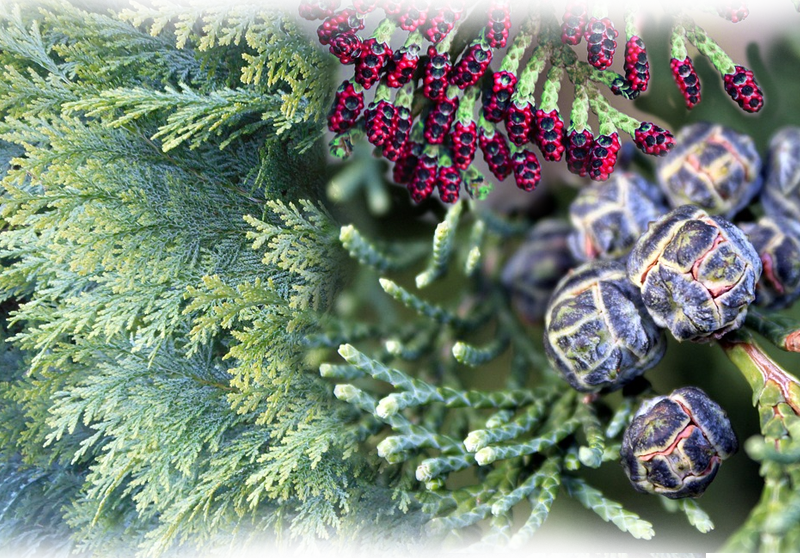
Oregon cedar
 2
2 2
2 8
8Will it grow where I live?
Oregon cedar is hardy to zone 5 – that covers all of Central Europe and the British Isles, and every USDA zone from 5 upwards.
Or check it for your location right here:
Profile
- Family
- Cupressaceae
- Habit
- Tree
- Height
- 27.5 m
- Spread
- 7 m
- Growth
- medium
- Lifespan
- 600 years
- First yield
- after 5 years
- Hardiness
- zone 5–8
- Shade tolerance
- partial shade
- Soil
- Sand, Silt, Loam, Clay
- Soil moisture
- very dry – very moist
- pH
- 4.5 – 7.5
- Synonyms
- Scheinzypresse
Flowering & harvest
| J | F | M | A | M | J | J | A | S | O | N | D | |
|---|---|---|---|---|---|---|---|---|---|---|---|---|
| Flowering | ||||||||||||
| Fruit harvest |
Uses
Other uses: Plants can be cultivated into tall hedges and are highly tolerant of pruning, as long as it avoids cutting into the inner brown wood, which trees cannot regenerate from. Trimming is best done during the summer months. Some compact varieties can serve as ground cover; recommended cultivars include 'Knowefieldensis', 'Nidiformis', and 'Tamariscifolia'. The branches have been historically utilized for crafting brooms. The wood is prized for its fine grain, hardness, strength, durability, ease of manipulation, lightness, fragrant resin content, and resistance to acids. Regarded as one of the world's finest woods, it finds extensive applications in flooring, fences, boat construction, and more. However, its availability has dwindled due to excessive harvesting without adequate replanting.
Growing
Die Douglasie gedeiht in den meisten Böden und Situationen, bevorzugt jedoch einen feuchten tiefen Lehmboden und eine geschützte Position. Sie wächst gut in schweren Tonböden und überlebt auf trockenen alkalischen Böden. Der Baum ist kaum von einem Mangel an Phosphat im Boden betroffen. Junge Pflanzen sind mäßig schattentolerant. Die Douglasie ist relativ windtolerant, mag aber keine starken Meeresexpositionen. Sie ist winterhart bis etwa -25°C. In der Wildnis ist die Douglasie eine recht langlebige Baumart, mit Exemplaren, die 500-600 Jahre alt werden können. Sie ist ein sehr wertvoller Holzbaum in Nordamerika und wird manchmal als Forstpflanze angebaut. Die Douglasie etabliert sich gut und wächst schnell. Neue Triebe können in einem Jahr bis zu einem Meter wachsen, aber Bäume halten selten dieses Wachstumstempo aufrecht. Die Douglasie ist in der Wildnis sehr einheitlich, aber in Kultur ist sie polymorph und es gibt viele benannte Sorten. Der zerquetschte Duft des Laubs ist stark. Die Douglasie wird von vielen Vögeln zum Übernachten bevorzugt, bietet hohen Schutz und ist besonders zum Nestbau geeignet. Große Exemplare dieses Baumes helfen, Singvögel in den Garten zu locken. Die Douglasie ist anfällig für den Hallimasch.
Notable
Special features: opaque and very tolerant of pruning, except into old wood; often unknowingly referred to as Thuja, so perhaps there is little mention of Oregon cypress or L. false cypress; unlike Thuja, it can cope with dry soils, not with drying winds. → Forest tree: Popular varieties: ('Columnaris Glauca' up to 10m tall, blue, 'Ivonne' up to 8m tall, yellow);
Origin & habitat
Western North America - Oregon to California. Locally wild in southern Europe.
Open forest and shrubland. Occurs infrequently on limestone.
⚠️ Hazards
The false cypress is toxic due to substances like thujene, pinene, and other terpenes found in every part of the plant. It is harmful to consume and should be avoided, particularly in households with young children or pets, and in areas where animals graze. This warning is relevant for all types of false cypress.
Frequently asked questions
Oregon cedar: how big does it get?
Oregon cedar (Chamaecyparis lawsoniana) grows as a Tree and reaches roughly 27.5 m in height when mature, with a spread of about 7 m. Growth is medium.
Oregon cedar: what site does it need?
Oregon cedar tolerates partial shade. Suitable soils are Sand, Silt, Loam, Clay. Soil moisture should be in the range very dry – very moist. The pH may lie between 4.5 and 7.5.
Oregon cedar: is it hardy?
Oregon cedar is listed as hardy in zone 5–8 and survives normal winters outdoors there.
Oregon cedar: will it grow in Central Europe?
Oregon cedar is hardy to zone 5 – that covers all of Central Europe and the British Isles, and every USDA zone from 5 upwards.
Oregon cedar: when does it flower?
In a temperate northern-hemisphere climate it flowers from April to May.
Oregon cedar: when is it harvested?
In a temperate northern-hemisphere climate the fruit ripens from September to October.
Oregon cedar: is it poisonous?
Individual parts of Oregon cedar are noted as mildly problematic — the plant does not count as poisonous. With wild plants, never rely on a database alone, only on a confident identification.
Oregon cedar: what is it used for?
Rated on a scale up to 10: Edible 2/10, Medicinal 2/10, Other uses 8/10.
Plan this plant into your own garden
Permaplans plans your garden to scale on the map — with a site check, harvest calendar and over 1,000 plants. Free for iPhone, Android, Mac, Windows & Linux.
Will this plant grow where you live? → Check your site
Community experience
No first-hand reports for this plant yet.
Growing it? Write in the app what works for you – your post will show up here.
💬 Get the app and join in