
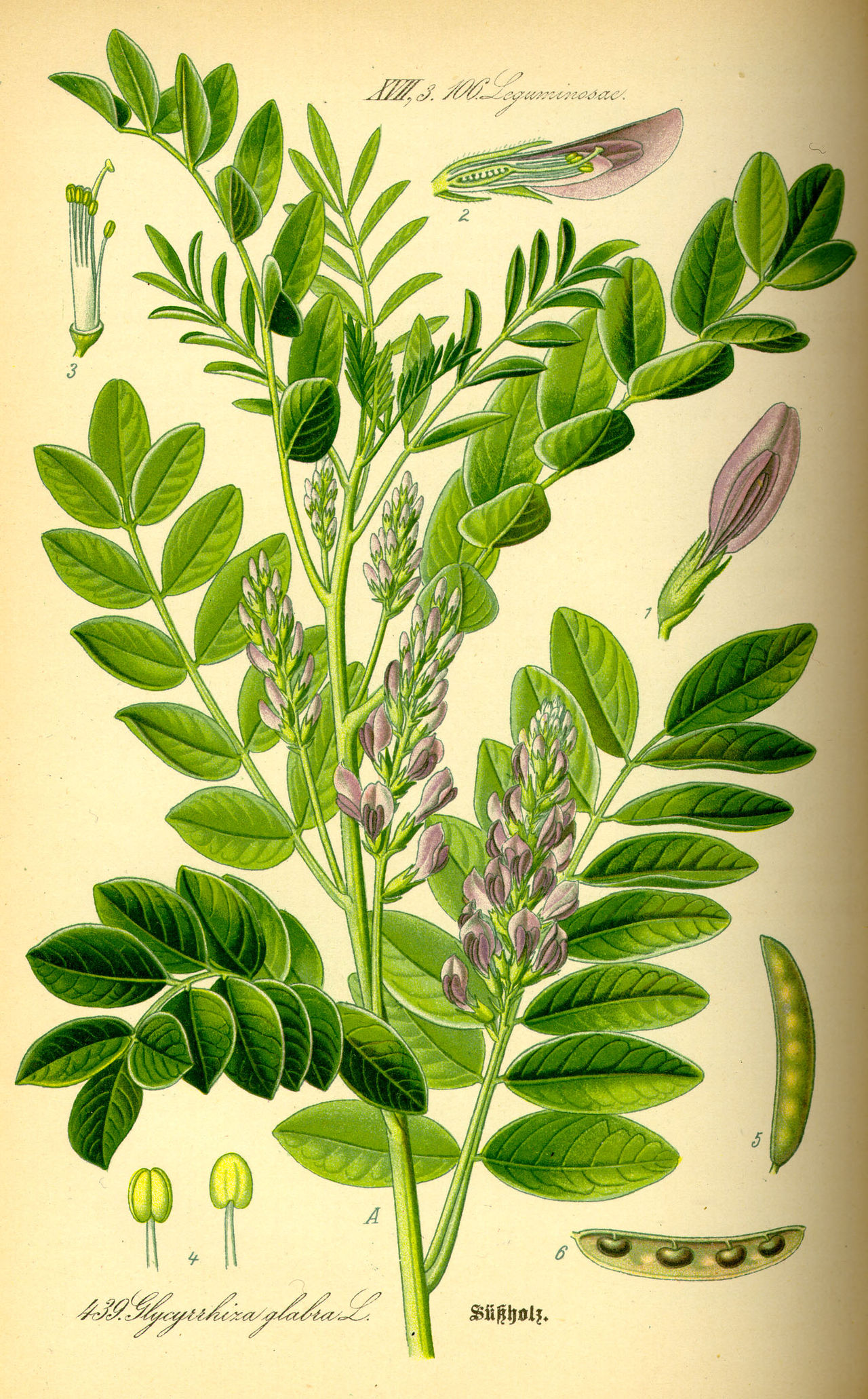
Licorice
 5
5 8
8 5
5Will it grow where I live?
Licorice is hardy to zone 7: lowlands, river valleys and cities across Central Europe are fine, harsher continental or upland sites need winter protection or a container. It also needs warm summers – in Central Europe that means wine-growing regions, cities or a sheltered south-facing wall.
Or check it for your location right here:
Profile
- Family
- Fabaceae
- Habit
- perennial
- Height
- 1.4 m
- Spread
- 2.5 m
- Growth
- slow
- Lifespan
- 10 years
- First yield
- after 3 years
- Yield in cultivation
- up to 10 t/ha
- Hardiness
- zone 7–11
- Shade tolerance
- partial shade
- Soil
- Sand, Silt
- Soil moisture
- semi-dry – very wet
- pH
- 6 – 8.5
- Synonyms
- Süßholz
Flowering & harvest
| J | F | M | A | M | J | J | A | S | O | N | D | |
|---|---|---|---|---|---|---|---|---|---|---|---|---|
| Flowering | ||||||||||||
| Fruit harvest |
Uses
Edible: Wurzel – roh oder als Aromastoff verwendet. Sie ist die Quelle von Lakritzpulver, das verwendet und in Süßigkeiten, Backwaren, Eiscreme, Erfrischungsgetränken usw. verwendet wird. Verwendet wird . Sie wird auch medizinisch genutzt. Sie hat einen süßen und köstlichen Geschmack, aber die Wurzel ist sehr faserig. Die Wurzel enthält Glycyrrhizin, eine Substanz, die 50-mal süßer ist als Saccharose. Die getrocknete Wurzel wird oft zum Kauen verwendet, eignet sich hervorragend für zahnende Kinder und auch als Zahnreiniger. Ein Tee aus den Wurzeln ist ein ausgezeichneter Durstlöscher. Die pulverisierte Wurzel wird auch als Süßungsmittel in anderen Kräutertees verwendet. Die Blätter werden in der Mongolei als Tee-Ersatz verwendet.
Medicinal: Licorice is one of the most commonly used herbs in Western herbal medicine, serving both medicinal and flavoring purposes to mask the unpleasant taste of other medications. It is a very sweet, moist, soothing herb that detoxifies and protects the liver, while also exhibiting strong anti-inflammatory properties used for various conditions such as arthritis and canker sores. The root acts as an alterative, antispasmodic, expectorant, diuretic, emollient, laxative, mildly pectoral, and tonic. Additionally, studies have shown that the root has a hormonal effect similar to ovarian hormone. Licorice root is frequently found in cough remedies and used to treat catarrhal infections of the urinary tract. Internally, it is taken for Addison's disease, asthma, bronchitis, cough, gastric ulcers, arthritis, allergies, and post-steroid therapy. Caution is advised, especially avoiding use by pregnant women or individuals with high blood pressure, kidney disease, or those taking Digoxin-based medications. Prolonged use can elevate blood pressure and lead to water retention. Externally, the root is applied to treat herpes, eczema, and shingles. Harvested in the fall at 3-4 years of age, the root is dried for later use. The German Commission E "Monographs," a therapeutic guide for herbal medicine, approves Glycyrrhiza glabra for treating cough/bronchitis and gastritis.
Other uses: The plant provides a substance used for etching steel profiles in microphotography. Root extracts serve as foaming agents in beer and fire extinguishers. Fibers extracted from the roots are utilized for insulation, wall panels, cardboard, etc. These fibers can be used after removing the medicinal and flavoring components of the root. It acts as a dynamic accumulator, collecting minerals and nutrients from the soil and storing them in a more bioavailable form for use as fertilizer or to enhance mulch.
Growing
Benötigt für eine gute Wurzelbildung einen tiefen, gut kultivierten, fruchtbaren, feuchtigkeitsspeichernden Boden. Vorzugsweise sandiger Boden mit reichlich Feuchtigkeit und nicht auf Lehm gedeiht. Leicht alkalische Bedingungen bringen die besten Pflanzen hervor. Die Pflanze gedeiht in maritimem Klima. Die Pflanzen sind bis etwa -15°C winterhart. Süßholz wird oft wegen seiner essbaren Wurzel angebaut, die weithin in der Medizin und als Gewürze verwendet wird. Es gibt einige benannte Sorten. Sterben ssp. Glandulifera wächst in Russland und bildet Adventivwurzeln von bis zu 10 cm Dicke. Erträge von 10 - 12 Tonnen pro Hektar galten im frühen 20. Jahrhundert als gut, wurden aber erst im vierten Wachstumsjahr erreicht. Sofern keine Saat benötigt wird, wird die Pflanze üblicherweise am Blühen gehindert, damit sie mehr Energie in die Bildung qualitativ hochwertiger Wurzeln steckt. Die gequetschte Wurzel hat einen charakteristischen süßlichen, stechenden Geruch. Die Pflanzen gewöhnen sich nur langsam an und wachsen in den ersten zwei Jahren nach dem Umpflanzen nicht stark. Die jungen Triebe sind außerdem sehr anfällig für Schäden durch Schnecken, weshalb die Pflanze in den ersten Jahren etwas Schutz benötigt. Die Pflanze wurzelt recht tief und ihre Wurzeln werden bis zu 120 cm lang. Hat sie sich erst einmal etabliert, ist sie nur schwer auszurotten. Diese Art lebt in Symbiose mit bestimmten Bodenbakterien; Diese Bakterien bilden Nährstoffe an den Wurzeln und fixieren atmosphärischen Stickstoff. Ein Teil dieses Stickstoffs wird von der wachsenden Pflanze selbst genutzt, ein anderer Teil kann aber auch von anderen Pflanzen in der Nähe verwendet werden. Die Pflanze ist hitzebeständig in den Zonen 12 bis 10. Die Winterhärtezonen geben an, wie gut Pflanzen kalte Wintertemperaturen vertragen Hitzetage). Beispielsweise bedeutet Hitzezone 11-1, dass die Pflanze in den Zonen 11 bis 1 hitzebeständig ist. Die Pflanze wächst ausläuferartig und breitet sich unbegrenzt über Rhizome oder Ausläufer aus. Das Wurzelmuster besteht aus stoloniferen Wurzeln von kriechenden Stämmen über dem Boden.
Origin & habitat
Europe - Mediterranean.
Dry coastal areas, wasteland.
⚠️ Hazards
An excessive dose of the root can cause edema, high blood pressure, and heart failure. Avoid use during premenstrual syndrome to prevent water retention and bloating. Caution is advised during pregnancy or liver cirrhosis. Limit use to no longer than 6 weeks. Excessive amounts may lead to headaches, lethargy, and potassium deficiency.
Frequently asked questions
Licorice: how big does it get?
Licorice (Glycyrrhiza glabra) grows as a perennial and reaches roughly 1.4 m in height when mature, with a spread of about 2.5 m. Growth is slow.
Licorice: what site does it need?
Licorice tolerates partial shade. Suitable soils are Sand, Silt. Soil moisture should be in the range semi-dry – very wet. The pH may lie between 6 and 8.5.
Licorice: is it hardy?
Licorice is listed as hardy in zone 7–11 and survives normal winters outdoors there.
Licorice: will it grow in Central Europe?
Licorice is hardy to zone 7: lowlands, river valleys and cities across Central Europe are fine, harsher continental or upland sites need winter protection or a container. It also needs warm summers – in Central Europe that means wine-growing regions, cities or a sheltered south-facing wall.
Licorice: when does it flower?
In a temperate northern-hemisphere climate it flowers in July.
Licorice: when is it harvested?
In a temperate northern-hemisphere climate the fruit ripens in October.
Licorice: when does it start cropping, and how much?
Licorice first crops after 3 years. In cultivation, up to 10 t per hectare is typical. Figures assume a good site; variety, soil and climate shift them considerably.
Licorice: is it poisonous?
Individual parts of Licorice are noted as mildly problematic — the plant does not count as poisonous. With wild plants, never rely on a database alone, only on a confident identification.
Licorice: what is it used for?
Rated on a scale up to 10: Edible 5/10, Medicinal 8/10, Other uses 5/10.
Plan this plant into your own garden
Permaplans plans your garden to scale on the map — with a site check, harvest calendar and over 1,000 plants. Free for iPhone, Android, Mac, Windows & Linux.
Will this plant grow where you live? → Check your site
Community experience
No first-hand reports for this plant yet.
Growing it? Write in the app what works for you – your post will show up here.
💬 Get the app and join in