
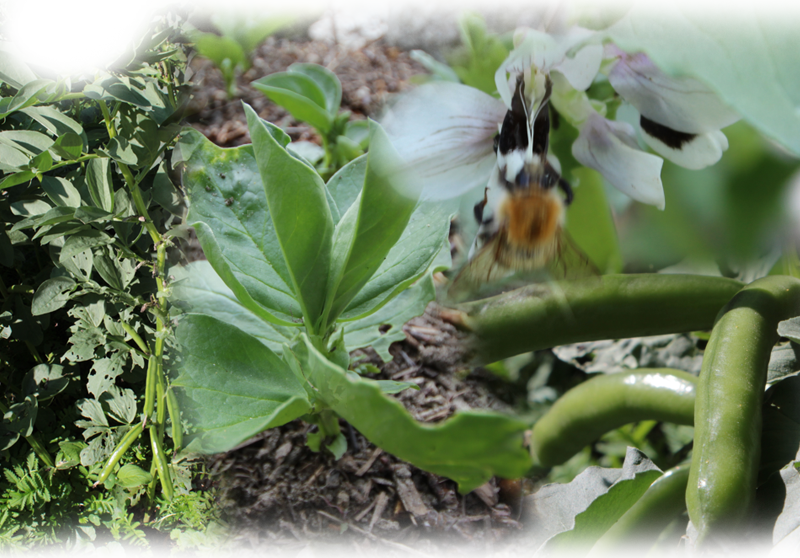
Broad bean
 9
9 4
4 5
5Will it grow where I live?
Broad bean is an annual and grows outdoors across Central Europe – one season from spring sowing to autumn harvest.
Or check it for your location right here:
Profile
- Family
- Fabaceae
- Habit
- annual
- Height
- 1.5 m
- Spread
- 0.4 m
- Growth
- very fast
- Lifespan
- 1 year
- First yield
- after 1 year
- Yield per plant
- up to 0.1 kg
- Yield in cultivation
- up to 4 t/ha
- Energy yield
- 600 kcal per m² a year
- Hardiness
- zone 3–9
- Shade tolerance
- light shade
- Soil
- Sand, Silt, Loam, Clay
- Soil moisture
- semi-dry – very moist
- pH
- 6.5 – 8.5
- Synonyms
- Dicke Bohnen
Flowering & harvest
| J | F | M | A | M | J | J | A | S | O | N | D | |
|---|---|---|---|---|---|---|---|---|---|---|---|---|
| Flowering | ||||||||||||
| Fruit harvest |
Uses
Edible: Seeds can be consumed raw or cooked, even when not fully ripe. Fully ripe seeds require soaking overnight before cooking to soften. The leaves are cooked and utilized similarly to spinach.
Other uses: A quality green manure crop can be planted in autumn or spring, growing fast, yielding a good amount, and fixing nitrogen. Its vertical growth limits its weed-killing effectiveness. The stems can provide fiber, while the ash-rich stems are useful for soap production.
Growing
Thrives in sunny locations in most well-drained soils, preferring a fairly heavy loam. It grows well in heavy clay soils and dislikes dry conditions. Cultivated for edible seeds or as a cover crop, it has two main types: 'Daffa' beans for autumn sowing and 'Tic' beans for spring sowing. Autumn-sown varieties are more prone to 'chocolate spot' fungus but less likely to be damaged by aphids. This species forms nodules on roots with soil bacteria, fixing atmospheric nitrogen. Some nitrogen benefits the plant, while the rest can support nearby plants. To release nitrogen, it's recommended to leave the roots in the soil when clearing plant debris at the end of the season.
Propagation
Before planting, immerse the seeds in lukewarm water for a day, then plant them directly in the chosen spot during spring or autumn.
Notable
Special features: thrives in marshland conditions with heavy clay soil and abundant water; able to sprout at soil temperatures as low as 2-3°C; develops a taproot that can reach up to 1m deep; consumption by individuals with G6PD deficiency can result in heightened red blood cell breakdown known as favism; categorized into field bean with small seeds and broad bean with large seeds.
Origin & habitat
Long grown for its seeds, the original location where it naturally grows remains uncertain.
Not found in its natural habitat, this primate species is among the least researched.
⚠️ Hazards
Consuming the seeds of this plant can lead to the disease 'favism' in susceptible individuals, but only when eaten excessively by those genetically predisposed to the condition.
Frequently asked questions
Broad bean: how big does it get?
Broad bean (Vicia faba) grows as a annual and reaches roughly 1.5 m in height when mature, with a spread of about 0.4 m. Growth is very fast.
Broad bean: what site does it need?
Broad bean tolerates light shade. Suitable soils are Sand, Silt, Loam, Clay. Soil moisture should be in the range semi-dry – very moist. The pH may lie between 6.5 and 8.5.
Broad bean: is it hardy?
Broad bean is listed as hardy in zone 3–9 and survives normal winters outdoors there.
Broad bean: will it grow in Central Europe?
Broad bean is an annual and grows outdoors across Central Europe – one season from spring sowing to autumn harvest.
Broad bean: when does it flower?
In a temperate northern-hemisphere climate it flowers in May.
Broad bean: when is it harvested?
In a temperate northern-hemisphere climate the fruit ripens from June to July.
Broad bean: when does it start cropping, and how much?
Broad bean crops in its first year. Expect up to 0.1 kg per plant, in cultivation up to 4 t per hectare. Figures assume a good site; variety, soil and climate shift them considerably.
Broad bean: is it poisonous?
Individual parts of Broad bean are noted as mildly problematic — the plant does not count as poisonous. With wild plants, never rely on a database alone, only on a confident identification.
Broad bean: what is it used for?
Rated on a scale up to 10: Edible 9/10, Medicinal 4/10, Other uses 5/10.
Plan this plant into your own garden
Permaplans plans your garden to scale on the map — with a site check, harvest calendar and over 1,000 plants. Free for iPhone, Android, Mac, Windows & Linux.
Will this plant grow where you live? → Check your site
Community experience
No first-hand reports for this plant yet.
Growing it? Write in the app what works for you – your post will show up here.
💬 Get the app and join in