
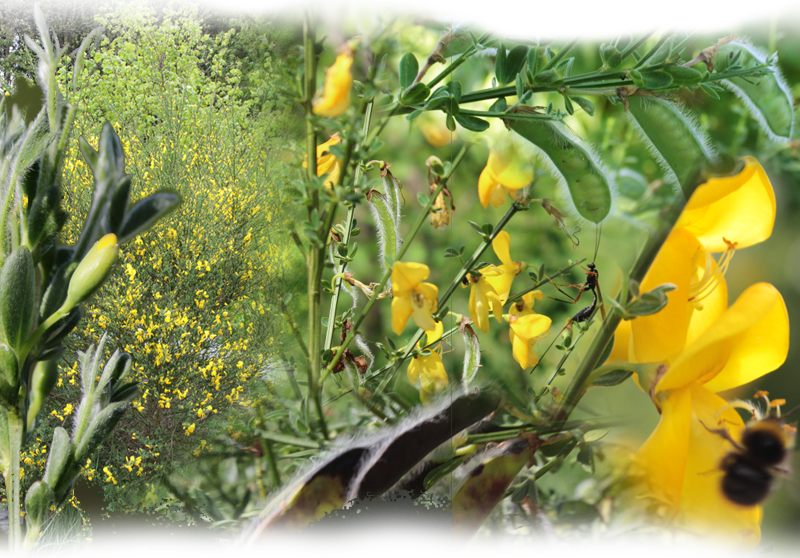
Common broom
 2
2 3
3 9
9Will it grow where I live?
Common broom is hardy to zone 5 – that covers all of Central Europe and the British Isles, and every USDA zone from 5 upwards.
Or check it for your location right here:
Profile
- Family
- Fabaceae
- Habit
- Shrub
- Height
- 2.7 m
- Spread
- 3 m
- Growth
- very fast
- Lifespan
- 12 years
- First yield
- after 3 years
- Hardiness
- zone 5–8
- Shade tolerance
- partial shade
- Soil
- Sand, Silt, Loam
- Soil moisture
- very dry – very moist
- pH
- 4.5 – 6.5
Flowering & harvest
| J | F | M | A | M | J | J | A | S | O | N | D | |
|---|---|---|---|---|---|---|---|---|---|---|---|---|
| Flowering | ||||||||||||
| Fruit harvest |
Uses
Edible: Nerve gift! Alkaloid Sparteine resembles nicotine, stimulating the heart and paralyzing respiration. In high doses, especially the seeds can be deadly. The flower buds can be eaten raw or pickled in salt and vinegar as a caper substitute in salads. The tender shoot tips are suitable as a beer additive, being bitter and intoxicating. The roasted seeds can serve as a coffee substitute.
Medicinal: The level of sparteine in the plant can vary, leading to uncertain effects. It is advisable to use only the flower of the plant under expert supervision as it has a lower sparteine content. The flowers can be used to make tea or tincture to aid in heart weakness, angina, heart pain, vein conditions, and other ailments. Traditionally, drinking a cup of tea with 1 tbsp of flowers or 20-30 drops of tincture is recommended three times a day.
Other uses: The English name is a set of instructions: the long, straight, tough switches were bundled into brooms and also woven into brushes and baskets and used in place of willow and reed. The bark yields a fibre that was worked into paper, coarse cloth and nets; for this the shoots are stripped of leaves, steamed until the fibres pull away, boiled for three hours in lye and then broken down mechanically. Bark and flowers give yellow to brown dyes for wool, and an essential oil for perfumery is obtained from the flowers. The wood is hard and handsomely figured and was used in small pieces for veneer and turnery. Today its main value is as a soil builder: through nitrogen fixation and dense rooting it binds sand, dunes, embankments and clear-fells and prepares raw ground for other species.
Growing
Site: Broom wants poor, acid, free-draining soil in full sun — on fed or limey ground it sulks or falls apart. As a nitrogen fixer it gradually enriches its surroundings, which makes it a soil builder on sand, dunes, embankments and raw ground but a problem next to a lean, low-nutrient bed. It is short-lived and must not be planned in as permanent structure. Two points decide its placing: it seeds itself heavily and builds a seed bank that stays viable in the soil for decades — critical near dry grassland and heath, and outside Europe it counts as invasive. And it contains the alkaloid sparteine, so it does not belong beside paddocks, pasture or small livestock pens. As an insect magnet, by contrast, it earns its place along sunny paths. Care: It makes a deep taproot and cannot be moved — plant young from a container or sow straight into place. Do not feed, and water only in the planting year. Pruning decides how long it lives: immediately after flowering shorten the current year's shoots by a third to a half, but never cut into the old leafless wood — it will not break from it, and too deep a cut kills the shrub. Left unpruned it goes bare from below and breaks apart within a few years. To limit its spread, cut off the pods in midsummer before they ripen. Hard winters kill back shoot tips, which the pruning corrects anyway; in winter hares and roe deer browse the twigs. Because it is short-lived, raise replacements in good time.
Propagation
Broom is propagated almost entirely from seed. The hard-coated seeds ripen from late August into early September in black pods that twist open explosively in dry weather and fling the seed several metres; ants then carry it further for the sake of its oil body. Untreated seed usually germinates only in the second year because of the hard coat, and it stays viable in the soil for decades — broom is a light and a fire germinator, in its home range a characteristic plant of burnt ground. In cultivation that is short-circuited: scratch the seeds or pour hot water over them and let them swell for 24 hours, after which they come up quickly and evenly. Because it drives a deep taproot, sow directly in place or into deep pots and plant out as young as possible. Selected flower forms are secured from half-ripe cuttings in late summer, rooted under a cover with bottom heat.
Value for wildlife
Broom is one of the strongest insect plants of poor acid ground. Forty-one wild bee species live on it, four of them specialists, and it serves 62 butterfly and moth species as a larval food plant, ten of them exclusively; two beetle species are bound to it as well. Its floral biology is unusual: it offers no nectar at all, only pollen, and its flowers are locked by a trip mechanism that only heavy bumblebees can release — as the bee lands the style springs out and slaps pollen onto its back. Smaller bees and beetles then work the flowers that have already been sprung. For mammals it is winter browse: hares, rabbits and roe deer gnaw the green twigs, which photosynthesise through the winter. The dense, thornless growth gives small birds cover and nesting sites.
Notable
Features: Sand/dune/slope/soil stabilizer; Insect attractant; Harvest branches → Remove leaves → Steam stems until fibers can be peeled off → Fibers boiled in lye for 3 hours + then placed in a ball mill for 3 hours; Celts: Healing the effects of improper/unfinished magic; (witches' broom); Flowers used to be in beer, now in smoking blends; Sheep eat the branches as an antidote for snakebites.
Origin & habitat
Europe: native to almost every European country from Scandinavia to the Iberian peninsula and eastwards to Poland and Hungary; only Iceland, Finland, Luxembourg, Albania, Bulgaria and Turkey lack it. In Central Europe it climbs to about 800 metres. Introduced, broom occurs in North and South America, South Africa, Madagascar, India, Korea, Japan, Australia and New Zealand, where it is widely treated as an invasive neophyte and controlled on a large scale — on the North American west coast, in Australia and in New Zealand it has turned open pasture and burnt ground into dense dominant stands. It is not on the EU list of invasive species of Union concern; within its European home range it is a regular part of the vegetation.
Broom is a short-lived pioneer of raw, acid, nutrient-poor ground and strongly calcifuge — it is absent from purely calcareous districts. It does best on base- and nitrogen-poor sandy and gritty soils, where root nodules with symbiotic bacteria fix atmospheric nitrogen and make it independent of soil fertility. Typical sites are extensive pasture, heathland, clear-fells and burnt ground, woodland margins, railway and road embankments, waste ground and open acid oak and birch woods. It is a decided light plant and disappears as soon as the canopy closes. Its life cycle is short: an individual plant rarely lives beyond twelve years, and the population persists through a long-lived soil seed bank and through fresh disturbance.
⚠️ Hazards
Toxicity: toxic
Poisonous, poisonous to grazing livestock, poisonous to dogs and cats Seeds and leaves contain the alkaloid sparteine. Five to ten seeds are enough to cause nausea and stomach upset; larger amounts accelerate the heartbeat and can bring on circulatory collapse. Horses and above all sheep are sensitive, as are dogs, cats, rabbits, rodents and birds — signs are salivation, vomiting, diarrhoea, restlessness and paralysis. In pregnant mares the alkaloid can induce labour. Beside fish ponds, fallen seeds can be lethal to the fish.
Frequently asked questions
Common broom: how big does it get?
Common broom (Cytisus scoparius) grows as a Shrub and reaches roughly 2.7 m in height when mature, with a spread of about 3 m. Growth is very fast.
Common broom: what site does it need?
Common broom tolerates partial shade. Suitable soils are Sand, Silt, Loam. Soil moisture should be in the range very dry – very moist. The pH may lie between 4.5 and 6.5.
Common broom: is it hardy?
Common broom is listed as hardy in zone 5–8 and survives normal winters outdoors there.
Common broom: will it grow in Central Europe?
Common broom is hardy to zone 5 – that covers all of Central Europe and the British Isles, and every USDA zone from 5 upwards.
Common broom: when does it flower?
In a temperate northern-hemisphere climate it flowers from May to June.
Common broom: when is it harvested?
In a temperate northern-hemisphere climate the fruit ripens in August.
Common broom: is it poisonous?
Common broom is classified as toxic. With wild plants, never rely on a database alone — only on a confident identification.
Common broom: what is it used for?
Rated on a scale up to 10: Edible 2/10, Medicinal 3/10, Other uses 9/10.
Plan this plant into your own garden
Permaplans plans your garden to scale on the map — with a site check, harvest calendar and over 1,000 plants. Free for iPhone, Android, Mac, Windows & Linux.
Will this plant grow where you live? → Check your site
Community experience
No first-hand reports for this plant yet.
Growing it? Write in the app what works for you – your post will show up here.
💬 Get the app and join in