
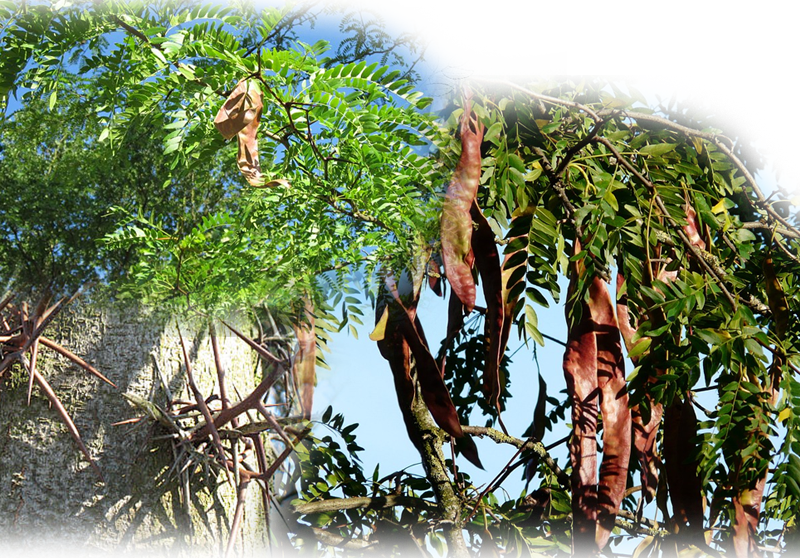
Honey locust
 6
6 5
5 9
9Will it grow where I live?
Honey locust is hardy to zone 4 – that covers all of Central Europe and the British Isles, and every USDA zone from 4 upwards.
Or check it for your location right here:
Profile
- Family
- Fabaceae
- Habit
- Tree
- Height
- 20 m
- Spread
- 14 m
- Growth
- fast
- Lifespan
- 120 years
- First yield
- after 10 years
- Productive years
- 10–100 years
- Yield per plant
- up to 200 kg a year
- Yield in cultivation
- up to 3 t/ha
- Energy yield
- 450 kcal per m² a year
- Hardiness
- zone 4–9
- Shade tolerance
- full sun
- Soil
- Sand, Silt, Loam
- Soil moisture
- very dry – moist
- pH
- 6 – 8
- Synonyms
- Honigdorn, Lederhülsenbaum
Flowering & harvest
| J | F | M | A | M | J | J | A | S | O | N | D | |
|---|---|---|---|---|---|---|---|---|---|---|---|---|
| Flowering | ||||||||||||
| Fruit harvest |
Uses
Edible: Seeds can be consumed raw or cooked and may have a sugar content of up to 30%. When young, the seeds taste similar to raw peas. They are typically found in regions with long, hot summers. The oval seeds are approximately 8 mm in length and contain varying amounts of protein, fat, carbohydrates, fiber, ash, calcium, and phosphorus per 100 g. These seeds have been roasted and utilized as a coffee alternative. The flesh of seed pods is sweet and can be eaten raw or processed into sugar. Young seed pods are edible when cooked, but the flesh in mature pods turns bitter. The seed pods, which can grow up to 40 cm long and 4 cm wide, can be used to create a sweet and savory beverage. The seed pulp has also been employed in beverage production.
Medicinal: The honey locust pods are brewed into a tea for various health issues such as indigestion, measles, and colds. The pod juice is known for its antiseptic properties, particularly effective for children's ailments. An alcoholic extract derived from honey locust fruit exhibited tumor growth inhibition, albeit with significant cytotoxic effects leading to organ damage and weight loss. The bark of the honey locust was traditionally used as a remedy for indigestion and other conditions like whooping cough, measles, and smallpox. Chemicals found in the twigs and leaves of the honey locust, such as gledichin and stenocarpine, have medicinal properties. Stenocarpine acts as a local anesthetic, while gledichin induces drowsiness and reduces reflex activity. Ongoing studies are exploring the potential of honey locust leaves in developing new anticancer medications.
Other uses: The plant is grown on mining waste for land restoration. The seeds' gum can replace acacia and tragacanth. The heartwood has 4–4.8% tannin and is durable, coarse-grained, elastic, very hard, and highly resistant to soil. It is commonly used for fence posts, rails, wheel hubs, agricultural tools, and construction, weighing 42 pounds per cubic foot.
Growing
Site: Honey locust is a tree for difficult places — it withstands drought, heat, road salt, compacted soil and air pollution, and thrives on acid as much as alkaline ground so long as it drains. It needs full sun and, once mature, is hardy to around minus 30 degrees. Everything else follows from the cultivar: the wild form carries branched trunk thorns up to 18 centimetres long, unacceptable beside paths, play areas and parking, where a thornless selection such as 'Inermis' belongs instead. Conversely that same armament is the ecological value where the tree stands free. The finely pinnate foliage casts only light shade, which makes honey locust a good overstorey in a forest garden with herb and shrub layers beneath it; the autumn leaves are so small they need no raking. Two points against naive use: despite belonging to the legumes it fixes no atmospheric nitrogen, and in southern and southeastern Europe it spreads from plantings and is considered potentially displacing. Care: Once established the tree largely looks after itself. Young plants need even watering through their first summers and a guard against deer where these are about; a stake helps, as the crown builds unevenly at first. Prune in winter and only to shape the crown, since honey locust tends to form forks and poorly attached leaders that break out later. On the wild form, pruning and any work near the trunk calls for caution because of the thorns — gloves and eye protection are no exaggeration. Do not feed. Diseases play little part, and the genus is regarded as resistant to honey fungus. First pods fall from about the tenth year and trees bear for over a century; in Central Europe, though, honey locust is slow to flower and cool summers often leave the pods unripe. Ripe pods drop in quantity through winter and should be gathered where grazing animals have access.
Propagation
Seeds - Soak in warm water for 24 hours and then plant in a greenhouse during the spring season. If the seed swells, it's ready for planting; if not, soak for another 24 hours. If needed, gently remove part of the seed coat without harming the embryo. After further soaking, the seed should swell. Once swollen, germination should occur within 2-4 weeks at 20°C. When the seedlings are large enough, transfer them to individual deep pots and place them in their final location in the summer. Provide some cold protection for the plants in their initial winters outdoors.
Value for wildlife
The small greenish flowers appear in June in inconspicuous racemes, but they are distinctly scented and yield nectar freely; in North America honey locust counts as productive bee forage and gives a varietal honey of its own, and honeybees and wild bees work it here too. Its value to native fauna nonetheless stays limited: native moth and butterfly caterpillars do not feed on it, and birds use neither seeds nor pods. The sugary pods, up to 40 centimetres long, are eaten readily by cattle and horses — their original dispersers, though, were the Ice Age megafauna of North America, mastodons, mammoths and giant sloths, without which the tree now carries fruit built for animals that no longer exist. Its structural contribution is notable: the finely pinnate foliage casts only light shade, so herb and shrub layers thrive beneath the crown, and the branched trunk thorns of the wild form, up to 18 centimetres long, give small birds a nest site no cat can reach. In conservation terms the species is rated in Central Europe as a potentially displacing non-native.
Notable
Special features: drought + salt + pollutant tolerant + heat-loving; belongs to the carob family (sometimes there is a conflicting opinion as to whether G. triacanthos fixes nitrogen or not) Some seedlings come without thorns, grafting is possible. Possible harvest of 75kg per tree according to: Wilson, A.A. 1993. Silvopastoral agroforestry using honeylocust The wood is among the hardest that grows in temperate latitudes: at roughly 1,580 lbf on the Janka scale it beats white oak (about 1,350 lbf) and red oak (about 1,290 lbf), and sits around half again above European pedunculate oak (about 1,120 lbf). Yet honey locust grows as fast as an ash — 40 to 60 cm a year on a warm, open site. That combination of rapid growth and very hard heartwood that lasts in ground contact makes it the most interesting timber tree for agroforestry in warming regions: fence posts, tool handles, wheel hubs and flooring in a fraction of the time an oak needs.
Origin & habitat
North America: the central and eastern United States. The core of the natural range lies in the Mississippi basin, from Pennsylvania and southern Ontario west to Nebraska and south to Texas and Alabama. Planted as a street and park tree, honey locust is now distributed far beyond its area of origin, in North America as much as in southern Europe, the Pannonian basin and western Asia. In southern and southeastern Europe it is naturalised in many places, colonising dry grassland, abandoned vineyards and railway embankments; in Central Europe it has so far escaped only sporadically, but is increasing as summers warm.
In its homeland honey locust grows chiefly in the floodplains and bottomlands of large rivers, on deep, fertile and often calcareous soils where it withstands periodic flooding as readily as summer drought. It usually stands singly among other broadleaves; on open ground it quickly forms closed stands. Its real strength is its indifference to conditions: it tolerates salt, compacted soil, heat, drought and air pollution, which is why it is planted along streets and in cities. One widespread error is worth naming: although it belongs to the legumes, honey locust forms no root nodules and fixes no atmospheric nitrogen — as a nitrogen fixer it is of no use.
⚠️ Hazards
The plant has substances that could be harmful. It is advised to be careful when touching the plant.
Frequently asked questions
Honey locust: how big does it get?
Honey locust (Gleditsia triacanthos) grows as a Tree and reaches roughly 20 m in height when mature, with a spread of about 14 m. Growth is fast.
Honey locust: what site does it need?
Honey locust tolerates full sun. Suitable soils are Sand, Silt, Loam. Soil moisture should be in the range very dry – moist. The pH may lie between 6 and 8.
Honey locust: is it hardy?
Honey locust is listed as hardy in zone 4–9 and survives normal winters outdoors there.
Honey locust: will it grow in Central Europe?
Honey locust is hardy to zone 4 – that covers all of Central Europe and the British Isles, and every USDA zone from 4 upwards.
Honey locust: when does it flower?
In a temperate northern-hemisphere climate it flowers in June.
Honey locust: when is it harvested?
In a temperate northern-hemisphere climate the fruit ripens in November.
Honey locust: when does it start cropping, and how much?
Honey locust first crops after 10 years. A mature plant gives up to 200 kg a year, in cultivation up to 3 t per hectare. The productive period lasts about 10–100 years, within a lifespan of around 120 years. Figures assume a good site; variety, soil and climate shift them considerably.
Honey locust: is it poisonous?
Individual parts of Honey locust are noted as mildly problematic — the plant does not count as poisonous. With wild plants, never rely on a database alone, only on a confident identification.
Honey locust: what is it used for?
Rated on a scale up to 10: Edible 6/10, Medicinal 5/10, Other uses 9/10.
Plan this plant into your own garden
Permaplans plans your garden to scale on the map — with a site check, harvest calendar and over 1,000 plants. Free for iPhone, Android, Mac, Windows & Linux.
Will this plant grow where you live? → Check your site
Community experience
No first-hand reports for this plant yet.
Growing it? Write in the app what works for you – your post will show up here.
💬 Get the app and join in