
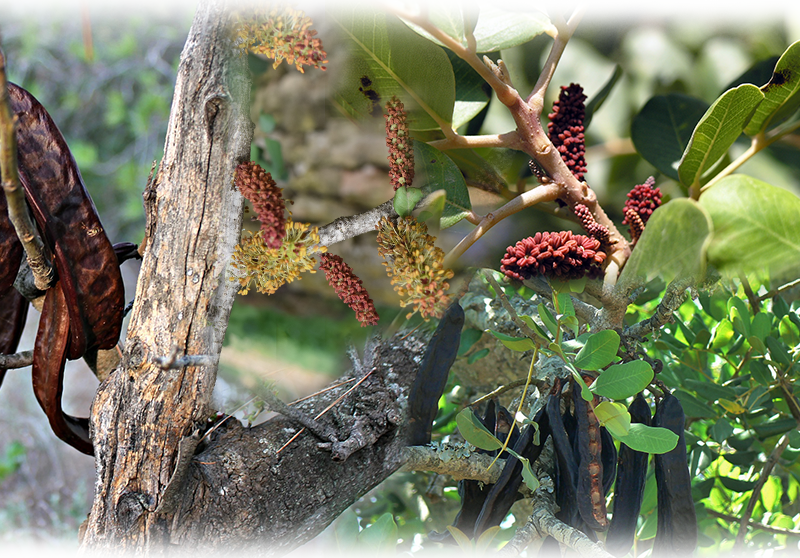
Carob tree
 8
8 5
5 9
9Will it grow where I live?
Carob tree is not winter-hardy in Central Europe (zone 9): outdoors from spring to autumn only, otherwise a container plant overwintered frost-free. It also needs warm summers – in Central Europe that means wine-growing regions, cities or a sheltered south-facing wall.
Or check it for your location right here:
Profile
- Family
- Fabaceae
- Habit
- Tree
- Height
- 11 m
- Spread
- 8 m
- Growth
- fast
- Lifespan
- 500 years
- First yield
- after 7 years
- Full yield
- after 40 years
- Productive years
- 100 years
- Yield per plant
- up to 1000 kg a year
- Yield in cultivation
- up to 10 t/ha
- Energy yield
- 1500 kcal per m² a year
- Hardiness
- zone 9–11
- Shade tolerance
- light shade
- Soil
- Sand, Silt, Loam
- Soil moisture
- very dry – very moist
- pH
- 6 – 8
- Synonyms
- Carob, Johannisbrot,
Uses
Edible: Seeds are high in protein and can be processed into a flour containing 60% protein, free of sugar and starch. This flour is suitable for baking and can be used as a chocolate substitute. The seed pods can be eaten raw or ground into powder, filled with a sweet pulp that can be consumed green or dried. The pulp, very sweet yet fibrous, can be used as a chocolate alternative in various recipes. The pods contain about 55% sugar, 10% protein, and 6% fat. An edible gum can be extracted from the seeds, serving as a substitute for gum tragacanth. This gum is used as a stabilizer, thickener, and even as an egg replacement. Roasted seeds can serve as a coffee substitute.
Medicinal: Seeds (soothing, healing for diarrhea); seed pods and bark (astringent, laxative) used as a decoction (for diarrhea).
Other uses: In the Mediterranean the carob is more than a fruit tree. It is planted as an evergreen shade tree over yards and pasture, serves as a windbreak in dry districts and holds erosion-prone slopes with deep roots; the pods are traditional concentrate feed for goats, sheep and horses. Its wood is hard and lustrous, turned and made into furniture, inlay and walking sticks, and the bark yields tannin. Economically the most important product today is locust bean gum from the seeds: as thickener and stabiliser E410 it goes into ice cream, sauces, soups and baked goods, and it is also used in cosmetics, paints, polishes, ceramics and adhesives. The uniform mass of those seeds is the origin of the carat as a unit of weight.
Growing
Site: In Central Europe the carob is a container plant — outdoors it persists only in zone 9b and warmer, because as an evergreen of the winter-wet subtropics it resents even moderate bare frost. It wants full sun and shelter from wind on free-draining, lime-tolerant compost; waterlogging kills it faster than drought. Anyone hoping for fruit must reckon with dioecy: a crop needs a male and a female tree, or a grafted hermaphrodite cultivar, and even then a harvest north of the Alps stays unrealistic, since flowering comes in late autumn and the pods take a full year to ripen. As a foliage plant with Mediterranean character it is rewarding and long-lived. Care: It forms a deep taproot and resents transplanting — so choose a tall container from the start and repot only when genuinely necessary. Water thoroughly but infrequently in summer and let it dry between times; feed sparingly. Overwinter bright and frost-free at about five to ten degrees, kept almost dry — most losses come from wet compost in a cool winter quarter, not from cold. Watch for scale, mealybug and red spider mite in winter quarters, where dry indoor air favours them. Prune only what is in the way: the tree grows slowly and is reluctant to break from old wood.
Propagation
Propagation is by seed; true to type, only by grafting. The seeds are hard and water-impermeable and need pre-treatment: either nick the coat or pour hot water over them and soak for twenty-four hours until the seeds have visibly swollen. At twenty to twenty-five degrees they then germinate in two to four weeks. Seedlings have two drawbacks: they take about six years to reach flowering age, and until then there is no telling whether the tree will be male or female. Fruiting cultivars are therefore budded or grafted onto two- to three-year-old seedling stocks in spring or late summer. Cuttings root only under mist with bottom heat and count as difficult even there; for the home garden, seed is the practical route.
Value for wildlife
The carob's wildlife value lies in its home range, not in Central Europe. There it is a late-season nectar tree of some consequence: it flowers from September to November, when Mediterranean vegetation has long passed its summer rest and little else offers nectar, and its inconspicuous flowers draw bees, flies and beetles — beekeepers around the Mediterranean know the characteristic carob honey. As an evergreen with a dense crown it also provides year-round shade, cover and nesting sites in a landscape largely bare through summer, and the fallen pods are worked over by small mammals, wild boar and grazing stock. In a Central European garden, where it stands in a container and spends most of the year under cover, little of this remains; as an insect plant it does not count here.
Notable
Special characteristics: mostly dioecious male+female trees needed for a crop, single specimens sometimes monoecious or trimonoecious; flowers September-November fruit ripens only the following year; bears from about year 6; evergreen+frost-sensitive in Central Europe a container plant with frost-free overwintering; extremely drought-tolerant (350-550mm) + salt-tolerant coastal sites; seeds of very uniform weight origin of the carat as a unit; fruit powder caffeine-free cocoa substitute;
Origin & habitat
The Mediterranean and the Near East. The carob originates in the eastern Mediterranean and on the Arabian peninsula; it has been cultivated demonstrably since the second millennium BC, first in Egypt. Trade carried it from there across the whole Mediterranean basin. Today the main growing areas are Morocco, Turkey, Lebanon, Spain, Portugal, Italy and Greece, along with California and Australia. Production centres between the 30th and 45th parallel north in the subtropics; typically it stays within about twenty-five kilometres of the coast and rarely above five hundred metres. In Central Europe it is not hardy and remains a container plant.
The carob belongs to Mediterranean sclerophyll vegetation: it grows in maquis and garrigue, on rocky slopes, in open holm oak stands and on old terraces, often alongside olive and mastic. It demands calcareous, free-draining ground — including sandy, permeable loam — and tolerates markedly saline sites, which suits it to coastal positions. It manages on three hundred and fifty to five hundred and fifty millimetres of annual rainfall and survives long summer drought on deep roots. Frost is its limit: as an evergreen tree of the winter-wet subtropics it resents even moderate bare frost, which is why it occurs neither at altitude nor far inland.
Frequently asked questions
Carob tree: how big does it get?
Carob tree (Ceratonia siliqua) grows as a Tree and reaches roughly 11 m in height when mature, with a spread of about 8 m. Growth is fast.
Carob tree: what site does it need?
Carob tree tolerates light shade. Suitable soils are Sand, Silt, Loam. Soil moisture should be in the range very dry – very moist. The pH may lie between 6 and 8.
Carob tree: is it hardy?
Carob tree is listed as hardy in zone 9–11 and survives normal winters outdoors there.
Carob tree: will it grow in Central Europe?
Carob tree is not winter-hardy in Central Europe (zone 9): outdoors from spring to autumn only, otherwise a container plant overwintered frost-free. It also needs warm summers – in Central Europe that means wine-growing regions, cities or a sheltered south-facing wall.
Carob tree: when does it start cropping, and how much?
Carob tree first crops after 7 years. Full yield comes after 40 years. A mature plant gives up to 1000 kg a year, in cultivation up to 10 t per hectare. The productive period lasts about 100 years, within a lifespan of around 500 years. Figures assume a good site; variety, soil and climate shift them considerably.
Carob tree: is it poisonous?
No toxicity is recorded for Carob tree. With wild plants, never rely on a database alone — only on a confident identification.
Carob tree: what is it used for?
Rated on a scale up to 10: Edible 8/10, Medicinal 5/10, Other uses 9/10.
Plan this plant into your own garden
Permaplans plans your garden to scale on the map — with a site check, harvest calendar and over 1,000 plants. Free for iPhone, Android, Mac, Windows & Linux.
Will this plant grow where you live? → Check your site
Community experience
No first-hand reports for this plant yet.
Growing it? Write in the app what works for you – your post will show up here.
💬 Get the app and join in