
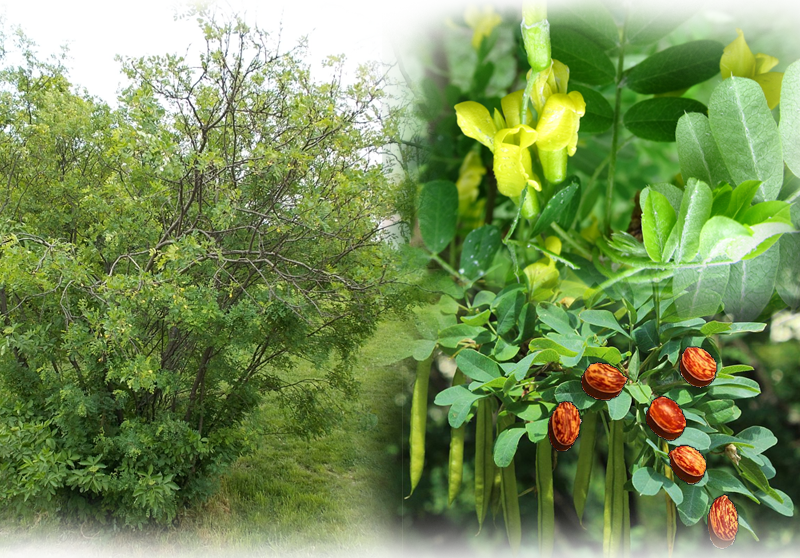
Pea bush
 3
3 3
3 7
7Will it grow where I live?
Pea bush is hardy to zone 2 – that covers all of Central Europe and the British Isles, and every USDA zone from 2 upwards.
Or check it for your location right here:
Profile
- Family
- Fabaceae
- Habit
- Shrub
- Height
- 6 m
- Spread
- 4 m
- Growth
- fast
- Lifespan
- 50 years
- First yield
- after 4 years
- Yield per plant
- up to 1 kg a year
- Hardiness
- zone 2–7
- Shade tolerance
- full sun
- Soil
- Sand, Silt
- Soil moisture
- very dry – very moist
- pH
- 7 – 8.5
Flowering & harvest
| J | F | M | A | M | J | J | A | S | O | N | D | |
|---|---|---|---|---|---|---|---|---|---|---|---|---|
| Flowering | ||||||||||||
| Fruit harvest |
Uses
Edible: Seeds and young pods (raw or cooked, similar to peas) are available in quantities of 40,000 seeds per kilogram, with 4-6 seeds per pod. They are especially popular with chickens and can also be used as salad leaves.
Medicinal: Plant (breast cancer, uterine dilatation, gynecological problems) according to the Dictionary of Traditional Chinese Medicine (Kiangsu, 1977) In traditional Chinese medicine, the plant is used to treat breast cancer, uterine dilatation, and gynecological problems.
Other uses: Leaves color blue; bark and fiber used for making ropes; biomass improves soil quality and prevents erosion; also used as animal feed and for protection.
Growing
The Siberian pea bush thrives in well-drained soils with full sun exposure, preferably light, sandy, dry, or well-drained soil, and can tolerate very alkaline conditions. It grows well in nutrient-poor soil and on marginal land, being drought-resistant and fast-growing. Hardy to about -30°C, it prefers a continental climate and requires very cold winters to thrive. While it flourishes in the eastern part of the country, including northern regions, it is less successful in the wetter west. Protection from morning sun is advisable for young growth in spring. The plant shows promise as a staple food crop due to its nutritious seeds, which are small but abundant and easy to harvest. It is also recommended for nitrogen-fixing, windbreak, and groundcover purposes, aiding soil binding and fiber and pigment production. Some cultivated forms are highly ornamental, such as the compact 'Nana' and the hanging-branched 'Pendula'. Additionally, it serves as a good bee plant and is resistant to the honey fungus. The species forms a symbiotic relationship with soil bacteria, fixing atmospheric nitrogen in nodules on the roots, benefiting both its growth and nearby plants.
Notable
Special features: wind and drought resistant; pioneer plant for sandy/well-drained and nutrient-poor soil, best in continental climates; seeds can be stored for years; 40,000 seeds ~ 1 kg; 4-6 seeds per pod; 1 kg ~ >5,000 pods! Large-fruited varieties are expected. Propagation: seeds, cuttings (7-10 cm), layering in spring.
Origin & habitat
Riverbanks, sand, open forests, forest edges, and rocky slopes are impacted by erosion.
Wooded areas and hedgerows, particularly on slopes, are frequently found on limestone-rich soils.
⚠️ Hazards
Reports of toxic substances in this plant have not been verified. The presence of cystine in the seeds is uncertain.
Frequently asked questions
Pea bush: how big does it get?
Pea bush (Caragana arborescens) grows as a Shrub and reaches roughly 6 m in height when mature, with a spread of about 4 m. Growth is fast.
Pea bush: what site does it need?
Pea bush tolerates full sun. Suitable soils are Sand, Silt. Soil moisture should be in the range very dry – very moist. The pH may lie between 7 and 8.5.
Pea bush: is it hardy?
Pea bush is listed as hardy in zone 2–7 and survives normal winters outdoors there.
Pea bush: will it grow in Central Europe?
Pea bush is hardy to zone 2 – that covers all of Central Europe and the British Isles, and every USDA zone from 2 upwards.
Pea bush: when does it flower?
In a temperate northern-hemisphere climate it flowers in May.
Pea bush: when is it harvested?
In a temperate northern-hemisphere climate the fruit ripens in August.
Pea bush: when does it start cropping, and how much?
Pea bush first crops after 4 years. A mature plant gives up to 1 kg a year. Figures assume a good site; variety, soil and climate shift them considerably.
Pea bush: is it poisonous?
Individual parts of Pea bush are noted as mildly problematic — the plant does not count as poisonous. With wild plants, never rely on a database alone, only on a confident identification.
Pea bush: what is it used for?
Rated on a scale up to 10: Edible 3/10, Medicinal 3/10, Other uses 7/10.
Plan this plant into your own garden
Permaplans plans your garden to scale on the map — with a site check, harvest calendar and over 1,000 plants. Free for iPhone, Android, Mac, Windows & Linux.
Will this plant grow where you live? → Check your site
Community experience
No first-hand reports for this plant yet.
Growing it? Write in the app what works for you – your post will show up here.
💬 Get the app and join in