
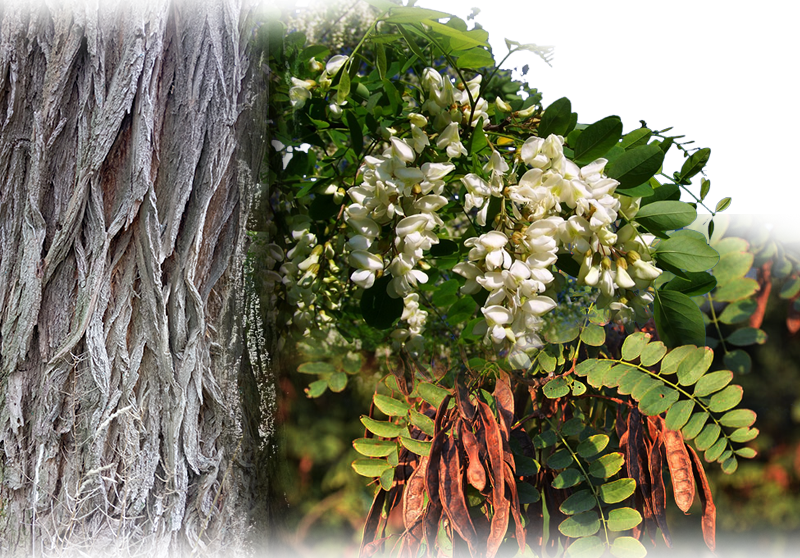
Black locust
 3
3 4
4 9
9Will it grow where I live?
Black locust is hardy to zone 4 – that covers all of Central Europe and the British Isles, and every USDA zone from 4 upwards.
Or check it for your location right here:
Profile
- Family
- Fabaceae
- Habit
- Tree
- Height
- 25 m
- Spread
- 12 m
- Growth
- very fast
- Lifespan
- 200 years
- First yield
- after 6 years
- Yield per plant
- up to 15 kg a year
- Yield in cultivation
- up to 4 t/ha
- Energy yield
- 480 kcal per m² a year
- Hardiness
- zone 4–9
- Shade tolerance
- light shade
- Soil
- Sand, Silt
- Soil moisture
- very dry – moist
- pH
- 3.5 – 7.5
- Synonyms
- Scheinakazie
Flowering & harvest
| J | F | M | A | M | J | J | A | S | O | N | D | |
|---|---|---|---|---|---|---|---|---|---|---|---|---|
| Flowering | ||||||||||||
| Fruit harvest |
Uses
Edible: The seeds are boiled and used in a similar way to peas, losing their sour taste after cooking. Measuring about 4 mm in length, they are found in pods up to 10 cm long, each containing 4-8 seeds. Young seed pods are also suitable for boiling, with sweetish pulp that is safe for consumption, particularly enjoyed by young children. The fruit's skin can produce a potent narcotic and intoxicating effect. Piperonal, extracted from the plant, serves as a vanilla alternative. Boiling the flowers releases a fragrant aroma, often utilized in making jams, pancakes, and delightful beverages.
Medicinal: The plant's flowers have antispasmodic, aromatic, diuretic, emollient, and laxative properties. They are traditionally employed in treating eye ailments. The flower is thought to harbor the antitumor substance benzoaldehyde. The inner bark and root bark possess laxative, emetic, and tonic qualities. The root bark was used for inducing vomiting or alleviating toothache. The fruit exhibits narcotic effects. The leaves display choleretic and emetic characteristics, with the leaf juice showing antiviral properties.
Other uses: A drying oil is obtained from the seeds of the black locust tree. The flowers yield a valuable essential oil for perfumery. The bark produces a yellow dye called robinetin for coloring fabrics. While the bark contains tannin, it is not sufficient for commercial use but is utilized in papermaking and as a silk and wool substitute. These trees are effective in stabilizing riverbanks due to their high water absorption. Black locust wood is durable, hard, heavy, and fine-grained, suitable for shipbuilding, fence posts, tree nails, and flooring. It serves as a good fuel source but requires careful handling due to its tendency to spark. The variety Robinia pseudoacacia var. rectissima, known as 'Long Island' or 'Shipmast' black locust, is notably resistant to rot and wood pests compared to other black locust types.
Growing
Site: The trickiest point is the root: it reaches up to fourteen metres and every damaged piece shoots again. Allow generous distance from beds, paths and neighbouring plots, and never work there with spade or tiller. The branches are brittle, and from thirty to forty years rotten limbs become a hazard over paths and seating areas. Young twigs bear paired thorns, which argues against children's play areas. It fixes atmospheric nitrogen and enriches the site, which is exactly why it does not belong near nutrient-poor, sandy or calcareous dry grassland or nature reserves, whose species composition it permanently devalues. For beekeepers, by contrast, it is one of the best nectar sources there is. Care: Feeding is pointless and harmful; it supplies its own nitrogen. Keep pruning to a minimum and do it in the dormant season, since every cut stimulates stump sprouts and root suckers. If a tree has to go, ringbarking in summer works better than felling, because felling multiplies the stand. Root suckers in lawn are kept down by mowing; in beds they must be dug out. Young trees are vulnerable to late frost and need a stake for the first few years, as the trunk tends to grow crooked. Coppiced on a short rotation it yields durable stake timber without any preservative.
Propagation
In the garden black locust mostly propagates itself: every severed root shoots again, and trees that are cut or felled produce stump sprouts and root suckers reaching many metres. Anyone wanting to propagate deliberately uses exactly that and lifts rooted suckers in winter. Seed keeps for more than ten years but needs its hard coat treated: soak for 24 to 48 hours in hot water or scarify, then sow in spring outdoors or into pots, and germination follows within two to three weeks. Cultivars such as the mop-headed 'Umbraculifera' or the yellow-leaved 'Frisia' are grafted onto seedling rootstocks, as they do not come true otherwise. More important than any propagation technique is the opposite question: cultivating the soil within the root zone multiplies the stand unintentionally.
Value for wildlife
Black locust is a special case: for honeybees it is one of the most productive nectar sources in Central Europe, while for the native fauna it is otherwise close to worthless. Its flowers yield nectar with 34 to 59 per cent sugar in May and June; 0.66 to 1.44 kilograms of honey per tree and season can be expected, and in Brandenburg it accounts for up to 60 per cent of the honey harvest in good years. Bumblebees and long-tongued solitary bees use the flowers too. There the benefit largely ends: as a caterpillar food plant black locust is a non-starter, since scarcely any native moth or butterfly can handle its leaf chemistry. Older trunks are, however, readily worked by woodpeckers, and the quickly rotting heartwood provides nest holes for later tenants such as starlings, tits and bats. Against that stands the nitrogen enrichment from its root nodules, which devalues nutrient-poor grassland and demonstrably impoverishes the spider and ground-beetle fauna of such sites.
Notable
Special features: Pioneer plant, which quickly forms large (through root runners) dense stands for 20-30 years, especially on (industrial) brownfield sites; 0.6-1.4 kg honey per tree (flowers 34-59% sugar); stops growing at 30-40 years, by which time the wood is ready for harvest; ~0.4% of German forests; 2100 kWh/rm; 4.1 kWh/kg
Origin & habitat
Eastern North America: Appalachians and Ozark Plateau. The original range is surprisingly small, covering essentially the uplands from Pennsylvania to Alabama plus a second area in Missouri, Arkansas and Oklahoma. The species reached Paris in 1601 and was named after the court gardener Jean Robin; from there it spread across the whole of Europe, first as an ornamental and bee tree, later deliberately for stabilising embankments, spoil heaps and railway cuttings. Today it is firmly naturalised in southern, central and eastern Europe, with concentrations in Hungary, Romania, Italy and the Pannonian region, and in Germany mainly in the warmer lowlands and wine-growing climates. It has also been carried to East Asia, South Africa, Australia and New Zealand.
In its homeland black locust grows in open deciduous woodland, along woodland edges and on slope debris in the Appalachians, mostly on freely drained, rather nutrient-poor soils. In Europe it occupies almost exclusively human-disturbed sites: railway embankments, road cuttings, spoil heaps, industrial wasteland, gravel pits, abandoned vineyards and woodland margins in warm positions. As a light-demanding pioneer it pushes into stands from the edges and forms dense pure stands by root suckering that persist for twenty to thirty years. It needs loose, freely drained soil of slightly acid to alkaline reaction, tolerates pure sand and great heat, and is markedly drought-tolerant. On compacted soils and with waterlogging it fails. In Central Europe it climbs to about 800 metres.
⚠️ Hazards
Toxicity: toxic
All plant parts, excluding the flowers, particularly the bark, are toxic. Heat can neutralize the toxins.
Frequently asked questions
Black locust: how big does it get?
Black locust (Robinia pseudoacacia) grows as a Tree and reaches roughly 25 m in height when mature, with a spread of about 12 m. Growth is very fast.
Black locust: what site does it need?
Black locust tolerates light shade. Suitable soils are Sand, Silt. Soil moisture should be in the range very dry – moist. The pH may lie between 3.5 and 7.5.
Black locust: is it hardy?
Black locust is listed as hardy in zone 4–9 and survives normal winters outdoors there.
Black locust: will it grow in Central Europe?
Black locust is hardy to zone 4 – that covers all of Central Europe and the British Isles, and every USDA zone from 4 upwards.
Black locust: when does it flower?
In a temperate northern-hemisphere climate it flowers in June.
Black locust: when is it harvested?
In a temperate northern-hemisphere climate the fruit ripens from December to February.
Black locust: when does it start cropping, and how much?
Black locust first crops after 6 years. A mature plant gives up to 15 kg a year, in cultivation up to 4 t per hectare. Figures assume a good site; variety, soil and climate shift them considerably.
Black locust: is it poisonous?
Black locust is classified as toxic. With wild plants, never rely on a database alone — only on a confident identification.
Black locust: what is it used for?
Rated on a scale up to 10: Edible 3/10, Medicinal 4/10, Other uses 9/10.
Plan this plant into your own garden
Permaplans plans your garden to scale on the map — with a site check, harvest calendar and over 1,000 plants. Free for iPhone, Android, Mac, Windows & Linux.
Will this plant grow where you live? → Check your site
Community experience
No first-hand reports for this plant yet.
Growing it? Write in the app what works for you – your post will show up here.
💬 Get the app and join in