
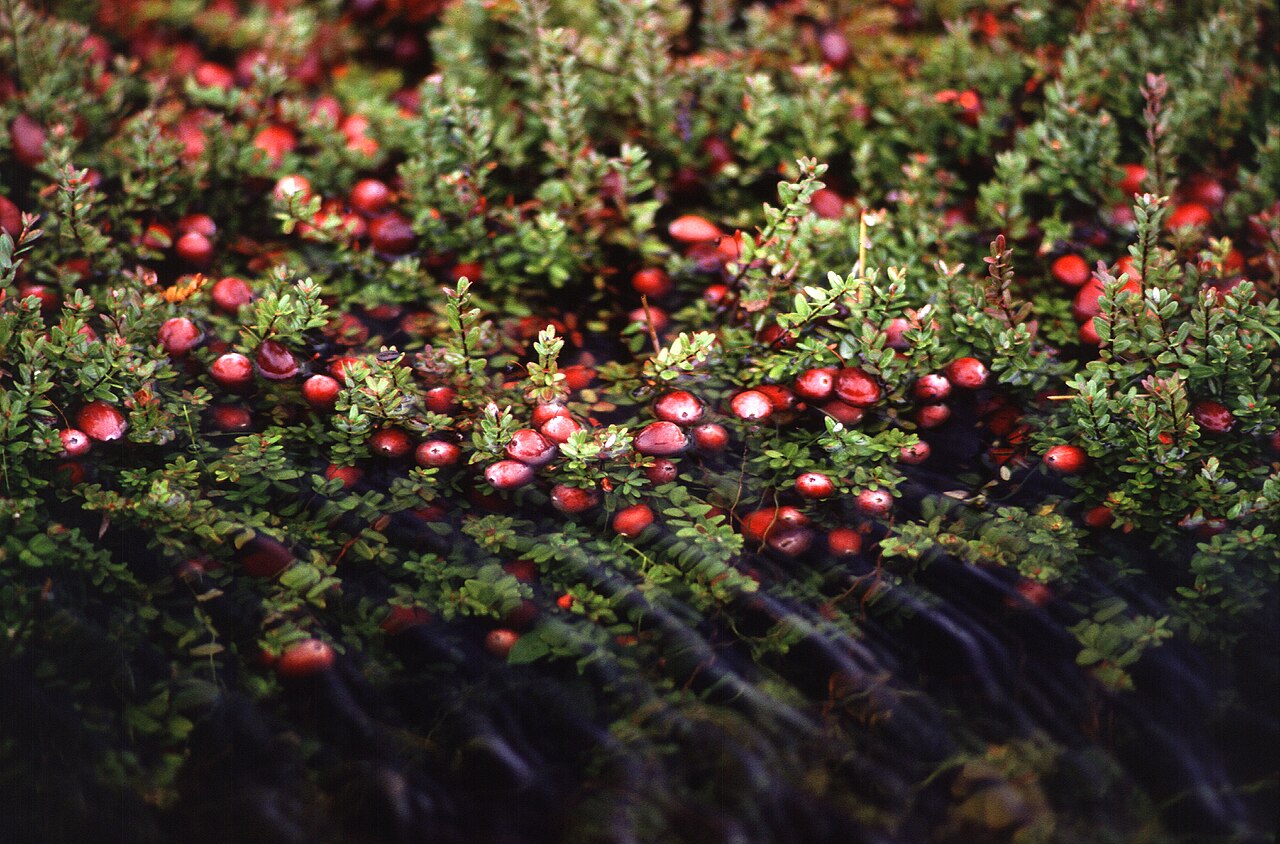
Cranberry
 5
5 4
4 1
1Will it grow where I live?
Cranberry is hardy to zone 2 – that covers all of Central Europe and the British Isles, and every USDA zone from 2 upwards. It needs real winter cold and struggles in the mildest sites (zone 8 and warmer).
Or check it for your location right here:
Profile
- Family
- Ericaceae
- Habit
- Shrub
- Height
- 1.1 m
- Spread
- 1.5 m
- Growth
- slow
- Lifespan
- 50 years
- First yield
- after 2 years
- Productive years
- 100 years
- Hardiness
- zone 2–6
- Shade tolerance
- partial shade
- Soil
- Sand, Silt
- Soil moisture
- semi-dry – very moist
- pH
- 4 – 5.5
Flowering & harvest
| J | F | M | A | M | J | J | A | S | O | N | D | |
|---|---|---|---|---|---|---|---|---|---|---|---|---|
| Flowering |
Varieties (15)
15 varieties of Cranberry are listed in the Permaplans variety finder — each with its own page: taste, ripening time, disease resistance, parentage and use.
- Ben Lear Early, intensely red cranberry with high pigment content, ideal for juice and concentrate.
- Bergman Early-ripening USDA hybrid with deep-red berries and good colour.
- Crowley Early-ripening West Coast cultivar, bred for cool Pacific climates.
- Demoranville Modern Rutgers hybrid with early, deep colour build-up and good yield.
- Early Black Old New England cultivar with small, almost blackish-red, early-ripening berries.
- Franklin USDA hybrid combining the colour of Early Black with the keeping quality of Howes.
- GH1 High-yielding private Wisconsin-bred variety with large, well-colouring berries.
- Howes Late, very storable classic cultivar with small, firm red berries.
- HyRed Early Wisconsin-bred variety with exceptionally intense red colouring.
- LeMunyon Older Wisconsin cultivar with dark-red berries, mainly grown regionally.
- McFarlin Hardy, late-ripening cultivar with large dark-red berries, parent of many bred varieties.
- Mullica Queen Modern Rutgers high-yielding variety with large, deep-red berries for processing.
- Pilgrim Large-fruited USDA hybrid with a striking red cheek, good for juice and fresh market.
- Searles Classic Wisconsin cultivar with dark-red berries and good colouring.
- Stevens The world-standard cranberry: hardy, high-yielding, with large deep-red berries for juice and dried fruit.
Uses
Frequently asked questions
Cranberry: how big does it get?
Cranberry (Vaccinium macrocarpon) grows as a Shrub and reaches roughly 1.1 m in height when mature, with a spread of about 1.5 m. Growth is slow.
Cranberry: what site does it need?
Cranberry tolerates partial shade. Suitable soils are Sand, Silt. Soil moisture should be in the range semi-dry – very moist. The pH may lie between 4 and 5.5.
Cranberry: is it hardy?
Cranberry is listed as hardy in zone 2–6 and survives normal winters outdoors there.
Cranberry: will it grow in Central Europe?
Cranberry is hardy to zone 2 – that covers all of Central Europe and the British Isles, and every USDA zone from 2 upwards. It needs real winter cold and struggles in the mildest sites (zone 8 and warmer).
Cranberry: when does it flower?
In a temperate northern-hemisphere climate it flowers in June.
Cranberry: when does it start cropping, and how much?
Cranberry first crops after 2 years. The productive period lasts about 100 years. Figures assume a good site; variety, soil and climate shift them considerably.
Cranberry: is it poisonous?
No toxicity is recorded for Cranberry. With wild plants, never rely on a database alone — only on a confident identification.
Cranberry: what is it used for?
Rated on a scale up to 10: Edible 5/10, Medicinal 4/10, Other uses 1/10.
Which Cranberry varieties are there?
The Permaplans variety finder lists 15 varieties of Cranberry, including Ben Lear, Bergman, Crowley, Demoranville, Early Black, Franklin, GH1, Howes, HyRed, LeMunyon, McFarlin, Mullica Queen and 3 more. Each variety has its own page with taste, ripening time, disease resistance and parentage.
Plan this plant into your own garden
Permaplans plans your garden to scale on the map — with a site check, harvest calendar and over 1,000 plants. Free for iPhone, Android, Mac, Windows & Linux.
Will this plant grow where you live? → Check your site
Community experience
No first-hand reports for this plant yet.
Growing it? Write in the app what works for you – your post will show up here.
💬 Get the app and join in