
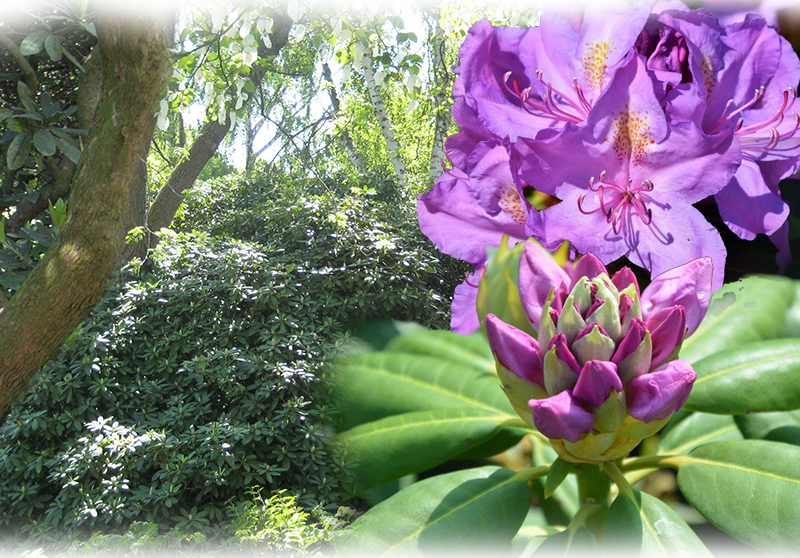
Pontic rhododendron
 1
1 8
8Will it grow where I live?
Pontic rhododendron is hardy to zone 6, which covers nearly all of Central Europe and the British Isles; only harsh upland sites (Alps, high ridges) call for winter protection.
Or check it for your location right here:
Profile
- Family
- Ericaceae
- Habit
- Shrub
- Height
- 5 m
- Spread
- 8 m
- Growth
- slow
- Lifespan
- 120 years
- First yield
- after 5 years
- Hardiness
- zone 6–9
- Shade tolerance
- full shade
- Soil
- Sand, Silt
- Soil moisture
- semi-dry – very moist
- pH
- 4 – 6
- Synonyms
- R. lancifolium, R. speciosum.
Flowering & harvest
| J | F | M | A | M | J | J | A | S | O | N | D | |
|---|---|---|---|---|---|---|---|---|---|---|---|---|
| Flowering | ||||||||||||
| Fruit harvest |
Uses
Edible: Rhododendron ponticum is not a food plant, and that holds without qualification: every part contains grayanotoxins, toxic diterpenes. Remarkably, the toxicity extends even to the bee product. Pontic honey made from its nectar and pollen can cause a drop in blood pressure and a marked slowing of the heartbeat in people who eat enough of it — antiquity knew it as an active substance, and in the Black Sea region it is still collected locally and handled with caution. For the garden the reverse applies: if a large stand is within range of your own bee colonies, the honey may be affected. No edible part exists on this plant, not even after processing.
Medicinal: All parts of the plant are toxic, including the Pontic honey produced from nectar and pollen, which can be highly toxic and lead to a significant decrease in pulse and heart rate. There are no known uses for this plant. The related alpine rose shrub was previously used in traditional medicine but is now only used homeopathically for rheumatism and pain. According to a study, it can even kill or paralyze bees, but not bumblebees.
Other uses: The economically most important use of Rhododendron ponticum is barely visible: in western Europe it is one of the commonest grafting rootstocks for more attractive rhododendrons. As an ornamental in its own right, mainly the subspecies baeticum is grown; the first plants were raised in England in the 1760s by Joachim Conrad Loddiges, and from there the emerging nursery trade spread the species widely in the late 18th and early 19th centuries. Horticulturally it is used for evergreen hedges, windbreaks and dense ground cover under open woodland, including natural building: set at least three plants in a circle and you get a leaf canopy outside and a sheltered space within. The wood is hard and strong and was used for posts, walking sticks and carving; it also burns green, which makes it usable as emergency fuel. Branches go into floristry.
Growing
Site: A broad evergreen large shrub that easily reaches five metres and lets almost nothing grow beneath it — use it as a specimen, a screen or underplanting for open woodland, not in a perennial border. The soil decides: humus-rich, lime-free, acid at pH 4.5 to 5.5, peaty or as a free-draining sandy loam, evenly moist without waterlogging. The commonest cause of failure is not the position but hard, limy irrigation water. As a shallow-rooting plant it tolerates neither competition from shallow-rooted trees nor planting over its root zone. Two points must go into the planning: every part of the plant is toxic, including nectar and pollen, so it has no place next to pasture, paddocks or small-animal enclosures. And it has genuine spreading potential — it is considered invasive in Britain, Ireland, Belgium, the Netherlands, Austria and on Madeira, while in Germany it has so far only naturalised impermanently. Root suckering plus heavy seed production are the mechanisms, so avoid positions at woodland edges or beside heathland and watch for seedlings. Care: Keep the root zone weed-free but do not hoe; a mulch of needle litter or bark humus is the right method. Water lime-free, ideally with rainwater. Deadhead after flowering; cutting back into old wood is possible but regrows slowly. In wet ground root rot threatens, to which the whole genus is prone; transplanting, by contrast, is easy as long as the root ball stays intact. It is hardy to about minus 15 degrees, but the real winter danger is frost drought: sun on evergreen foliage while the soil is frozen scorches the leaves, and in exposed positions shading helps. One special case concerns grafted rhododendrons standing on it: ungrafted shoots rise from the rootstock and overgrow the named cultivar — anyone who does not remove these suckers consistently ends up, after a few years, with a pure Rhododendron ponticum again.
Propagation
Sow seeds in a greenhouse in autumn once ripe, providing artificial light. Alternatively, sow seeds in late winter in a slightly shaded area of a warm greenhouse or in April in a cold greenhouse. Sow seeds superficially and keep the compost from drying out. Repot seedlings when large enough and let them grow in the greenhouse for at least the first winter. Stratification in late July. Takes 15-24 months. Take cuttings from semi-hardwood in August in a frame. Challenging.
Value for wildlife
With Rhododendron ponticum, structure and food have to be judged separately. Its nectar is toxic to part of the pollinator community: a study shows that honeybees die within hours of taking it and that the mining bee Andrena carantonica is also paralysed — affected individuals groom excessively, behave abnormally and feed less. The buff-tailed bumblebee (Bombus terrestris), by contrast, is unaffected and uses the flowers safely. For beekeepers a large stand is therefore more a risk than a resource. On the other hand the shrub delivers what evergreen woody plants are good for: dense, thornless cover, shelter from wind and nesting sites at a season when deciduous shrubs stand bare; pigeons and other open nesters use the dense branchwork. In the naturalised stands of western Europe the damage ultimately outweighs this, because it displaces the native flora and with it the food base of whole insect communities — British conservation organisations list it as a serious problem of atlantic oak woods.
Notable
Special features: Prefers sandy, peaty, acidic soil in beech/pine forests; Also grows on steep cliffs; Mature plants can still be transplanted successfully; There are >1000 different species & countless (hybrid) varieties; Breeding focus on large-flowered varieties adapted for lime-tolerant small gardens; Different varieties = different flowering times: February - September; R. ponticum thrives "invasively" in Ireland.
Origin & habitat
Pontic Mountains and the western Caucasus, plus two separate relict areas. The main range lies in the mountain chain south of the Black Sea in Turkey and the adjoining western Caucasus in Georgia and Russia; it continues into Europe in a small area in the Strandzha Mountains and the easternmost Balkan range of south-eastern Bulgaria. Far separated from this it grows in the mountains of Lebanon along watercourses. On the Iberian Peninsula three relict areas survive up to 850, rarely 1,000 metres: in the Serra de Monchique and Serra de Vouzela in Portugal and in the Sierra del Aljibe in Cádiz province. Fossil evidence shows the species was spread across most of southern and western Europe before the last glacial maximum — today's occurrences are remnants. In western Europe it has naturalised widely.
Rhododendron ponticum is a plant of humid, acid mountain forest. In the Pontic Mountains and western Caucasus it grows in the understorey of woodland but also forms its own thickets reaching into the subalpine zone above 2,400 metres. In its Bulgarian outpost it stands beneath oriental beech; in the Iberian relict areas it grows in the understorey of woodland on acid ground and there strikingly often in stream valleys near water; in Lebanon exclusively along watercourses. The pattern is the same everywhere: high air humidity, lime-free, humus-rich, evenly moist soils, partial shade and a climate without long dry spells. In western Europe it has built up stands in atlantic oak woods and heathland where it completely overgrows the native ground flora.
⚠️ Hazards
Although no specific mention of toxicity has been found for this species, it belongs to a genus where many members have poisonous leaves. The pollen of many, if not all, species of rhododendrons is also likely toxic and is said to cause poisoning if consumed in large quantities.
Frequently asked questions
Pontic rhododendron: how big does it get?
Pontic rhododendron (Rhododendron ponticum) grows as a Shrub and reaches roughly 5 m in height when mature, with a spread of about 8 m. Growth is slow.
Pontic rhododendron: what site does it need?
Pontic rhododendron tolerates full shade. Suitable soils are Sand, Silt. Soil moisture should be in the range semi-dry – very moist. The pH may lie between 4 and 6.
Pontic rhododendron: is it hardy?
Pontic rhododendron is listed as hardy in zone 6–9 and survives normal winters outdoors there.
Pontic rhododendron: will it grow in Central Europe?
Pontic rhododendron is hardy to zone 6, which covers nearly all of Central Europe and the British Isles; only harsh upland sites (Alps, high ridges) call for winter protection.
Pontic rhododendron: when does it flower?
In a temperate northern-hemisphere climate it flowers from May to June.
Pontic rhododendron: when is it harvested?
In a temperate northern-hemisphere climate the fruit ripens in November.
Pontic rhododendron: is it poisonous?
Individual parts of Pontic rhododendron are noted as mildly problematic — the plant does not count as poisonous. With wild plants, never rely on a database alone, only on a confident identification.
Pontic rhododendron: what is it used for?
Rated on a scale up to 10: Medicinal 1/10, Other uses 8/10.
Plan this plant into your own garden
Permaplans plans your garden to scale on the map — with a site check, harvest calendar and over 1,000 plants. Free for iPhone, Android, Mac, Windows & Linux.
Will this plant grow where you live? → Check your site
Community experience
No first-hand reports for this plant yet.
Growing it? Write in the app what works for you – your post will show up here.
💬 Get the app and join in