
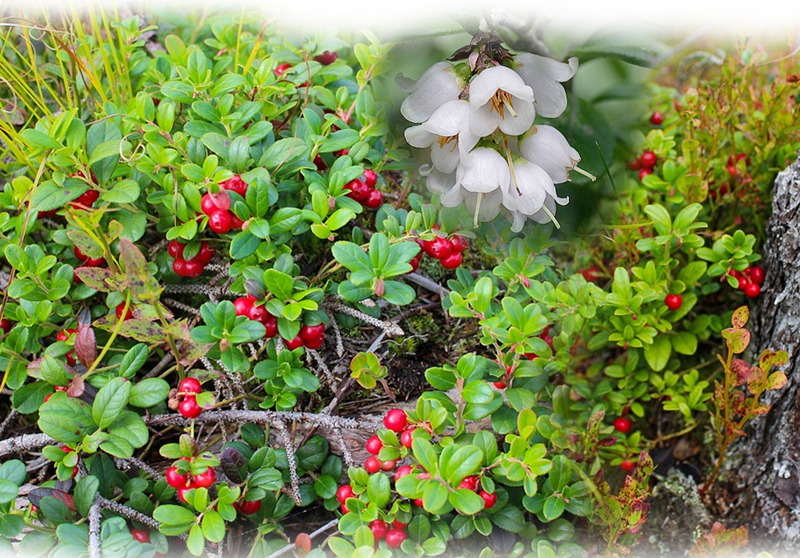
Lingonberry
 7
7 5
5 4
4Will it grow where I live?
Lingonberry is hardy to zone 4 – that covers all of Central Europe and the British Isles, and every USDA zone from 4 upwards.
Or check it for your location right here:
Profile
- Family
- Ericaceae
- Habit
- Shrub
- Height
- 0.3 m
- Spread
- 1.5 m
- Growth
- medium
- Lifespan
- 15 years
- First yield
- after 2 years
- Productive years
- 20 years
- Yield per plant
- up to 0.5 kg a year
- Yield in cultivation
- up to 4 t/ha
- Energy yield
- 70 kcal per m² a year
- Hardiness
- zone 4–8
- Shade tolerance
- partial shade
- Soil
- Sand, Silt
- Soil moisture
- dry – very moist
- pH
- 3 – 5.5
Flowering & harvest
| J | F | M | A | M | J | J | A | S | O | N | D | |
|---|---|---|---|---|---|---|---|---|---|---|---|---|
| Flowering | ||||||||||||
| Fruit harvest |
Uses
Edible: Fruit can be consumed raw or cooked and has a pleasant taste, slightly sour, commonly used in preserves. Some consider it better than cranberries. The flavor improves after frost. Sometimes, two harvests occur in a year. The fruit is around 6 mm in diameter. Leaves can be used to make tea, but it should not be consumed frequently due to the presence of the toxin arbutin.
Medicinal: The plant's leaves possess antiseptic, astringent, diuretic, and cooling qualities. They are gathered and dried in early summer. The mature fruits, whether fresh or dried, are utilized to address diarrhea and alleviate sore throats, coughs, and colds. The juice is suitable for gargling to soothe sore throats.
Other uses: A yellow dye is obtained from the leaves and stems, while a purple dye is extracted from the fruit of the plant. It can serve as ground cover, spreading through underground runners. Weeding is crucial in the initial phase, and the recommended planting distance is around 30 cm in all directions.
Growing
Requires moist but well-drained, lime-free soil, preferably rich in peat or a light loamy soil with added leaf litter. Thrives in very acidic soil with a pH between 4.5 and 6, as lime presence can lead to chlorosis. Flourishes in full sun or light shade, with better fruiting in sunny spots. Needs shelter from strong winds. Avoids root disturbance; grows best in pots until transplanted permanently. Occasionally grown for its edible fruits, with various named cultivars available. 'Koralle' stands out for its large, showy berries that persist on the bush throughout winter. The flowers attract bees with their copious nectar. Plants in this genus show remarkable resistance to the honey fungus.
Notable
Special features: Requires highly acidic, well-draining soil and shelter from harsh cold winds in heath and peat environments. High-yielding cultivars include 'Koralle' and 'Amemerland'. In some countries, such as Canada and the USA, the yield is significantly higher (Canada 28t/ha, USA 23t/ha). Several varieties can produce fruit twice annually, typically in August and October. The plant is capable of surviving temperatures as low as -50°C when insulated under protective snow.
Origin & habitat
Europe spans from Iceland in the north to the Pyrenees in the south and from Macedonia in the east to Japan in the east.
Sonnige Bergwiesen, Hochmoore und Kiefernwälder, auf sauren Böden.
Frequently asked questions
Lingonberry: how big does it get?
Lingonberry (Vaccinium vitis-idaea) grows as a Shrub and reaches roughly 0.3 m in height when mature, with a spread of about 1.5 m. Growth is medium.
Lingonberry: what site does it need?
Lingonberry tolerates partial shade. Suitable soils are Sand, Silt. Soil moisture should be in the range dry – very moist. The pH may lie between 3 and 5.5.
Lingonberry: is it hardy?
Lingonberry is listed as hardy in zone 4–8 and survives normal winters outdoors there.
Lingonberry: will it grow in Central Europe?
Lingonberry is hardy to zone 4 – that covers all of Central Europe and the British Isles, and every USDA zone from 4 upwards.
Lingonberry: when does it flower?
In a temperate northern-hemisphere climate it flowers in May.
Lingonberry: when is it harvested?
In a temperate northern-hemisphere climate the fruit ripens in August.
Lingonberry: when does it start cropping, and how much?
Lingonberry first crops after 2 years. A mature plant gives up to 0.5 kg a year, in cultivation up to 4 t per hectare. The productive period lasts about 20 years. Figures assume a good site; variety, soil and climate shift them considerably.
Lingonberry: is it poisonous?
No toxicity is recorded for Lingonberry. With wild plants, never rely on a database alone — only on a confident identification.
Lingonberry: what is it used for?
Rated on a scale up to 10: Edible 7/10, Medicinal 5/10, Other uses 4/10.
Plan this plant into your own garden
Permaplans plans your garden to scale on the map — with a site check, harvest calendar and over 1,000 plants. Free for iPhone, Android, Mac, Windows & Linux.
Will this plant grow where you live? → Check your site
Community experience
No first-hand reports for this plant yet.
Growing it? Write in the app what works for you – your post will show up here.
💬 Get the app and join in