
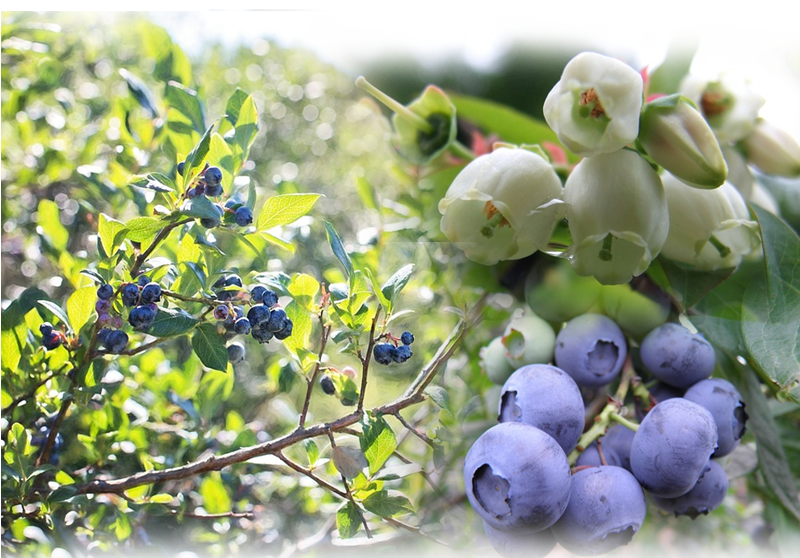
Cultivated blueberry
 9
9 5
5 1
1Will it grow where I live?
Cultivated blueberry is hardy to zone 3 – that covers all of Central Europe and the British Isles, and every USDA zone from 3 upwards.
Or check it for your location right here:
Profile
- Family
- Ericaceae
- Habit
- Shrub
- Height
- 2 m
- Spread
- 1.5 m
- Growth
- slow
- Lifespan
- 50 years
- First yield
- after 3 years
- Full yield
- after 8 years
- Yield per plant
- up to 7 kg a year
- Yield in cultivation
- up to 7 t/ha
- Energy yield
- 300 kcal per m² a year
- Hardiness
- zone 3–8
- Shade tolerance
- partial shade
- Soil
- Sand, Silt
- Soil moisture
- semi-dry – very moist
- pH
- 3.5 – 5
- Synonyms
- Heidelbeere
- Planned in gardens
- 6×
Flowering & harvest
| J | F | M | A | M | J | J | A | S | O | N | D | |
|---|---|---|---|---|---|---|---|---|---|---|---|---|
| Flowering | ||||||||||||
| Fruit harvest |
Varieties (26)
26 varieties of Cultivated blueberry are listed in the Permaplans variety finder — each with its own page: taste, ripening time, disease resistance, parentage and use.
- Aurora The latest modern commercial variety, stretching the harvest furthest into autumn.
- Berkeley Classic, sturdy variety with large, light-blue berries and a mild flavor.
- Bluecrop The global standard highbush blueberry: tough, productive and reliable in almost any climate.
- Bluegold Compact, very hardy variety with heavy crops of small, flavourful berries.
- BlueromaSelf-fertile variety with large, sweet-aromatic berries and red autumn foliage.
- Blues Brothers Compact, exceptionally productive variety for balcony and container.
- Bluetta One of the earliest cultivars for the first blueberries of the season.
- Brigitta Australian late variety with large, very firm berries and excellent storage life.
- Chandler
- Coville Classic late large-fruited variety with a boldly tart flavour, named after the founder of blueberry breeding.
- Draper Modern commercial variety with very firm, crisp berries and outstanding shelf life.
- Duke Reliable early variety with firm, uniform berries and consistently high yields.
- Elizabeth Large-fruited connoisseur variety with arguably the best flavour of all highbush blueberries.
- Elliott The classic late variety: extends the harvest into September and stores exceptionally well.
- Goldtraube 71 Proven German garden-standard variety with aromatic berries and a long harvest.
- HardyblueEspecially cold-hardy, late-ripening variety with very sweet berries.
- Legacy Aromatic, semi-evergreen variety with outstanding flavour and broad climate adaptability.
- Liberty Late-season quality variety with sweet, firm berries and good storage life.
- Nelson Large-fruited, sweet variety with strong winter hardiness and a long picking window.
- Northland Extremely hardy half-high variety with wild, sweet flavour for cold climates.
- Patriot Extremely hardy early variety with large berries and tolerance of wetter soils.
- Pink Lemonade Novelty with pink, sweet berries and ornamental habit, an eye-catcher in the garden.
- Reka Very vigorous, adaptable early variety, even for heavy and wet soils.
- Spartan Early variety with especially large, aromatic berries and outstanding flavour.
- Sunshine Blue Dwarf variety for containers and mild climates, self-fertile with a low chill requirement.
- Toro Ornamental variety with pink blossoms and large, uniformly ripening berries.
Uses
Edible: Fruit - raw or cooked. It is typically sweet and juicy, although the taste can vary. It can be used in pies, pastries, cereals, jellies, etc. The fruits can also be dried and used like raisins. The fruit is rich in Vitamin C. It has a diameter of about 15 mm. A tea is prepared from the leaves and dried fruits.
Medicinal: Astringent, pertaining to the chest area. Translate the remaining text into German and rephrase it to be more structured and easily readable. If the United Kingdom is mentioned, omit that remark.
Other uses: Beyond its fruit the highbush blueberry is mainly grown as an ornamental: the deciduous foliage turns yellow to brilliant orange-red in autumn, and its stiffly upright, densely branched habit suits it to small groups at the edge of larger shrub plantings. In heath gardens it stands as a specimen among other slow-growing small shrubs and rhododendrons, with which it shares a need for acidic soil. It underplants well with bilberry, lingonberry or cranberry, all of which ask for the same soil conditions. The high anthocyanin content of the fruit, 85 to 270 mg per 100 g, also makes the juice a strong natural colourant.
Growing
Site: The highbush blueberry is a bog-bed plant and stands or falls with its soil: acidic, humus-rich, loose and lime-free. That governs where it can go, because set into ordinary garden soil it merely struggles. Good neighbours are rhododendron, lingonberry and bilberry, which ask for the same conditions. Its fine roots barely reach 40 cm down and tolerate no cultivation — hoeing near the stem does more harm than the weeds. It is vulnerable to frost at flowering, so late-frost sites are unsuitable. Birds harvest alongside you, often while the fruit is still unripe, and deer and hares browse young shoots; in areas with game, guards are part of the job. Care: The usual approach improves the ground about 30 cm deep with unfertilised raw peat, pine bark or well-rotted bark compost, topped with bark mulch. It tolerates neither waterlogging nor drying out; water with water low in lime, since hard tap water raises the pH and turns the plants chlorotic. The species is self-fertile, but its flowers do not pollinate themselves unaided and depend on insects, bumblebees above all; a second, genetically different bush raises both yield and berry size. Prune in winter dormancy: dead wood out, older shoots removed at ground level from the third year. Spotted wing drosophila can attack the ripening fruit.
Propagation
In the garden, layering is the simplest route: peg a low shoot down, mound soil over it, and it will root over the following season. Commercially, growers use softwood cuttings from half-ripe wood in early summer and hardwood cuttings taken from ripened shoots in winter; both need an acidic, peaty and evenly moist medium to root at all. For new cultivars, laboratory meristem propagation matters considerably, since it delivers large numbers true to type. Raising plants from seed is possible, the seed requiring several weeks of cold, but it gives variable seedlings and has no role outside breeding. The species resents root disturbance, so plant it from a container.
Value for wildlife
The highbush blueberry carries pale pink bell-shaped flowers worked by some nine wild bee species for nectar and pollen; none of them is a specialist. As a North American cultigen it has attracted no caterpillar community of its own in Central Europe, and anyone planting blueberries specifically for insects will achieve far more with the native bilberry. Its surest ecological contribution is to birds: the fruit is taken heavily, often while still unripe, which counts as crop loss in commercial growing but means a dependable source of food in midsummer in a garden. The densely branched habit offers cover as well. Deer and hares will occasionally browse young shoots.
Notable
Special characteristics: prefers acidic soil, requires wind protection; does not grow well alongside blackberries/raspberries; numerous varieties: 'Duke', 'Bluecrop', etc. Older/3-year-old shoots are removed for rejuvenation; Plant hole 30cm deep with peat moss/pine debris (bark, needles,..); popular with birds; up to 10kg yield per bush measured; see also common blueberry V. myrtillus (<60cm tall)
Origin & habitat
Eastern North America. The wild form of the highbush blueberry occurs across eastern North America, from Nova Scotia and Quebec south to Florida. Its career as a crop began only at the start of the 20th century, when Elizabeth Coleman White, daughter of a New Jersey cranberry farmer, had wild blueberries planted out on the family holding and so set the breeding work in motion. The species is now grown worldwide: the area under cultivation has risen from 40,000 to around 70,000 hectares, and production reached some 280,000 tonnes in 2007. Plantations exist in Germany, France, Spain, the Netherlands, Poland, Austria, New Zealand and Chile among others. In Central Europe the species occurs as a neophyte.
In its natural range in eastern North America the species grows on consistently acidic ground in swamps, bogs and open woodland, where acidic raw humus layers coincide with a high but not stagnant water table. The soil is typically rich in humus, loose and low in nutrients. The fine, shallow root system barely reaches 40 cm down and is closely associated with mycorrhizal fungi, which are what allow the plant to take up nutrients on such poor substrates at all. It does not tolerate lime. It is often found in the understorey of open pine stands, where slowly rotting needle litter keeps the soil permanently acidic.
Frequently asked questions
Cultivated blueberry: how big does it get?
Cultivated blueberry (Vaccinium corymbosum) grows as a Shrub and reaches roughly 2 m in height when mature, with a spread of about 1.5 m. Growth is slow.
Cultivated blueberry: what site does it need?
Cultivated blueberry tolerates partial shade. Suitable soils are Sand, Silt. Soil moisture should be in the range semi-dry – very moist. The pH may lie between 3.5 and 5.
Cultivated blueberry: is it hardy?
Cultivated blueberry is listed as hardy in zone 3–8 and survives normal winters outdoors there.
Cultivated blueberry: will it grow in Central Europe?
Cultivated blueberry is hardy to zone 3 – that covers all of Central Europe and the British Isles, and every USDA zone from 3 upwards.
Cultivated blueberry: when does it flower?
In a temperate northern-hemisphere climate it flowers in May.
Cultivated blueberry: when is it harvested?
In a temperate northern-hemisphere climate the fruit ripens in August.
Cultivated blueberry: when does it start cropping, and how much?
Cultivated blueberry first crops after 3 years. Full yield comes after 8 years. A mature plant gives up to 7 kg a year, in cultivation up to 7 t per hectare. Figures assume a good site; variety, soil and climate shift them considerably.
Cultivated blueberry: is it poisonous?
No toxicity is recorded for Cultivated blueberry. With wild plants, never rely on a database alone — only on a confident identification.
Cultivated blueberry: what is it used for?
Rated on a scale up to 10: Edible 9/10, Medicinal 5/10, Other uses 1/10.
Which Cultivated blueberry varieties are there?
The Permaplans variety finder lists 26 varieties of Cultivated blueberry, including Aurora, Berkeley, Bluecrop, Bluegold, Blueroma, Blues Brothers, Bluetta, Brigitta, Chandler, Coville, Draper, Duke and 14 more. Each variety has its own page with taste, ripening time, disease resistance and parentage.
Plan this plant into your own garden
Permaplans plans your garden to scale on the map — with a site check, harvest calendar and over 1,000 plants. Free for iPhone, Android, Mac, Windows & Linux.
Will this plant grow where you live? → Check your site
Community experience
No first-hand reports for this plant yet.
Growing it? Write in the app what works for you – your post will show up here.
💬 Get the app and join in