
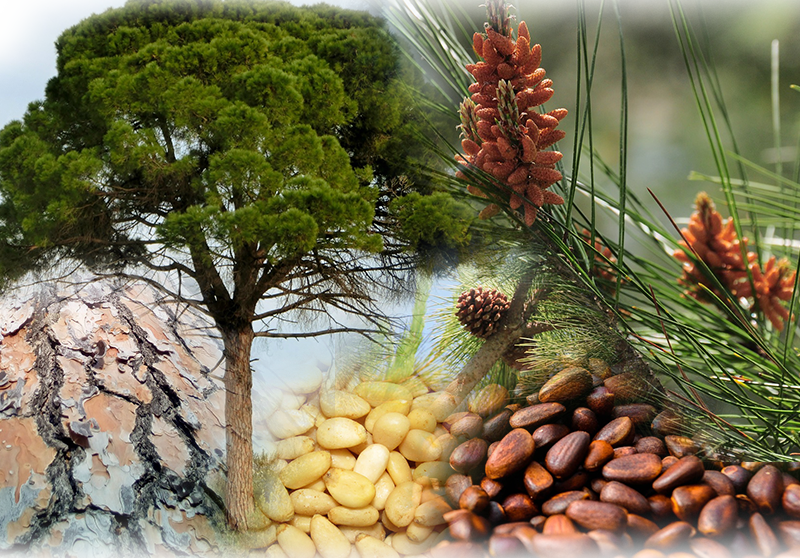
Stone pine
 7
7 6
6 7
7Will it grow where I live?
Stone pine is only hardy to zone 8, so outdoors year-round it needs the mildest spots in Central Europe – wine-growing regions, the Rhine valley, coasts, Lake Constance, Ticino – or a container overwintered under cover. Most of the British Isles and the Pacific coast of North America qualify.
Or check it for your location right here:
Profile
- Family
- Pinaceae
- Habit
- Tree
- Height
- 20 m
- Spread
- 10 m
- Growth
- medium
- Lifespan
- 175 years
- First yield
- after 17 years
- Yield per plant
- up to 60 kg a year
- Yield in cultivation
- up to 1 t/ha
- Energy yield
- 15 kcal per m² a year
- Hardiness
- zone 8–10
- Shade tolerance
- full sun
- Soil
- Sand, Silt
- Soil moisture
- dry – moist
- pH
- 6 – 8
Flowering & harvest
| J | F | M | A | M | J | J | A | S | O | N | D | |
|---|---|---|---|---|---|---|---|---|---|---|---|---|
| Flowering | ||||||||||||
| Fruit harvest |
Uses
Edible: The seed can be consumed raw or cooked, offering a soft texture with a hint of resin in taste, suitable as a delicious snack or staple food. Commonly used in ice cream, cakes, pudding, and various dishes, these seeds can also be ground into powder to thicken and flavor soups and other meals. Measuring up to 20 mm x 10 mm, they serve as a significant source of pine nuts in the market. Additionally, a vanilla aroma can be extracted as a byproduct of other resins released from the pulpwood. Young fir cones can also be ground into powder and utilized as a flavoring agent.
Medicinal: Pine resin-derived turpentine offers various health benefits, acting as an antiseptic, diuretic, rubefacient, and vermifuge. It is used internally for kidney and bladder issues and externally for rheumatic conditions. Additionally, it may aid in respiratory problems such as coughs, colds, and flu. Externally, turpentine can be applied to skin conditions, wounds, burns, and boils using rubs, compresses, herbal steam baths, and inhalers.
Other uses: Pins are the main components of dyes and terpenes extracted from resin and turpentine. Resin is obtained by distilling wood, while turpentine is used as a solvent to produce varnishes and for medical purposes. Rosin is a by-product in the production of turpentine. Pitch is obtained from the resin, and the wood is used for carpentry and furniture making.
Growing
Thrives in well-draining sandy or gravelly loamy soil. Does not tolerate poorly draining moorland soils and shady locations. Established plants withstand drought. Also grows well in calcareous soil. This species is hardy to about -18°C. While sometimes considered somewhat sensitive in this country, it is fully hardy up to the southeast of Scotland. The Italian evergreen oak is extensively cultivated in Europe for its edible seeds. The 'Fragilis' variety has thin-walled seeds and is the most widespread form. Trees take between 10 and 20 years to produce cones from seeds. Plants are highly cross-pollinated, self-fertilized seeds usually grow poorly. This species does not hybridize with other members of this genus. Leaf secretions inhibit seed germination, reducing the number of plants that can grow under the trees. Plants of this genus are particularly susceptible to honey fungus.
Propagation
The stone pine is raised from seed — from the pine nuts themselves. Cones ripen only in the autumn of the third year after flowering, fertilisation following some twenty-four months after pollination; among pines it is a notable late starter. The seeds are large and heavy, with a thousand-grain weight between 500 and 1100 grams, and the wing is merely rudimentary. For sowing, the nuts are freed from opened cones and stratified cool and moist for a few weeks, which makes germination markedly more even. Sow deep, into sandy, free-draining substrate. Seedlings carry ten to twelve cotyledons and form a strong taproot early, so they belong in deep pots and should go to their final position young, since older plants transplant badly. The first cones of their own appear after fifteen to twenty years.
Value for wildlife
The stone pine is wind-pollinated, so its flowering is of no value to bees and hoverflies; it offers no nectar, and the pollen shed in quantity in May is gathered at most as a substitute. Its contribution to wildlife lies elsewhere. The seeds are large, oil-rich and carry only a stunted wing — a clear sign that dispersal falls not to the wind but to birds and rodents, which carry the nuts off and cache them; in Mediterranean stands the cones are a dependable winter food. The structure matters just as much: the broad umbrella crown is in leaf all year and offers cover, shelter from wind and nesting sites at a season when broadleaved trees stand bare. The coarsely fissured, scaly bark of older trunks harbours spiders, beetles and overwintering insects.
Notable
Special features: cones ripen only in the 3rd year, fertilisation ~24 months after pollination; umbrella crown only from ~50 years of age; highly drought-resistant; hardy to -25°C only in dry air, markedly more sensitive in high humidity; taproot - older specimens transplant badly; first cones after 15-20 years; timber resinous+not durable (construction+furniture+masts);
Origin & habitat
The northern Mediterranean: from the Iberian peninsula across southern France, Italy and the Balkans to Anatolia, together with the larger Mediterranean islands. Where the original range ends and cultivation begins can scarcely be separated any more — the stone pine has been grown for its edible seeds since antiquity, spread by Etruscans and Romans, and now stands in extensive stands that go back to planting; the umbrella pines of the Italian coastal landscape are largely planted too. The main growing areas lie in Spain, Portugal, Turkey and Italy. Outside the Mediterranean it is cultivated in California, South Africa and Australia; in Central Europe it thrives outdoors only in vine-growing climates, and otherwise as a container plant.
The stone pine is a warmth-loving, light-demanding tree of low ground near the coast. It occupies dunes, sandy coastal plains, open pine woodland and maquis, and climbs from sea level to about 1000 metres. It prefers fresh, slightly acid to acid sands, but tolerates a wide span from pH 4 to 9 and so also calcareous ground. Annual rainfall at its sites runs between 400 and 800 millimetres; it comes through long summer drought remarkably well thanks to a deep taproot. It will not tolerate shade and loses any competition for light. On coastal dunes it works against sand drift and wind, which is why large stands were deliberately established for coastal stabilisation. To the north winter cold limits its range, particularly in combination with high humidity.
⚠️ Hazards
Wood, sawdust, and resins from various pine species can cause dermatitis in sensitive individuals.
Frequently asked questions
Stone pine: how big does it get?
Stone pine (Pinus pinea) grows as a Tree and reaches roughly 20 m in height when mature, with a spread of about 10 m. Growth is medium.
Stone pine: what site does it need?
Stone pine tolerates full sun. Suitable soils are Sand, Silt. Soil moisture should be in the range dry – moist. The pH may lie between 6 and 8.
Stone pine: is it hardy?
Stone pine is listed as hardy in zone 8–10 and survives normal winters outdoors there.
Stone pine: will it grow in Central Europe?
Stone pine is only hardy to zone 8, so outdoors year-round it needs the mildest spots in Central Europe – wine-growing regions, the Rhine valley, coasts, Lake Constance, Ticino – or a container overwintered under cover. Most of the British Isles and the Pacific coast of North America qualify.
Stone pine: when does it flower?
In a temperate northern-hemisphere climate it flowers in May.
Stone pine: when is it harvested?
In a temperate northern-hemisphere climate the fruit ripens in March.
Stone pine: when does it start cropping, and how much?
Stone pine first crops after 17 years. A mature plant gives up to 60 kg a year, in cultivation up to 1 t per hectare. Figures assume a good site; variety, soil and climate shift them considerably.
Stone pine: is it poisonous?
Individual parts of Stone pine are noted as mildly problematic — the plant does not count as poisonous. With wild plants, never rely on a database alone, only on a confident identification.
Stone pine: what is it used for?
Rated on a scale up to 10: Edible 7/10, Medicinal 6/10, Other uses 7/10.
Plan this plant into your own garden
Permaplans plans your garden to scale on the map — with a site check, harvest calendar and over 1,000 plants. Free for iPhone, Android, Mac, Windows & Linux.
Will this plant grow where you live? → Check your site
Community experience
No first-hand reports for this plant yet.
Growing it? Write in the app what works for you – your post will show up here.
💬 Get the app and join in