
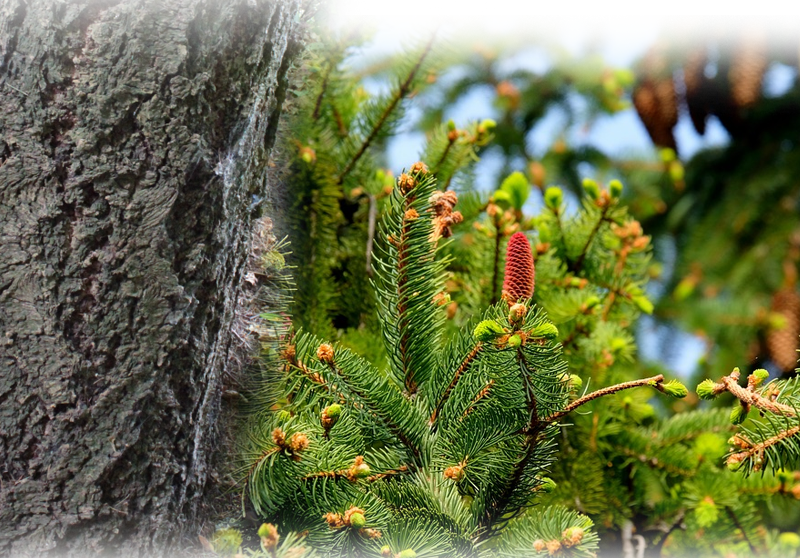
Silver fir
 3
3 7
7 7
7Will it grow where I live?
Silver fir is hardy to zone 5 – that covers all of Central Europe and the British Isles, and every USDA zone from 5 upwards.
Or check it for your location right here:
Profile
- Family
- Pinaceae
- Habit
- Tree
- Height
- 50 m
- Spread
- 14 m
- Growth
- very fast
- Lifespan
- 600 years
- First yield
- after 30 years
- Hardiness
- zone 5–8
- Shade tolerance
- full shade
- Soil
- Sand, Silt, Loam, Clay
- Soil moisture
- semi-dry – very wet
- pH
- 4 – 5.5
- Synonyms
- Tanne
Flowering & harvest
| J | F | M | A | M | J | J | A | S | O | N | D | |
|---|---|---|---|---|---|---|---|---|---|---|---|---|
| Flowering | ||||||||||||
| Fruit harvest |
Uses
Edible: Silver fir is not a food plant in the narrow sense, but it supplies several ingredients from needles, shoots and cones. The pale green May shoots taste resinous and slightly lemony; they are made into syrup, flavoured sugar and liqueur, or scattered fresh over salads. The needles yield a vitamin-bearing tea — Sebastian Kneipp recommended it for coughs. In the 16th and 17th centuries a fir beer was brewed from shoots and needles and regarded as a remedy against scurvy, a pointer to the appreciable vitamin C content of fresh needles. Unripe cones can be boiled down into cone syrup. Templin oil, steam-distilled from the cones, is a fragrance and flavouring rather than a food in its own right. There is no fruit in the horticultural sense; the winged seeds are edible but resinous and of no culinary value.
Medicinal: The buds have antibiotic, antiseptic, and balsamic properties, while the bark is antiseptic and astringent. They can be collected throughout the year as necessary. The leaves act as an expectorant and soothe bronchial passages, ideal for harvesting in spring and drying for future use. The resin possesses various qualities such as being antiseptic, balsamic, diuretic, eupeptic, expectorant, vasoconstrictor, and aiding in wound healing. Commonly found in remedies for colds and coughs, both the leaves and resin can be ingested or used as an inhalant. In traditional medicine, they are used to address conditions like bronchitis, cystitis, leucorrhoea, ulcers, and colic. Externally, the resin is included in bath products and massage oils to alleviate rheumatic pain and neuralgia. Turpentine oil, derived from the tree's trunk, is sometimes a substitute for the leaves or resin and is known for its reddening effect when applied externally to treat neuralgia.
Other uses: An oleoresin is obtained from blister-like thickenings found in the bark, harvested during summer and utilized fresh, dried, or distilled. Commonly known as "Strasbourg turpentine," this resin serves various purposes in perfumery, medicine, and ship sealing. Turpentine oil acts as a crucial solvent in the varnish sector, while the byproduct, referred to as "rosin oil," is integral in manufacturing varnishes, paints, and soot. Extracted in spring from trees aged between 60-80 years, the resin is used for oil distillation. Essential oil derived from the leaves serves as a disinfectant and finds applications in medicine and perfumery, often included in bath products for its distinctive pine fragrance. The bark is a tannin source, and the tree's lightweight, soft, durable, and flexible wood is utilized in construction, furniture making, packaging, pulp production, and various other applications.
Growing
Site: Silver fir is the opposite case to pine — it wants shade, coolness and even soil moisture. As an extremely shade-tolerant species it is one of the few that can be planted under an existing older stand; on open, sun-baked ground it fails. On cold, wet, clayey soils it outperforms every other native tree. Browsing is the decisive factor: roe deer, red deer and chamois prefer fir markedly over spruce and beech, and in many places regeneration fails entirely because of it — without protection, planting in deer country is pointless. It is the most pollution-sensitive native tree and reacts to even low sulphur dioxide concentrations; sites near traffic and industry are out. Allow space: the lateral roots reach up to ten metres beyond the crown edge and frequently fuse with neighbouring trees. Care: Protection against browsing and fraying in the first years is the single most important measure; in winter bark-stripping by red deer is added. Do not fertilise — a closed layer of litter and humus keeping the soil cool and moist matters more. Nor is it pruned: like all firs it does not resprout from old wood, and topping the leader destroys the form permanently. Water during dry spells in the first years; after that the taproot makes it little troubled by drought, though sustained drought stress leaves it open to bark beetles. Watch for fir rust with witches' brooms, needle cast in damp young stands, honey fungus on weakened roots, and the introduced silver fir woolly adelgid; cut out and remove affected shoots.
Propagation
Aussaat – Anfang Februar im Gewächshaus oder im März im Freien. Die Keimung verläuft oft ungleichmäßig und dauert in der Regel 6–8 Wochen. Eine Stratifizierung soll die Keimung verbessern, daher empfiehlt es sich, die Samen im Herbst, sobald sie reif sind, im Frühbeet auszusäen. Bei guter Lagerung bleiben die Samen bis zu 5 Jahre keimfähig. Sobald die Sämlinge groß genug sind, werden sie in einzelne Töpfe pikiert und mindestens den ersten Winter im Topf weiterkultiviert. Im späten Frühjahr oder frühen Sommer, nach den letzten Frösten, werden sie an ihren endgültigen Standort gepflanzt. Alternativ kann bei ausreichend Saatgut auch direkt im Freiland ausgesät werden. Eine Quelle empfiehlt die Anzucht im Schatten mit einer Dichte von etwa 550 Pflanzen pro Quadratmeter, während eine andere Quelle einen sonnigen Standort bevorzugt.
Value for wildlife
Silver fir carries a rich attendant flora and fauna, but it also has a problem with wildlife. It serves as a caterpillar food plant for the pine looper, pine lappet, nun moth, pine arches and pine beauty, among others — species feared in commercial forestry during outbreaks, but on a garden scale chiefly a source of bird food. Below ground it is tied into an unusually broad mycorrhizal network: chanterelle and trumpet chanterelle, man-on-horseback, waxcaps, russulas and milkcaps belong to it as much as boletes and numerous webcaps. Its dense evergreen crowns offer cover, roosting and nesting sites all year, particularly in winter when broadleaves stand bare; old trees with cavities and white rot are habitat for woodpeckers and bats. The fir mistletoe, spread by birds, lives on it as a hemiparasite. Browsing is the other side of the coin: roe deer, red deer and chamois prefer young fir so strongly that regeneration fails entirely in many places.
Notable
Special features: prefers cool, moist climates protected from late frosts, initially grows slowly in the shade; later, rapid growth; roots 10m deep; after 60 years, the resin harvest begins. Very popular with game! Sensitive to air pollution; honeydew for bees; ~1.6% of German forests; 1400kWh/m²; 4.4kWh/kg
Origin & habitat
Central and southern Europe. The range largely matches the European mountain systems: from the Pyrenees across the Alps, the Swiss Jura, the Black Forest and the Thuringian Forest into Lower Lusatia, eastwards across the whole arc of the Carpathians, southwards into the Balkan peninsula, the southern foothills of the Apennines and Corsica; the northern limit runs south of Warsaw. Elevation rises markedly from north to south: in the Thuringian Forest and Fichtelgebirge the centre lies around 800 metres, in the Maritime Alps at 2100, in the Pirin mountains up to 2900. Only in the north-east of the range does it descend into the lowlands. In Germany it holds 1.7 per cent of the forest area and is red-listed; in Switzerland, by contrast, over twelve per cent.
Silver fir is a climax tree of the montane and subalpine belt and tolerates deep shade as no other native tree does — young plants survive decades of suppression without lasting damage and resume normal growth once released. Its typical communities are fir-beech woods in oceanic areas and spruce-fir woods of the mountain belt; pure fir stands arise only under extreme conditions. It grows on fresh, cool, humus-rich, stony loamy soils over both limestone and silicate and copes even with gleyed subsoil — a good water supply matters more to it than a good nutrient supply. The pre-emergent taproot opens up one and a half to three metres of soil depth. It requires an oceanic to moderately continental climate with at least three frost-free months and is sensitive to late frost and frost drought.
⚠️ Hazards
Mucous membrane irritation from essential oils The essential oils from needles and cones — particularly the templin oil distilled from the cones — irritate skin and mucous membranes in concentrated form and are applied only diluted. Conifer essential oils do not belong in the eyes or near infants and small children, in whom they can trigger spasms of the airways. The needles, young shoots and cones themselves are not toxic.
Frequently asked questions
Silver fir: how big does it get?
Silver fir (Abies alba) grows as a Tree and reaches roughly 50 m in height when mature, with a spread of about 14 m. Growth is very fast.
Silver fir: what site does it need?
Silver fir tolerates full shade. Suitable soils are Sand, Silt, Loam, Clay. Soil moisture should be in the range semi-dry – very wet. The pH may lie between 4 and 5.5.
Silver fir: is it hardy?
Silver fir is listed as hardy in zone 5–8 and survives normal winters outdoors there.
Silver fir: will it grow in Central Europe?
Silver fir is hardy to zone 5 – that covers all of Central Europe and the British Isles, and every USDA zone from 5 upwards.
Silver fir: when does it flower?
In a temperate northern-hemisphere climate it flowers from May to June.
Silver fir: when is it harvested?
In a temperate northern-hemisphere climate the fruit ripens in October.
Silver fir: is it poisonous?
No toxicity is recorded for Silver fir. With wild plants, never rely on a database alone — only on a confident identification.
Silver fir: what is it used for?
Rated on a scale up to 10: Edible 3/10, Medicinal 7/10, Other uses 7/10.
Plan this plant into your own garden
Permaplans plans your garden to scale on the map — with a site check, harvest calendar and over 1,000 plants. Free for iPhone, Android, Mac, Windows & Linux.
Will this plant grow where you live? → Check your site
Community experience
No first-hand reports for this plant yet.
Growing it? Write in the app what works for you – your post will show up here.
💬 Get the app and join in