
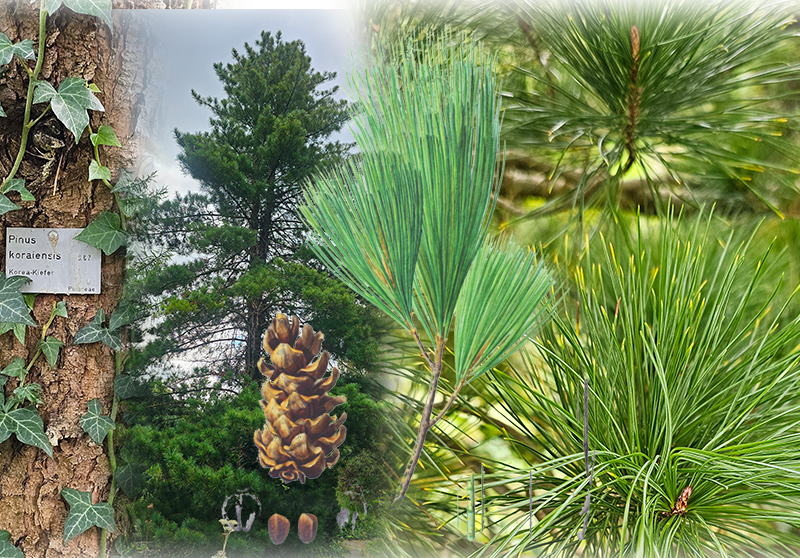
Korean pine
 6
6 7
7 7
7Will it grow where I live?
Korean pine is hardy to zone 5 – that covers all of Central Europe and the British Isles, and every USDA zone from 5 upwards.
Or check it for your location right here:
Profile
- Family
- Pinaceae
- Habit
- Tree
- Height
- 24 m
- Spread
- 10 m
- Growth
- medium
- Lifespan
- 500 years
- First yield
- after 5 years
- Yield per plant
- up to 15 kg a year
- Hardiness
- zone 5–8
- Shade tolerance
- full sun
- Soil
- Sand, Silt
- Soil moisture
- dry – moist
- pH
- 4 – 7
- Synonyms
- Koreakiefer
Flowering & harvest
| J | F | M | A | M | J | J | A | S | O | N | D | |
|---|---|---|---|---|---|---|---|---|---|---|---|---|
| Flowering | ||||||||||||
| Fruit harvest |
Uses
Edible: Seeds can be consumed raw or cooked and are high in oil content. They have a soft texture with a slight resinous flavor, making them a tasty snack and a flexible cooking ingredient. The seeds, which can be quite large, up to 16 mm x 12 mm, can also be dried and powdered to add flavor and thickness to soups. Additionally, a vanillin taste is produced as a secondary product of the resins released from the pulpwood.
Medicinal: Stomach. Translate the remaining text into English, restructuring it for better clarity. The stomach, situated in the upper abdomen, is a vital component of the digestive system responsible for food digestion. Through the production of gastric acid and enzymes, it aids in food breakdown before passing the digested food to the intestines for nutrient absorption. Maintaining a healthy diet is crucial to prevent stomach issues such as heartburn, ulcers, and gastritis. If stomach problems persist, seeking medical advice is recommended.
Other uses: Pine needles yield a light brown or green dye, while the seeds provide soap and lubricating oil. Tannin is obtained from the bark, and the needles contain terpene, which can hinder the germination of certain plants like wheat when washed by rain. Pine can also yield turpentine and tar. Although oleoresins are found in all pine species, their extraction may not always be cost-effective due to insufficient quantities. Turpentine, comprising around 20% oleoresin, is obtained through distillation and serves various purposes such as a solvent, in varnishes, and medicinal products. Residue from turpentine, known as rosin, is utilized by violinists and in making sealing wax and varnishes. Additionally, resin can be processed into pitch for waterproofing, wood preservation, among other uses. Pine wood is commonly used in construction, bridges, vehicles, furniture, and pulp production.
Growing
Thrives in well-drained sandy or gravelly loam soils. Does not tolerate poorly drained moorland soils. Established plants tolerate drought and prefer a cool, moist climate. The leaf secretions inhibit seed germination, hindering the growth of other plants under the tree. Sometimes cultivated for its edible seeds, this species has various named cultivars. It is a primary species for its edible seeds, harvested from both cultivated and wild trees. Large quantities of seeds are exported from northern China for food. Young trees have slow growth rates. While growth is generally poor in southeastern regions, trees in the west and north thrive, showing average annual height gains of about 25 cm and girth gains of 3 cm or more. Highly cross-pollinated, plants of this species have poor growth from self-pollinated seeds. They readily cross with other genus members. The seeds are extracted by breaking the soft scales of the cone since the cones do not open. This genus is highly susceptible to the honey fungus.
Propagation
Sow seeds right after maturity in separate pots in a cool environment or in late winter. A brief 6-week stratification at 4°C can enhance germination. Transfer seedlings to their final spot promptly and shield them for the initial winter or two due to their sparse root system. For optimal growth, plant trees when they are small, around 30-90 cm, ideally at 5-10 cm height. Ensure a good weed mulch for successful establishment. Larger trees need heavy pruning and show minimal growth initially, impacting root development and wind resistance. Cuttings are suitable for trees under 10 years old, using leaf fascicles from short shoots. Budding shoots before taking cuttings may be beneficial, but cuttings typically grow slowly.
Notable
Special features: prefers cold, humid climates, tolerates drought; cultivated in Korea and the Russian-Asiatic region for its nuts; bears fruit from 3.5 meters in height; mixes with other species such as Pinus cembra (Swiss pine), Pinus pinea (stone pine), and Pinus sibirica (Siberian cedar); roots are sensitive, plant plants in their final location when they are 5-10 cm tall.
Origin & habitat
East Asia - China, Korea, Manchuria, Siberia.
Dry slopes, deep, moist, fertile, well-drained soils in valleys and lowlands.
⚠️ Hazards
Pine wood, sawdust, and resins from different pine species can trigger skin irritation in individuals with sensitivity.
Frequently asked questions
Korean pine: how big does it get?
Korean pine (Pinus koraiensis) grows as a Tree and reaches roughly 24 m in height when mature, with a spread of about 10 m. Growth is medium.
Korean pine: what site does it need?
Korean pine tolerates full sun. Suitable soils are Sand, Silt. Soil moisture should be in the range dry – moist. The pH may lie between 4 and 7.
Korean pine: is it hardy?
Korean pine is listed as hardy in zone 5–8 and survives normal winters outdoors there.
Korean pine: will it grow in Central Europe?
Korean pine is hardy to zone 5 – that covers all of Central Europe and the British Isles, and every USDA zone from 5 upwards.
Korean pine: when does it flower?
In a temperate northern-hemisphere climate it flowers in May.
Korean pine: when is it harvested?
In a temperate northern-hemisphere climate the fruit ripens in August.
Korean pine: when does it start cropping, and how much?
Korean pine first crops after 5 years. A mature plant gives up to 15 kg a year. Figures assume a good site; variety, soil and climate shift them considerably.
Korean pine: is it poisonous?
No toxicity is recorded for Korean pine. With wild plants, never rely on a database alone — only on a confident identification.
Korean pine: what is it used for?
Rated on a scale up to 10: Edible 6/10, Medicinal 7/10, Other uses 7/10.
Plan this plant into your own garden
Permaplans plans your garden to scale on the map — with a site check, harvest calendar and over 1,000 plants. Free for iPhone, Android, Mac, Windows & Linux.
Will this plant grow where you live? → Check your site
Community experience
No first-hand reports for this plant yet.
Growing it? Write in the app what works for you – your post will show up here.
💬 Get the app and join in