
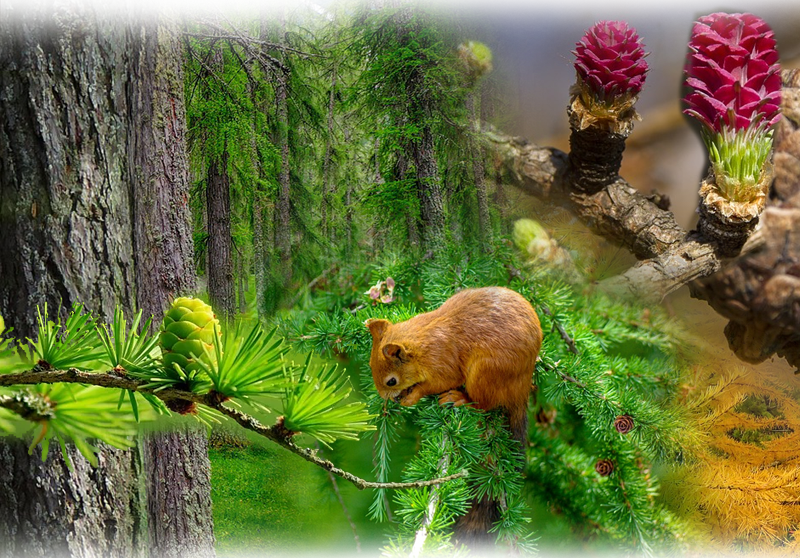
European larch
 3
3 7
7 8
8Will it grow where I live?
European larch is hardy to zone 3 – that covers all of Central Europe and the British Isles, and every USDA zone from 3 upwards.
Or check it for your location right here:
Profile
- Family
- Pinaceae
- Habit
- Tree
- Height
- 47.5 m
- Spread
- 16 m
- Growth
- very fast
- Lifespan
- 500 years
- First yield
- after 14 years
- Hardiness
- zone 3–7
- Shade tolerance
- full sun
- Soil
- Sand, Silt
- Soil moisture
- semi-dry – very moist
- pH
- 5.5 – 7
- Synonyms
- Lärche
Flowering & harvest
| J | F | M | A | M | J | J | A | S | O | N | D | |
|---|---|---|---|---|---|---|---|---|---|---|---|---|
| Flowering | ||||||||||||
| Fruit harvest |
Uses
Edible: The tree's inner bark is edible raw or dried, and can be ground into powder for bread-making with grain flour. A sweet manna is obtained from the trunk for consumption or medicinal purposes. Another sweet manna, known as 'Briancon Manna,' is said to be produced from the leaves during summer, being white, sweet, and nearly odorless.
Medicinal: The leaves of the plant have a laxative and choleretic effect similar to tobacco, making them useful in treating nicotinism. However, caution is advised as the plant is highly toxic and should only be taken internally under professional supervision.
Other uses: The larch yields the most durable timber of any Central European conifer. Resin-rich, tough, elastic and easy to split, it stays weatherproof for decades without chemical treatment and resists woodworm — it is used for facade cladding and shingles, in hydraulic and bridge engineering, for boat planking, windows, stairs and garden furniture. The second raw material is the resin: from holes bored obliquely through the centre of the trunk flows larch turpentine, once collected on a large scale for varnishes, lacquers, wood preservatives and ointments; a hole once made yields for decades. The bark contains around eleven percent tannin and served the tanning trade. In forestry it is used as a fast-growing, deep-rooting pioneer on clear-felled ground and raw soils, where it quickly provides shelter and litter and prepares the site for the tree species that follow.
Growing
Site: The larch tolerates no shading — under older trees or against a north wall it dies; it needs an open, fully sunlit position. There it grows to thirty or forty metres with a trunk over a metre thick, which makes space the real question of site. Its heart-root system makes it notably windfirm and suitable as a free-standing specimen, and because root wounds resin over quickly the risk of root rot is low. Two situations are best avoided: hot, summer-dry lowlands where it comes under drought stress, and mild oceanic districts where larch canker regularly strikes. In cities with heavy air pollution it stays stunted. The fine needle cover drops completely in autumn, blocks gutters and slightly acidifies the surface soil. Care: Plant small — two- or three-year-old stock establishes fast and overtakes large nursery trees within a few years. In the first years game is the main problem: roe deer fray the smooth young stems and hares gnaw the bark in winter, so fit a guard or wire sleeve. Water only while establishing and in drought years, and do not feed at all. What matters most is not to prune: larches do not break from old wood, and any cut into a living branch causes heavy resin bleeding — remove dead branches only, and do that in late winter. The larch leaf miner turns the needles silvery grey in June, which looks poor and does no harm; the larch budmoth appears cyclically at altitude. Branches affected by larch canker are cut back into sound wood.
Propagation
Sow seeds in pots during late winter in a cool environment. Cold stratification for a month aids germination. Seedlings should be given light shade in their first year and later transplanted into individual pots. When they reach a few centimeters in height, they can be transferred to their permanent spots in summer. Ensure proper weed mulching and possibly winter protection in their initial year. Alternatively, cultivate them in a cold environment during the first winter and relocate them in early summer the next year. Seeds will remain viable for up to three years. For larger plant quantities, sow seeds in an outdoor seedbed in late winter. Allow seedlings to mature in the seedbed for a few years before moving them to their final spots, planting them in winter.
Value for wildlife
The larch is wind-pollinated and offers neither nectar nor appreciable bee pollen — its value to wildlife lies elsewhere. Eighteen species of butterfly and moth caterpillar feed on it, six of them exclusively, along with two beetle species bound to it; the larch budmoth is the best known of these specialists and, in the Alps, a cyclically irrupting part of the ecosystem. The small winged seeds are winter food for common crossbill, siskin and tits, which break the little cones open. Beyond that it is a favoured nesting and perching tree, and old specimens supply cavities and deadwood. Its quietest contribution is mycorrhizal: at the foot of a larch grow the larch bolete, the hollow-stemmed bolete and the grey and orange larch boletes, several fungi that do not occur without it — a whole set of species hanging on this one tree.
Notable
Special features: avalanche + weather + erosion protection, forest preparation; tolerates extreme temperatures, but no air pollution; e.g. professional resin harvest: drilling 50-80cm deep, 3cmØ for 80-120 year old trees diagonally downwards through the middle of the trunk towards the main root; around 200-370g/tree/year possible for 10-15 years; 2.9% of the German forest, BW = 1700kWh/rm, 4.4kWh/kg;
Origin & habitat
Mountains of Central Europe: the Alps, the Sudetes and the Western Carpathians. The range falls into three separate parts — the common European larch in the Alps and Sudetes, the Carpathian larch in the eastern and southern Carpathians, and the Polish larch with an outlying occurrence on the Polish and North German lowland. In the Central and Eastern Alps it climbs to 2,500 metres and helps form the upper treeline. Contrary to a widespread claim, its natural range does not extend to northern Russia or Siberia; those regions hold the separate Siberian and Dahurian larches. In forestry it has been planted for centuries far outside its home range, in the Central European uplands and lowlands, where increasing summer drought is now causing it considerable trouble.
The larch is the light-demanding tree of the upper montane to subalpine belt and in its core range is tied to a subcontinental mountain climate: cold snowy winters and short summers that are not too humid. It forms woodland above all together with spruce, occurs in pine and mountain-pine forests, and with the Swiss stone pine makes up the larch-arolla forest at the upper treeline. Its nutrient demands are low to moderate and it prefers loamy soils; it grows on limestone as well as silicate and takes fresh to moderately dry, often stony ground. As the only native conifer to do so it sheds its needles in autumn and thereby escapes the winter desiccation that kills evergreen conifers in such exposed positions. It withstands minus forty degrees as readily as high summer heat, but as a strict light-demander it cannot survive under a canopy.
⚠️ Hazards
Skin irritation on contact Larch resin contains resin acids that can cause redness and irritation on sensitive skin; those affected are mainly people with prolonged contact while pruning or tapping. Fresh resin comes off with oil, not with water. Needles, bark and cones are non-toxic.
Frequently asked questions
European larch: how big does it get?
European larch (Larix decidua) grows as a Tree and reaches roughly 47.5 m in height when mature, with a spread of about 16 m. Growth is very fast.
European larch: what site does it need?
European larch tolerates full sun. Suitable soils are Sand, Silt. Soil moisture should be in the range semi-dry – very moist. The pH may lie between 5.5 and 7.
European larch: is it hardy?
European larch is listed as hardy in zone 3–7 and survives normal winters outdoors there.
European larch: will it grow in Central Europe?
European larch is hardy to zone 3 – that covers all of Central Europe and the British Isles, and every USDA zone from 3 upwards.
European larch: when does it flower?
In a temperate northern-hemisphere climate it flowers in April.
European larch: when is it harvested?
In a temperate northern-hemisphere climate the fruit ripens in October.
European larch: is it poisonous?
No toxicity is recorded for European larch. With wild plants, never rely on a database alone — only on a confident identification.
European larch: what is it used for?
Rated on a scale up to 10: Edible 3/10, Medicinal 7/10, Other uses 8/10.
Plan this plant into your own garden
Permaplans plans your garden to scale on the map — with a site check, harvest calendar and over 1,000 plants. Free for iPhone, Android, Mac, Windows & Linux.
Will this plant grow where you live? → Check your site
Community experience
No first-hand reports for this plant yet.
Growing it? Write in the app what works for you – your post will show up here.
💬 Get the app and join in