
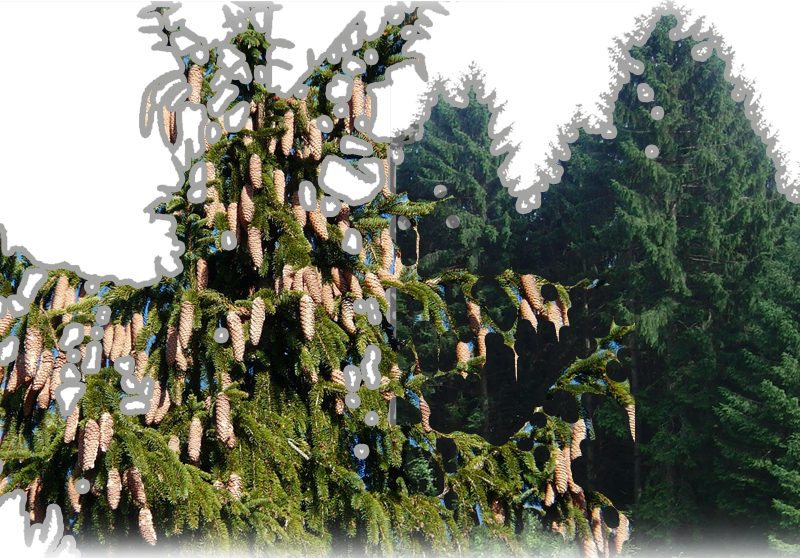
Norway spruce
 3
3 7
7 7
7Will it grow where I live?
Norway spruce is hardy to zone 3 – that covers all of Central Europe and the British Isles, and every USDA zone from 3 upwards.
Or check it for your location right here:
Profile
- Family
- Pinaceae
- Habit
- Tree
- Height
- 40 m
- Spread
- 14 m
- Growth
- very fast
- Lifespan
- 600 years
- First yield
- after 30 years
- Hardiness
- zone 3–7
- Shade tolerance
- light shade
- Soil
- Sand, Silt, Loam
- Soil moisture
- semi-dry – very wet
- pH
- 4 – 7
- Synonyms
- Fichte
Flowering & harvest
| J | F | M | A | M | J | J | A | S | O | N | D | |
|---|---|---|---|---|---|---|---|---|---|---|---|---|
| Flowering | ||||||||||||
| Fruit harvest |
Uses
Edible: Male catkins are utilized for flavoring, while unripe female cones can be boiled. The roasted central part of the cones has a sweet and syrupy taste. The inner bark, when dried and ground into powder, acts as a thickening agent in soups or bread-making. Additionally, it can serve as emergency food. The seeds are edible raw, containing rich oil with a slightly resinous flavor. Young shoots can be brewed into a vitamin C-rich tea, and they are also employed in spruce beer production.
Other uses: The tree produces Burgundy pitch and Jurassic turpentine, both extracted by making cuts in the trunk and scraping out the resin months later. Burgundy pitch is used in varnishes, medicinal plasters, and as a strong adhesive, while Jurassic turpentine serves as an impregnating agent and wood preservative. An essential oil from the leaves is utilized in perfumery, and the seed contains 30% fixed oil for varnish production. The bark, rich in tannin, was historically used as a tannin source in Europe, with up to 13% tannin content. Heating or steaming the bark immediately after felling doubled the tannin yield. The tree, known for its wind resistance and fast growth, is often planted in shelterbelts for wind protection. Dwarf varieties like 'Inversa,' 'Reflexa,' and 'Procumbens' can be grown as ground cover in sunny areas. The wood, valued for its medium-hardness, elasticity, water resistance, light color, and weight, is used in joinery, musical instruments, and paper production in the pulp industry.
Growing
Site: The decisive factor is the root plate: it stays shallow, especially on compacted or waterlogged ground, and makes spruce the most frequently windthrown species in Central Europe. It must therefore not stand where it could fall towards house, power line or seating area. At 25 to 40 metres final height it is almost always too large as a garden specimen; as a shelter hedge planted one to one and a half metres apart it is very effective and gives cover and nesting sites in winter, when every leaf has fallen. The needle litter acidifies the soil, so only acid-tolerant plants thrive beneath the crown. In warm, dry lowlands it is in the wrong place. Care: Plant root-balled stock in autumn or early spring and water thoroughly in the first years; water demand stays high all year. Do not feed, which only encourages soft growth. As a hedge, cut annually in June into the current year's growth; never cut into old, needleless wood, because spruce does not reshoot from it and bare patches stay bare permanently. Summer drought leaves it open to the European spruce bark beetle and the engraver beetle, so remove infested trunks quickly and do not leave them lying with the bark on. Roe and red deer fray young stems, so browsing protection pays. Mind the provenance: high-altitude seed grows poorly in the lowlands.
Propagation
Spruce is raised from seed. The cones ripen in their first year and open from October; harvest them once brown, after which drying in a warm room releases the seed. Cold stratification is not essential but improves evenness and speed: four to six weeks moist at about four degrees, then sow in spring. Alternatively, sow fresh seed in autumn and let it overwinter outdoors. Sow shallowly, barely covered, on acid to neutral humus-rich substrate; the seedlings need partial shade in the first year and must never dry out. Prick out after two years and plant out after three to four. Cuttings root poorly, which is why dwarf and ornamental forms are sold grafted. Watch the provenance: seed from high altitudes grows slowly in the lowlands, while lowland provenances are killed by frost in the mountains.
Value for wildlife
Norway spruce supports fewer insects than native broadleaved trees, but it is by no means worthless. 28 moth and butterfly species feed on the needles as caterpillars, 16 of them exclusively on spruce, and there are 26 beetle and nine hoverfly species besides. The flowers offer no nectar but large amounts of pollen in May; economically more important is the honeydew of the spruce bark aphids, from which bees bring in dark forest honey. The real value lies in the structure: the dense evergreen crown gives cover and shelter all year round, at the season when broadleaved trees stand bare. Common crossbill, treecreeper, nutcracker and jay, goldcrest, sparrowhawk, long-eared owl and tawny owl breed or hunt here, the black woodpecker works on bark beetle larvae, and red deer and wild boar use the dim light as daytime cover. Ecologically valuable, however, are structurally rich mixed stands rather than even-aged monocultures.
Notable
Special features: Grows on impoverished, compacted, moist, acidic soils (moorland edge → high mountains → -60°C). Stands trap cold air/fog; susceptible to wind and pests; as a hedge, it provides good wind protection; grows so quickly that it produces 2-3 times more wood mass than beech, always maintaining an upright growth. ~28% of German forests; 1500 kWh/m³; 4.5 kWh/kg
Origin & habitat
Northern, eastern and central Europe to Siberia. The natural range covers almost all of Europe apart from Ireland, Great Britain and the Iberian Peninsula and extends far into continental Asia, with its centres in Scandinavia, the Baltic states, Belarus, Poland, the Carpathians and the Balkans. Southwards the spruce becomes a purely montane tree, rising to the treeline at about 950 metres in the Harz, 2200 metres in Valais and 2460 metres in the Allgäu Alps. Decisive for planning is the difference between natural and planted range: in Germany spruce would naturally form part of the forest only in the mountain woodlands of the Alps and the highest uplands. Its present extent of 2.3 million hectares is the result of forestry planting, in many cases on unsuitable sites.
Norway spruce is a tree of cold-winter continental and montane climates and, as an indicator of cool conditions, depends on an adequate water supply all year. It occupies fresh to moderately fresh, well-aerated soils with a moder humus layer and manages on a low nutrient supply as long as moisture is present. It grows best on sandy to loamy weathered soils over silicate rock, on deeply loamy sands and on mild glacial till. Its roots are markedly dependent on soil air: on compacted, waterlogged or oxygen-poor ground it stays shallow-rooted and thus vulnerable to windthrow. On shallow limestone sites it shows needle discolouration and tends to red rot, and on floodplain soils it fails altogether. Naturally it forms montane mixed forest with beech and silver fir and only becomes dominant in pure stands at high altitude and along bog margins.
Frequently asked questions
Norway spruce: how big does it get?
Norway spruce (Picea abies) grows as a Tree and reaches roughly 40 m in height when mature, with a spread of about 14 m. Growth is very fast.
Norway spruce: what site does it need?
Norway spruce tolerates light shade. Suitable soils are Sand, Silt, Loam. Soil moisture should be in the range semi-dry – very wet. The pH may lie between 4 and 7.
Norway spruce: is it hardy?
Norway spruce is listed as hardy in zone 3–7 and survives normal winters outdoors there.
Norway spruce: will it grow in Central Europe?
Norway spruce is hardy to zone 3 – that covers all of Central Europe and the British Isles, and every USDA zone from 3 upwards.
Norway spruce: when does it flower?
In a temperate northern-hemisphere climate it flowers from May to June.
Norway spruce: when is it harvested?
In a temperate northern-hemisphere climate the fruit ripens in November.
Norway spruce: is it poisonous?
No toxicity is recorded for Norway spruce. With wild plants, never rely on a database alone — only on a confident identification.
Norway spruce: what is it used for?
Rated on a scale up to 10: Edible 3/10, Medicinal 7/10, Other uses 7/10.
Plan this plant into your own garden
Permaplans plans your garden to scale on the map — with a site check, harvest calendar and over 1,000 plants. Free for iPhone, Android, Mac, Windows & Linux.
Will this plant grow where you live? → Check your site
Community experience
No first-hand reports for this plant yet.
Growing it? Write in the app what works for you – your post will show up here.
💬 Get the app and join in