
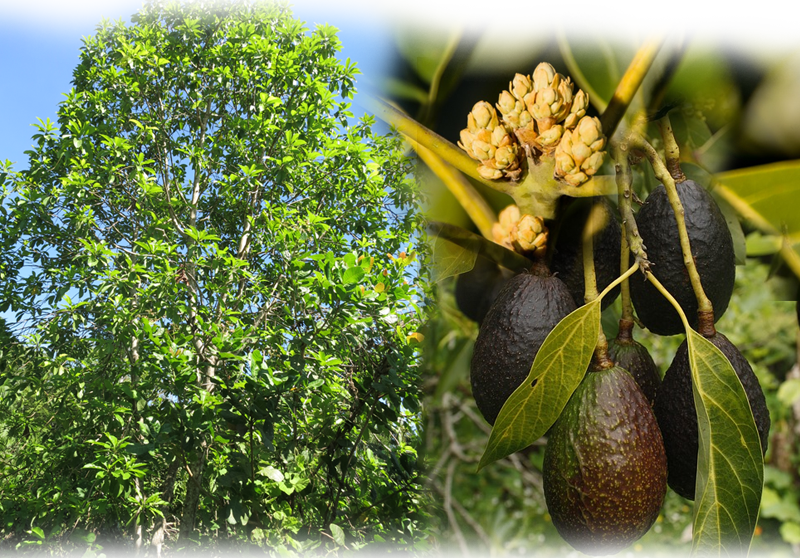
Avocado
 9
9 8
8 6
6Will it grow where I live?
Avocado is not winter-hardy in Central Europe (zone 10): outdoors from spring to autumn only, otherwise a container plant overwintered frost-free. It also needs warm summers – in Central Europe that means wine-growing regions, cities or a sheltered south-facing wall.
Or check it for your location right here:
Profile
- Family
- Lauraceae
- Habit
- Tree
- Height
- 12.5 m
- Spread
- 15 m
- Growth
- very fast
- Lifespan
- 70 years
- First yield
- after 5 years
- Full yield
- after 10 years
- Yield per plant
- up to 40 kg a year
- Yield in cultivation
- up to 7 t/ha
- Energy yield
- 800 kcal per m² a year
- Hardiness
- zone 10–12
- Shade tolerance
- full sun
- Soil
- Silt, Loam, Clay
- Soil moisture
- semi-dry – very wet
- pH
- 6 – 7
- Synonyms
- ZD
- Planned in gardens
- 3×
Flowering & harvest
| J | F | M | A | M | J | J | A | S | O | N | D | |
|---|---|---|---|---|---|---|---|---|---|---|---|---|
| Flowering | ||||||||||||
| Fruit harvest |
Varieties (15)
15 varieties of Avocado are listed in the Permaplans variety finder — each with its own page: taste, ripening time, disease resistance, parentage and use.
- Bacon Cold-tolerant green-skinned early cultivar with mild, light flesh – ideal for cooler sites.
- Choquette Very large, glossy-green Florida avocado with mild, juicy and low-oil flesh.
- Ettinger Israeli green-skinned early cultivar with glossy skin – an important commercial and pollenizer variety.
- Fuerte The classic green-skinned winter benchmark with thin skin and mild, buttery flesh.
- Gwen Hass-like but green-skinned cultivar on a compact tree with excellent, rich flavour.
- Hass The creamy world-standard avocado with nutty flavour and thick, storable pebbly skin.
- Lamb Hass Late, high-yielding Hass successor on a compact tree – more heat- and sunburn-tolerant.
- Mexicola Extremely cold-hardy small Mexican avocado with thin, edible skin and intense flavour.
- Monroe Large, firm Florida avocado for the late season – low in oil and holds long on the tree.
- Nabal Large, nearly round green summer avocado with firm, mild flesh and a small seed.
- Pinkerton Elongated pear-shaped cultivar with small seed and lots of creamy flesh – high yielding in the kitchen.
- Reed Large, round summer avocado with thick green skin and especially rich, creamy flesh.
- Sharwil Australian-Hawaiian gourmet cultivar with especially high oil content and intensely nutty flavour.
- Wurtz The only true dwarf avocado – ideal for containers and small gardens, bearing green fruit.
- Zutano Hardy, cold-tolerant green-skinned cultivar prized mainly as a reliable pollenizer.
Uses
Edible: It is the flesh that is eaten, raw. It is the fattiest of the common fruits and tastes mild and nutty; cooking turns it bitter, which is why it is added to dishes only at the end. It is used as a spread and as guacamole, in salads, pureed in dressings, in soups and smoothies, and in Central and South America in ice cream and desserts as well. Ripeness decides everything: the avocado does not ripen on the tree, it is picked hard and ripens afterwards — indoors, hastened by an apple or banana in the same bag. It is ripe when it yields slightly to thumb pressure. Cut fruit browns quickly through enzyme action, which lemon juice delays. The leaves of the Mexican race serve dried or roasted as an aniseed-like spice, the ground seeds as an additive and infusion.
Other uses: Besides the fruit the avocado chiefly supplies oil. Avocado oil pressed from the flesh is a base material of the cosmetics and pharmaceutical industries and goes into skin creams, hair care and ointment bases; cold-pressed it is also a culinary oil. The leaves of the Mexican race smell and taste of aniseed and are used in Mexico fresh or roasted as a spice. A red-brown dye can be obtained from the ground stone, once used for dyeing textiles and colouring cheese. The wood is rarely used: it is brittle, not durable and prone to termite attack, but serves for simple building, furniture, carving and veneer. About a third of the fruit weight is skin and stone and thus arises as residue — one reason why the use of stone flour and stone pigment is attracting attention again.
Growing
Site: In Central Europe the avocado is a container plant — none of the three races is frost-hardy, the Mexican tolerates slight frost briefly, the West Indian none at all. The summer position is bright, sunny, warm and sheltered from wind; at least 2000 hours of sunshine a year is the benchmark. The substrate decides between success and failure: loose, free-draining, slightly acid, low in salt — if in doubt, citrus or cactus compost with plenty of coarse material added. Waterlogging leads within weeks to root rot from Phytophthora cinnamomi, the most important disease of the species. Where it is planted out, allow six to ten metres between trees. Because of the persin contained throughout the plant it does not belong within reach of small pets, cage birds or grazing livestock; the falling leaves are the real problem here, not the fruit. Care: Water generously but never into a standing saucer — the avocado needs plenty of water and air at the roots at the same time. Use low-lime water; it answers lime with chlorosis. Feed weakly every fortnight from April to September, not at all in winter. Overwinter bright at ten to fifteen degrees; in a warm living room it drops its leaves when light is short. The young tree grows lanky and is forced to branch by shortening the leading shoot to about thirty centimetres — without that cut you get a single bare stick. Repot every two to three years into only a moderately larger pot. Spider mites and scale insects are the typical pests of dry indoor air. Seed-grown plants often flower only after about ten years; anyone wanting a crop needs a grafted plant.
Propagation
The avocado can be raised from the stone, though in commercial growing it is exclusively grafted. The stone germinates in four to six weeks depending on temperature; lay it half-buried horizontally in moist substrate or suspend it point upwards over water, the substrate method giving the stronger roots. Fresh stones germinate markedly better than dried-out ones, and warmth of around twenty-five degrees matters more than light. Seedlings grow vigorously but do not come true: they bear fruit of different size, oil content and ripening time from the mother tree, and they flower only after some ten years. In cultivation, therefore, scions are grafted onto seedling rootstocks, usually as whip or side grafts on pencil-thick stocks in spring; grafted trees bear in their second year. On moist soils the choice of rootstock decides tolerance of Phytophthora.
Value for wildlife
The avocado depends on insect pollination and is unusually arranged for it. Its flowers are hermaphrodite but pass through two separate sexual phases: in type A they are female on the morning of the first day and male from midday of the second, in type B exactly the reverse. This intrafloral dichogamy hinders self-pollination but leaves one to three hours of daily overlap. The main pollinators are bees and wasps, alongside flies and other insects. The 2015 US pollination report rates the avocado as attractive to honey bees for both nectar and pollen, and likewise to solitary bees; pollination is strictly required for a crop. In Central Europe none of this matters outdoors, since the species stands in a container here and rarely flowers. The other side must be kept in mind: the persin contained throughout the plant is toxic to many mammals and birds — the avocado is not a wildlife plant but a crop with a pollinator requirement.
Notable
Special: Used for ~10,000 years + domesticated at least three times independently — the wild stones were far smaller, today's stone size is a breeding result; one tree can carry up to 500 fruits (~100kg); 33% of the fruit weight is skin+stone; flower type A ('Hass') + B ('Fuerte', 'Bacon') → markedly better set when planted mixed; 'Hass' is the most widely grown cultivar worldwide.
Origin & habitat
Central America and southern Mexico. The tree comes from the warm, humid tropical forests between southern Mexico and Central America and has been used there for some ten thousand years; finds from the Tehuacán valley document cultivation by the Coxcatlán culture. The species was domesticated at least three times independently. Today the avocado is grown throughout the tropics and subtropics, led by a wide margin by Mexico with about 2.76 million tonnes, followed by Colombia with 1.27 million, the Dominican Republic, Peru, Indonesia and Kenya; to these are added California, Chile, Israel, South Africa, Spain, Australia and New Zealand. In Central Europe it is purely a container plant.
The avocado comes from the warm, humid tropical rainforest of Mexico and Central America, where it grows as an evergreen tree. Within that range three ecological races with markedly different requirements have formed: the Mexican race (var. drymifolia) from cooler highlands, the Guatemalan (var. guatemalensis) from middle elevations and the West Indian (var. americana) from the hot, humid lowlands. All share a high light demand of at least 2000 hours of sunshine a year, a very high water requirement and a pronounced sensitivity to waterlogging and soil salt — the roots need a loose, air-bearing substrate. There is no outdoor habitat for it in Central Europe.
⚠️ Hazards
Toxic to dogs and cats, toxic to cage birds, toxic to grazing livestock All parts of the avocado contain persin, a toxin held in the plant's oil cells, its concentration highest in leaves and unripe fruit. It is toxic to goats, horses, cattle, rabbits and especially cage birds; damage to heart muscle, drops in milk yield, mastitis and deaths have been described. With a container plant in the house, the falling leaves are the real risk, not the fruit on the plate — small-animal runs and bird cages do not belong near it. For humans, persin in the flesh is regarded as harmless.
Frequently asked questions
Avocado: how big does it get?
Avocado (Persea americana) grows as a Tree and reaches roughly 12.5 m in height when mature, with a spread of about 15 m. Growth is very fast.
Avocado: what site does it need?
Avocado tolerates full sun. Suitable soils are Silt, Loam, Clay. Soil moisture should be in the range semi-dry – very wet. The pH may lie between 6 and 7.
Avocado: is it hardy?
Avocado is listed as hardy in zone 10–12 and survives normal winters outdoors there.
Avocado: will it grow in Central Europe?
Avocado is not winter-hardy in Central Europe (zone 10): outdoors from spring to autumn only, otherwise a container plant overwintered frost-free. It also needs warm summers – in Central Europe that means wine-growing regions, cities or a sheltered south-facing wall.
Avocado: when does it flower?
In a temperate northern-hemisphere climate it flowers from April to May.
Avocado: when is it harvested?
In a temperate northern-hemisphere climate the fruit ripens from September to October.
Avocado: when does it start cropping, and how much?
Avocado first crops after 5 years. Full yield comes after 10 years. A mature plant gives up to 40 kg a year, in cultivation up to 7 t per hectare. Figures assume a good site; variety, soil and climate shift them considerably.
Avocado: is it poisonous?
Individual parts of Avocado are noted as mildly problematic — the plant does not count as poisonous. With wild plants, never rely on a database alone, only on a confident identification.
Avocado: what is it used for?
Rated on a scale up to 10: Edible 9/10, Medicinal 8/10, Other uses 6/10.
Which Avocado varieties are there?
The Permaplans variety finder lists 15 varieties of Avocado, including Bacon, Choquette, Ettinger, Fuerte, Gwen, Hass, Lamb Hass, Mexicola, Monroe, Nabal, Pinkerton, Reed and 3 more. Each variety has its own page with taste, ripening time, disease resistance and parentage.
Plan this plant into your own garden
Permaplans plans your garden to scale on the map — with a site check, harvest calendar and over 1,000 plants. Free for iPhone, Android, Mac, Windows & Linux.
Will this plant grow where you live? → Check your site
Community experience
No first-hand reports for this plant yet.
Growing it? Write in the app what works for you – your post will show up here.
💬 Get the app and join in