
Pineapple guava
 9
9 3
3 3
3Will it grow where I live?
Pineapple guava is not winter-hardy in Central Europe (zone 9): outdoors from spring to autumn only, otherwise a container plant overwintered frost-free. It also needs warm summers – in Central Europe that means wine-growing regions, cities or a sheltered south-facing wall.
Or check it for your location right here:
Profile
- Family
- Myrtaceae
- Habit
- Shrub
- Height
- 3.5 m
- Spread
- 4 m
- Growth
- slow
- Lifespan
- 70 years
- First yield
- after 4 years
- Full yield
- after 12 years
- Productive years
- 20 years
- Yield per plant
- up to 30 kg a year
- Yield in cultivation
- up to 12 t/ha
- Energy yield
- 400 kcal per m² a year
- Hardiness
- zone 9–12
- Shade tolerance
- full sun
- Soil
- Sand, Silt, Loam
- Soil moisture
- semi-dry – very moist
- pH
- 6 – 7
- Synonyms
- Acca sellowiana, Orthostemon sellowianus, Brasilianische Guave, Feijoa, Ananasguave
- Planned in gardens
- 3×
Flowering & harvest
| J | F | M | A | M | J | J | A | S | O | N | D | |
|---|---|---|---|---|---|---|---|---|---|---|---|---|
| Flowering | ||||||||||||
| Fruit harvest |
Varieties (14)
14 varieties of Pineapple guava are listed in the Permaplans variety finder — each with its own page: taste, ripening time, disease resistance, parentage and use.
- Anatoki Early, very sweet cultivar with mild, low-tartness flavour.
- Apollo Large-fruited, mild-sweet cultivar with smooth skin and fine texture.
- Coolidge Proven, reliably self-fertile cultivar from California.
- Den's Choice Large-fruited, sweet cultivar with soft, juicy flesh.
- Gemini Early, smaller cultivar and a good pollinator for large-fruited types.
- Kaiteri Very large-fruited, aromatic premium cultivar from New Zealand.
- Mammoth New Zealand classic bearing very large, well-flavoured fruit.
- Marion Aromatic cultivar with a pronounced, spicy feijoa flavour.
- Nazemetz Sweet, self-fertile US cultivar with pale, fine-textured flesh.
- Pounamu Large-fruited, sweet cultivar with bright-green flesh.
- Trask Californian Coolidge selection with thick, firm flesh.
- Triumph Sturdy commercial cultivar with firm flesh and good keeping quality.
- Unique The reliably self-fertile feijoa – ideal as a single specimen.
- Wiki Tu Late-ripening, aromatic cultivar that extends the season.
Uses
Edible: Fruit - raw or cooked. The fruit has a delicious aromatic flavor reminiscent of a cross between pineapple and strawberry. Best enjoyed raw, it can also be used in pies, cakes, puddings, jams, jellies, etc. Fruit may be damaged by autumn frosts, although the flavor develops better at lower temperatures. It can grow up to 7.5 cm long. Flowers - raw. The petals are sweet, crunchy, and delicious, tasting more like a single fruit than many fruits. Harvest when they begin to soften.
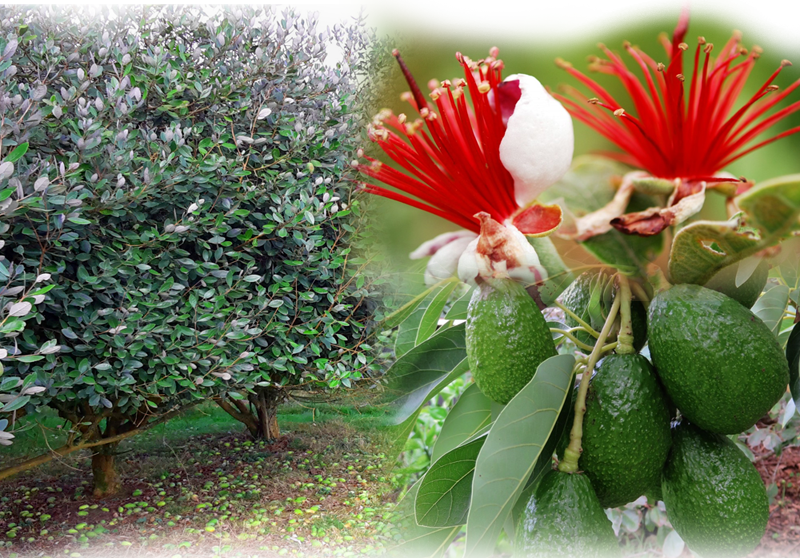
Other uses: Beyond its fruit the feijoa is useful as a shrub. It is evergreen, densely bushy and takes pruning well, so it can be grown as a hedge or windbreak — in mild enough situations and near the coast, where it withstands salt-laden air. Its ornamental value is considerable: the flowers carry fleshy white and pink petals around a bundle of crimson stamens, and those petals are sweet and edible; they can be picked without costing the crop, since pollination does not depend on them. The leaves are dark green above and silvery felted beneath, which makes the shrub come alive in wind. In Central Europe container growing is the norm: outdoors from May until the first frost, then overwintered bright and cool.
Growing
Site: The feijoa needs full sun and shelter from wind. North of the wine-growing districts it is a container plant; planted out it succeeds only in a vine climate with winter protection, being hardy to about minus eight degrees and surviving lower readings only briefly and exceptionally. Autumn matters more than winter: the fruit needs a long, mild autumn to ripen, and where frost comes early there is no crop. Pollination is the second decision to make before buying — many cultivars are self-sterile and need a second bush, while Coolidge counts as fully self-fertile and Mammoth and Triumph partly so. Ripe fruit drops and is gathered from the ground; over paving or lawn that is awkward, and a mulched area beneath makes harvesting easier. Care: It wants slightly acid, free-draining soil and takes hard water badly — in a container use rainwater and acidic compost. Keep it evenly moist through flowering and fruit development, since drought stress at that stage costs fruit. Overwinter bright at five to ten degrees, distinctly cooler than a living room, watering sparingly. Prune after harvest: the flowers come on the current season's wood, so hard spring pruning does not cost the crop, whereas late summer pruning does. Watch for scale and mealybug in winter quarters. Protect plants set outdoors in their first year with fleece and a mulch blanket over the root zone.
Propagation
Seed is the easiest route, but not true to type. Seed is taken from fully ripe fruit, washed free of pulp and sown fresh; at twenty to twenty-five degrees it germinates in two to four weeks. Seedlings, however, take four to six years to first flowering and turn out unpredictable in flavour and self-fertility — the wrong route for a reliable crop. True-to-type plants come from semi-ripe cuttings: taken in late summer, stripped at the base, treated with rooting hormone and held at twenty to twenty-five degrees bottom heat under film or mist, they root in eight to twelve weeks, though not dependably. Layering is simpler: peg down a low shoot, wound it, weight it and sever it after a year. Commercially, grafting onto seedling stocks is also used.
Value for wildlife
In its South American homeland the feijoa is bird-pollinated, and the flower still shows it: the fleshy, sweet petals are the actual reward — birds eat them and brush the crimson stamens as they go. In cultivation bees mostly take over pollination, in Central Europe honey bees and bumblebees, which collect the abundant pollen of the showy June flowers. For a Central European garden the wildlife value nevertheless stays limited: the species has no associated fauna here, feeds no caterpillar, and in a container it spends a good part of the year under cover. Planted out and grown on, it does contribute something — an evergreen, dense shrub gives cover and nesting opportunity at a season when deciduous shrubs stand bare, and windfalls left unharvested are worked over by blackbirds, wasps and hedgehogs.
Notable
Special characteristics: drought and salt-wind tolerant; optimal rainfall 750-1000mm; frost-resistant up to -8°C, rarely survives below -15°C; There are self-fertile varieties: 'Mammoth', 'Coolidge' (100% self-fertile), and 'Triumph'; Fruits taste better in cold regions than in warm ones.
Origin & habitat
South America: southern Brazil, Uruguay, north-eastern Argentina and eastern Paraguay. The feijoa comes from the subtropical highlands of this region, above all the uplands of Rio Grande do Sul, Santa Catarina and Paraná and the sierras of Uruguay. From there it reached Europe around 1890 and travelled on by way of France to California, the Caucasus and finally New Zealand, where commercial growing found its centre. Today it is also grown in Colombia, Georgia, Azerbaijan, Israel and the Mediterranean. In Central Europe it remains a container plant, or one for wine-growing climates with winter protection.
In its homeland the feijoa grows in subtropical hill country, mostly between five hundred and two thousand metres: on woodland margins and in gallery forest along the rivers, in the transition between araucaria forest and open campos grassland. That origin explains its needs well — it is used to annual rainfall of about seven hundred and fifty to a thousand millimetres, tolerates wind and salt-laden air, but needs no great summer heat. On the contrary: in cooler situations the fruit tastes more pronounced than in warm ones. It asks for free-draining, slightly acid soil and takes frost to about minus eight degrees, exceptionally a little more.
Frequently asked questions
Pineapple guava: how big does it get?
Pineapple guava (Acca sellowiana) grows as a Shrub and reaches roughly 3.5 m in height when mature, with a spread of about 4 m. Growth is slow.
Pineapple guava: what site does it need?
Pineapple guava tolerates full sun. Suitable soils are Sand, Silt, Loam. Soil moisture should be in the range semi-dry – very moist. The pH may lie between 6 and 7.
Pineapple guava: is it hardy?
Pineapple guava is listed as hardy in zone 9–12 and survives normal winters outdoors there.
Pineapple guava: will it grow in Central Europe?
Pineapple guava is not winter-hardy in Central Europe (zone 9): outdoors from spring to autumn only, otherwise a container plant overwintered frost-free. It also needs warm summers – in Central Europe that means wine-growing regions, cities or a sheltered south-facing wall.
Pineapple guava: when does it flower?
In a temperate northern-hemisphere climate it flowers from May to June.
Pineapple guava: when is it harvested?
In a temperate northern-hemisphere climate the fruit ripens in November.
Pineapple guava: when does it start cropping, and how much?
Pineapple guava first crops after 4 years. Full yield comes after 12 years. A mature plant gives up to 30 kg a year, in cultivation up to 12 t per hectare. The productive period lasts about 20 years, within a lifespan of around 70 years. Figures assume a good site; variety, soil and climate shift them considerably.
Pineapple guava: is it poisonous?
No toxicity is recorded for Pineapple guava. With wild plants, never rely on a database alone — only on a confident identification.
Pineapple guava: what is it used for?
Rated on a scale up to 10: Edible 9/10, Medicinal 3/10, Other uses 3/10.
Which Pineapple guava varieties are there?
The Permaplans variety finder lists 14 varieties of Pineapple guava, including Anatoki, Apollo, Coolidge, Den's Choice, Gemini, Kaiteri, Mammoth, Marion, Nazemetz, Pounamu, Trask, Triumph and 2 more. Each variety has its own page with taste, ripening time, disease resistance and parentage.
Plan this plant into your own garden
Permaplans plans your garden to scale on the map — with a site check, harvest calendar and over 1,000 plants. Free for iPhone, Android, Mac, Windows & Linux.
Will this plant grow where you live? → Check your site
Community experience
No first-hand reports for this plant yet.
Growing it? Write in the app what works for you – your post will show up here.
💬 Get the app and join in