
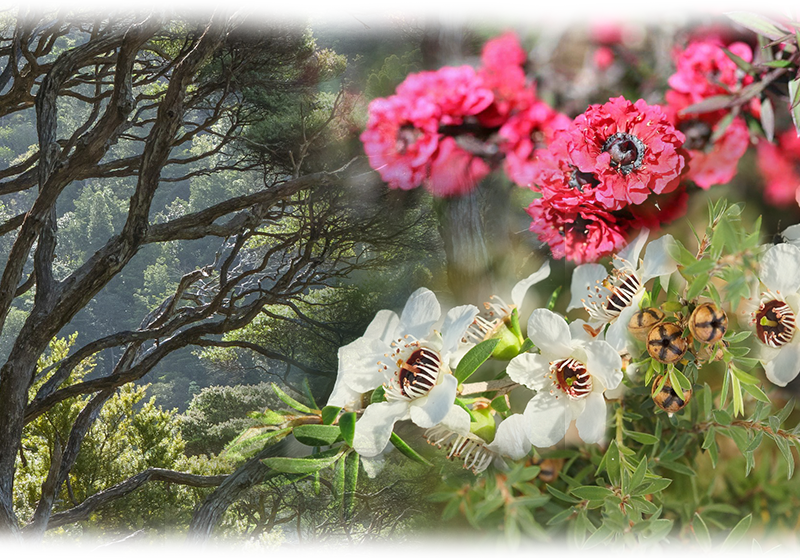
Mānuka
 4
4 7
7 6
6Will it grow where I live?
Mānuka is only hardy to zone 8, so outdoors year-round it needs the mildest spots in Central Europe – wine-growing regions, the Rhine valley, coasts, Lake Constance, Ticino – or a container overwintered under cover. Most of the British Isles and the Pacific coast of North America qualify. It also needs warm summers – in Central Europe that means wine-growing regions, cities or a sheltered south-facing wall.
Or check it for your location right here:
Profile
- Family
- Myrtaceae
- Habit
- Shrub
- Height
- 5 m
- Spread
- 3 m
- Growth
- medium
- Lifespan
- 100 years
- First yield
- after 3 years
- Hardiness
- zone 8–12
- Shade tolerance
- light shade
- Soil
- Sand, Silt, Loam
- Soil moisture
- semi-dry – very wet
- pH
- 5 – 6
- Synonyms
- ZD
Flowering & harvest
| J | F | M | A | M | J | J | A | S | O | N | D | |
|---|---|---|---|---|---|---|---|---|---|---|---|---|
| Flowering | ||||||||||||
| Fruit harvest |
Uses
Edible: Leaves (fragrant) (beer, finest tea); Manna (pia manuka);
Other uses: Diese Art kann in milderen Regionen als Hecke angebaut werden und ist relativ tolerant gegenüber maritimer Exposition. Es wird empfohlen, die Pflanzen nicht stark zurückzuschneiden, da sie sich nicht gut davon erholen. Aus den Blüten, Zweigen und Blättern dieser Pflanze kann ein gelb-grüner Farbstoff gewonnen werden, während ein grün-schwarzer Farbstoff aus den Blüten extrahiert wird. Es gibt auch ein Insektizid, das aus dieser Pflanze gewonnen wird, jedoch sind keine weiteren Details dazu bekannt. Das Holz dieser Pflanze ist rot, stark und elastisch und wird für Intarsienarbeiten und Schreinerei verwendet. Die Rinde wird traditionell für das Decken von Hütten verwendet.
Notable
Eigenschaften: verträgt Meeresexposition und Trockenheit; Pionier in gestörten Gebieten; Wächst vom Tiefland bis in subalpine Gebiete in verschiedenen Lebensräumen, insbesondere an offenen Hängen, Flussufern, Feuchtgebieten, Waldrändern und Gestrüpp, wo es häufig die vorherrschende Vegetation bildet; Sehr anpassungsfähig an unterschiedliche Umgebungen; „Burgundy Queen“ ist eine rot blühende Ziersorte, die nur 2 m hoch wird;
Origin & habitat
Australia and New Zealand
Derived from A. chinensis cultivation, it is not known to occur in a truly wild setting.
Frequently asked questions
Mānuka: how big does it get?
Mānuka (Leptospermum scoparium) grows as a Shrub and reaches roughly 5 m in height when mature, with a spread of about 3 m. Growth is medium.
Mānuka: what site does it need?
Mānuka tolerates light shade. Suitable soils are Sand, Silt, Loam. Soil moisture should be in the range semi-dry – very wet. The pH may lie between 5 and 6.
Mānuka: is it hardy?
Mānuka is listed as hardy in zone 8–12 and survives normal winters outdoors there.
Mānuka: will it grow in Central Europe?
Mānuka is only hardy to zone 8, so outdoors year-round it needs the mildest spots in Central Europe – wine-growing regions, the Rhine valley, coasts, Lake Constance, Ticino – or a container overwintered under cover. Most of the British Isles and the Pacific coast of North America qualify. It also needs warm summers – in Central Europe that means wine-growing regions, cities or a sheltered south-facing wall.
Mānuka: when does it flower?
In a temperate northern-hemisphere climate it flowers from May to June.
Mānuka: when is it harvested?
In a temperate northern-hemisphere climate the fruit ripens from October to November.
Mānuka: is it poisonous?
No toxicity is recorded for Mānuka. With wild plants, never rely on a database alone — only on a confident identification.
Mānuka: what is it used for?
Rated on a scale up to 10: Edible 4/10, Medicinal 7/10, Other uses 6/10.
Plan this plant into your own garden
Permaplans plans your garden to scale on the map — with a site check, harvest calendar and over 1,000 plants. Free for iPhone, Android, Mac, Windows & Linux.
Will this plant grow where you live? → Check your site
Community experience
No first-hand reports for this plant yet.
Growing it? Write in the app what works for you – your post will show up here.
💬 Get the app and join in