
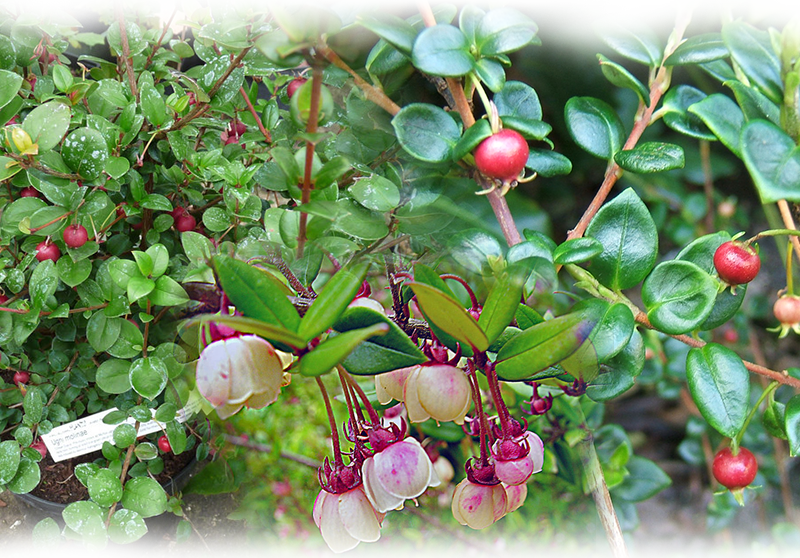
Ugni
 6
6 3
3 2
2Will it grow where I live?
Ugni is only hardy to zone 8, so outdoors year-round it needs the mildest spots in Central Europe – wine-growing regions, the Rhine valley, coasts, Lake Constance, Ticino – or a container overwintered under cover. Most of the British Isles and the Pacific coast of North America qualify. It also needs warm summers – in Central Europe that means wine-growing regions, cities or a sheltered south-facing wall.
Or check it for your location right here:
Profile
- Family
- Myrtaceae
- Habit
- Shrub
- Height
- 1.8 m
- Spread
- 2.5 m
- Growth
- medium
- Lifespan
- 30 years
- First yield
- after 3 years
- Yield in cultivation
- up to 6 t/ha
- Energy yield
- 400 kcal per m² a year
- Hardiness
- zone 8–12
- Shade tolerance
- light shade
- Soil
- Sand, Silt, Loam
- Soil moisture
- dry – very wet
- pH
- 5.5 – 6.5
- Synonyms
- Eugenia ugni, Chilenische Guave
Flowering & harvest
| J | F | M | A | M | J | J | A | S | O | N | D | |
|---|---|---|---|---|---|---|---|---|---|---|---|---|
| Flowering | ||||||||||||
| Fruit harvest |
Uses
Edible: Fruit (raw or cooked), including jams, jellies, ice cream, coulis, desserts, and liqueur, yields around 6 tonnes per hectare, providing approximately 400 kcal per square meter. Fruits thrive best in full sun. Leaves can be used for making tea.
Other uses: Plant (patch hedge, roof garden); Plant them near patios or windows to appreciate the scent.
Growing
Gedeiht auf jedem einigermaßen guten Boden, auch auf trockenen. Bevorzugt einen mäßig fruchtbaren, gut durchlässigen Lehmboden an einem sonnigen Standort. Verträgt relativ viel Seewind. Etablierte Pflanzen sind trockenheitsresistent. Diese sehr dekorative Pflanze ist nur in den milderen Regionen Großbritanniens winterhart und verträgt im Ruhezustand Temperaturen bis etwa -10 °C. Spätfröste können den jungen Austrieb im Frühjahr schädigen. In Cornwall wächst und fruchtet sie sehr gut; früher wurde sie dort sogar kommerziell wegen ihrer Früchte angebaut (sie war eine der Lieblingsfrüchte von Königin Victoria), wird heute aber üblicherweise nur noch als Zierpflanze kultiviert. Diese Pflanze ist stark unterschätzt und verdient es, aufgrund ihrer Früchte kommerziell angebaut zu werden. Blüht und fruchtet reichlich, selbst wenn die Pflanzen jung sind. Pflanzen dieser Gattung sind bemerkenswert resistent gegen Hallimasch.
Notable
Eigenschaften: (See-)Wind+Trockenheit tolerant; Es verfügt über ein faseriges Wurzelsystem, das durch Hacken, Bodenbearbeitung oder Umpflanzen beschädigt werden kann.; Nichtinvasiv; Eignet sich gut als Kübelpflanze, die man bei drohender Kälte ins Haus bringen kann.; Junge Pflanzen haben Schwierigkeiten, mit Unkräutern und Gräsern zu konkurrieren. Es gibt verschiedene frostharte Sorten von -6°C bis -12°C;
Origin & habitat
Woodland borders and undergrowth.
Alpine regions on rocky, well-drained soils, occasionally also on marshy soils.
Frequently asked questions
Ugni: how big does it get?
Ugni (Ugni molinae) grows as a Shrub and reaches roughly 1.8 m in height when mature, with a spread of about 2.5 m. Growth is medium.
Ugni: what site does it need?
Ugni tolerates light shade. Suitable soils are Sand, Silt, Loam. Soil moisture should be in the range dry – very wet. The pH may lie between 5.5 and 6.5.
Ugni: is it hardy?
Ugni is listed as hardy in zone 8–12 and survives normal winters outdoors there.
Ugni: will it grow in Central Europe?
Ugni is only hardy to zone 8, so outdoors year-round it needs the mildest spots in Central Europe – wine-growing regions, the Rhine valley, coasts, Lake Constance, Ticino – or a container overwintered under cover. Most of the British Isles and the Pacific coast of North America qualify. It also needs warm summers – in Central Europe that means wine-growing regions, cities or a sheltered south-facing wall.
Ugni: when does it flower?
In a temperate northern-hemisphere climate it flowers from May to June.
Ugni: when is it harvested?
In a temperate northern-hemisphere climate the fruit ripens from September to October.
Ugni: when does it start cropping, and how much?
Ugni first crops after 3 years. In cultivation, up to 6 t per hectare is typical. Figures assume a good site; variety, soil and climate shift them considerably.
Ugni: is it poisonous?
Individual parts of Ugni are noted as mildly problematic — the plant does not count as poisonous. With wild plants, never rely on a database alone, only on a confident identification.
Ugni: what is it used for?
Rated on a scale up to 10: Edible 6/10, Medicinal 3/10, Other uses 2/10.
Plan this plant into your own garden
Permaplans plans your garden to scale on the map — with a site check, harvest calendar and over 1,000 plants. Free for iPhone, Android, Mac, Windows & Linux.
Will this plant grow where you live? → Check your site
Community experience
No first-hand reports for this plant yet.
Growing it? Write in the app what works for you – your post will show up here.
💬 Get the app and join in