
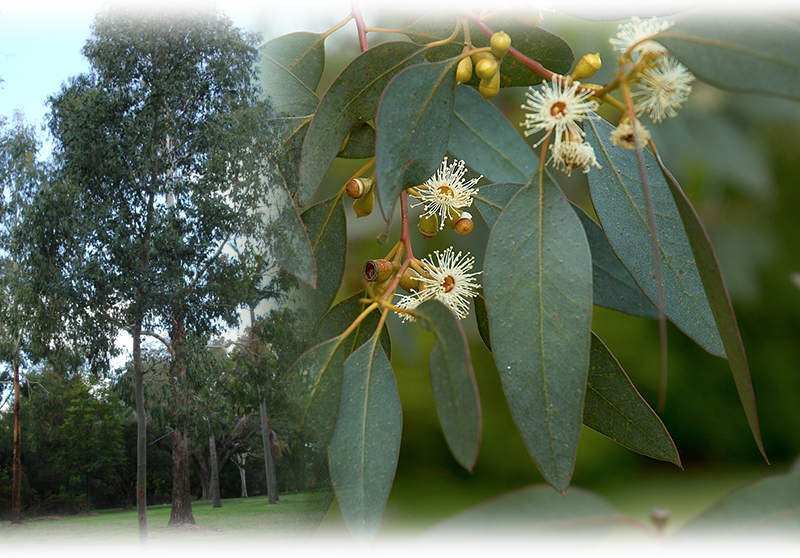
Cider gum eucalyptus
 4
4 7
7 7
7Will it grow where I live?
Cider gum eucalyptus is only hardy to zone 8, so outdoors year-round it needs the mildest spots in Central Europe – wine-growing regions, the Rhine valley, coasts, Lake Constance, Ticino – or a container overwintered under cover. Most of the British Isles and the Pacific coast of North America qualify.
Or check it for your location right here:
Profile
- Family
- Myrtaceae
- Habit
- Tree
- Height
- 30 m
- Spread
- 6 m
- Growth
- fast
- Lifespan
- 150 years
- First yield
- after 4 years
- Hardiness
- zone 8–10
- Shade tolerance
- light shade
- Soil
- Sand, Silt, Loam
- Soil moisture
- very dry – near water
- pH
- 5.5 – 7.5
Uses
Edible: Juice (sweet flavor, consumed fresh or fermented into cider) up to ½ liter daily; Edible manna;
Other uses: Foliage 5-12 t/ha, 1% essential oil with antifungal properties; Wood is strong and dense, used as fuel (needs to be dried for over 12 months) and for ornamental purposes, to dry wet soils, repel mosquitoes, and protect the soil.
Propagation
Sow seeds on the surface in February/March in a sunny greenhouse. Species from high altitudes benefit from 6-8 weeks of cold stratification at 2°C. Transfer seedlings to individual pots once the second set of leaves appears. Plant them in their permanent spots in early summer, protecting them from cold in the first winter. Alternatively, sow seeds in June and plant young trees in their final spots in late spring the next year. The seeds have a long viability.
Notable
Eigenschaften: dürretolerant (wenn etabliert), toleriert salzhaltige Winde; frostbeständig: verträgt langzeitig bis -14°C + kurzzeitig bis -18°C; E. Monokulturen = Umweltkatastrophe: (gefräßig, allelopathisch, feuergefährlich, ziehen Schädlinge an und fördern die schlechteste Einstellung zur Landnutzung/-erhaltung; weiterhin mulchen; Beschneiden im Frühjahr;
Origin & habitat
Australia - South Australia, Tasmania.
Unknown
⚠️ Hazards
Citronellal, a key component in most eucalyptus varieties, is considered mutagenic when used alone. In high doses, eucalyptus oil, like other essential oils, has led to fatal poisonings due to gut irritation. Fatalities have occurred from consuming 4 to 24 ml of the oil, although there have been cases of recovery after the same dosage. Symptoms may include burning sensation in the gut, nausea, vomiting, diarrhea, hypoxia, weakness, dizziness, drowsiness, difficulty breathing, confusion, paralysis, seizures, and typically death from respiratory issues.
Frequently asked questions
Cider gum eucalyptus: how big does it get?
Cider gum eucalyptus (Eucalyptus gunnii) grows as a Tree and reaches roughly 30 m in height when mature, with a spread of about 6 m. Growth is fast.
Cider gum eucalyptus: what site does it need?
Cider gum eucalyptus tolerates light shade. Suitable soils are Sand, Silt, Loam. Soil moisture should be in the range very dry – near water. The pH may lie between 5.5 and 7.5.
Cider gum eucalyptus: is it hardy?
Cider gum eucalyptus is listed as hardy in zone 8–10 and survives normal winters outdoors there.
Cider gum eucalyptus: will it grow in Central Europe?
Cider gum eucalyptus is only hardy to zone 8, so outdoors year-round it needs the mildest spots in Central Europe – wine-growing regions, the Rhine valley, coasts, Lake Constance, Ticino – or a container overwintered under cover. Most of the British Isles and the Pacific coast of North America qualify.
Cider gum eucalyptus: is it poisonous?
Individual parts of Cider gum eucalyptus are noted as mildly problematic — the plant does not count as poisonous. With wild plants, never rely on a database alone, only on a confident identification.
Cider gum eucalyptus: what is it used for?
Rated on a scale up to 10: Edible 4/10, Medicinal 7/10, Other uses 7/10.
Plan this plant into your own garden
Permaplans plans your garden to scale on the map — with a site check, harvest calendar and over 1,000 plants. Free for iPhone, Android, Mac, Windows & Linux.
Will this plant grow where you live? → Check your site
Community experience
No first-hand reports for this plant yet.
Growing it? Write in the app what works for you – your post will show up here.
💬 Get the app and join in