
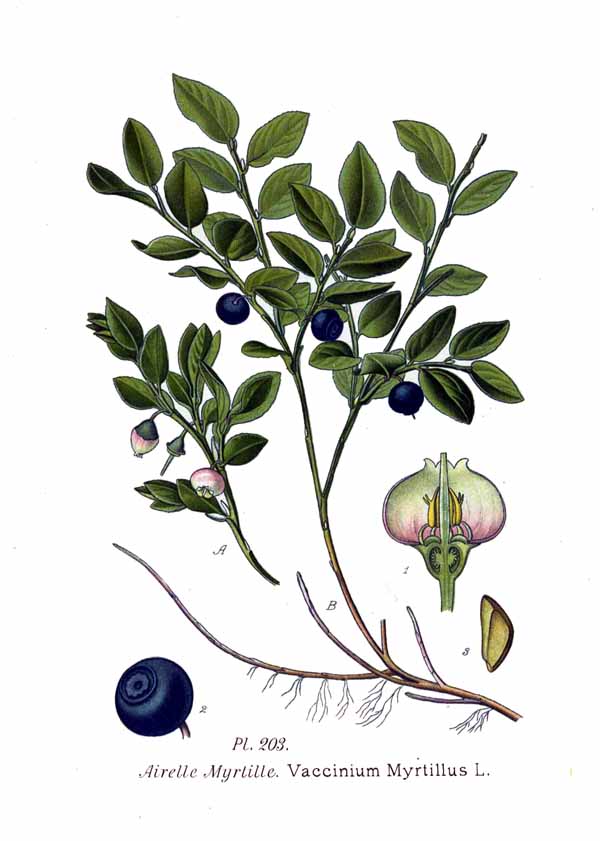
Bilberry
 6
6 6
6 2
2Will it grow where I live?
Bilberry is hardy to zone 3 – that covers all of Central Europe and the British Isles, and every USDA zone from 3 upwards.
Or check it for your location right here:
Profile
- Family
- Ericaceae
- Habit
- Shrub
- Height
- 0.3 m
- Spread
- 1.5 m
- Growth
- medium
- Lifespan
- 30 years
- First yield
- after 3 years
- Hardiness
- zone 3–7
- Shade tolerance
- partial shade
- Soil
- Sand, Silt
- Soil moisture
- dry – moist
- pH
- 4 – 5.5
Flowering & harvest
| J | F | M | A | M | J | J | A | S | O | N | D | |
|---|---|---|---|---|---|---|---|---|---|---|---|---|
| Flowering |
Uses
Edible: The blue-black berries ripen in central Europe from July to September and are eaten raw or processed into juice, jam, compote, wine, liqueur and spirits. Unlike the American highbush blueberry the flesh is coloured right through, so the juice stains tongue, fingers and fabric strongly. They taste more aromatic and more acidic than garden blueberries but are considerably smaller. Germany harvests an estimated 5,000 to 10,000 tonnes a year, mostly for industrial processing. The berries bruise easily and keep only a few days, but they freeze and dry well. Dried berries and leaves are brewed as tea.
Other uses: Its high anthocyanin content makes bilberry one of the strongest plant dye sources in central Europe. Dyeing clothing with bilberry juice is documented as far back as ancient Gaul; into modern times the juice was used to deepen the colour of wine and confectionery, and today bilberry extract serves as a natural food colourant. The colour is pH-dependent and shifts from red to blue-violet. Wild collection was also economically significant: until the 1970s up to 4,000 tonnes a year were combed from the Black Forest and Bavaria alone. Today commercial supply comes mainly from Poland, Czechia, Slovakia, Austria and the Balkans.
Growing
Site: Bilberry lives or dies by soil acidity. It needs strongly acidic, humus-rich raw soil around pH 4 to 5 in an evenly moist position that never dries out; on calcareous topsoil iron chlorosis sets in quickly and only a fully replaced planting bed will help. As a half-shade plant it thrives under open pine and birch, but barely fruits in deep shade. It creeps by runners and closes into a low carpet over the years: welcome as underplanting for rhododendrons and cultivated blueberries, less so among weak-growing perennials. The juice stains, so pale paving beneath the stand will spot. Care: Work conifer litter, bark compost or a peat substitute into the ground before planting, then mulch permanently with rotted needle litter, because the raw humus keeps the mycorrhiza working. Avoid hard tap water and irrigate with rainwater in dry spells. Mineral fertiliser does more harm than good; if anything, use small doses of an acid special feed. Prune only to rejuvenate: every few years remove the oldest shoots at ground level, since new growth crops best. Aphids, gall mites and gall midges appear occasionally, fungal attack is rare. Birds harvest ripening berries fast.
Propagation
Bilberry is propagated mainly from seed. The berries are crushed, the seed washed out and briefly dried; it germinates after several weeks of cold stratification and needs light, so it is pressed onto the surface rather than covered. Acidic, low-peat seed compost that stays evenly moist suits it well. Seedlings grow very slowly in the first year and are not ready to plant out for three or four years. Division is quicker: older clumps can be split with a spade in spring provided each piece keeps its own roots and runners. Semi-ripe cuttings taken in midsummer will root under film, though unreliably. In every case bring some soil from the original site along so the mycorrhizal fungi travel with the plant.
Value for wildlife
Bilberry is among the most valuable wild plants of acidic woodland. Twenty-one wild bee species have been recorded at its flowers, three of them specialists on the genus; nectar value is rated high, pollen value low. Its importance as larval food is far greater: around 118 moth and butterfly species feed on it, 21 of them exclusively on Vaccinium, including the pale eggar, the clouded buff and the red sword-grass. Some two dozen mammal species take the berries, as do thrushes, jays and corvids. For capercaillie the berries and shoots are a key food, which is why bilberry-rich mountain forests are deliberately promoted in forestry. In winter the shoots, which stay green, are important browse for roe and red deer.
Notable
Notable: old names blackberry-of-the-wood, druid berry; the only bilberry with flesh coloured right through → stains tongue+fingers, the American highbush blueberry does not; almost no cultivars because it does not suit plantation culture, 'Sylvana' excepted; combed from the Black Forest with berry rakes until the 1970s; single clones persist for decades, creeping slowly through the forest.
Origin & habitat
Eurasia: northern and central Europe, Siberia, northern Asia. Bilberry is a Palaearctic species centred on the temperate and boreal zones. In northern Europe its range reaches about 71 degrees north, well beyond the Arctic Circle; southwards it thins out in the mountains of Spain, Italy and the Balkans, where it retreats to higher elevations. In central Europe it occurs from the lowlands to the mountains and climbs to 2840 metres in the Grisons. It is most abundant in the oceanic west and in high-rainfall uplands, and becomes scarce in the dry basins of east-central Europe. In western North America it is only scattered; there it is largely replaced by closely related species.
Bilberry is a dwarf shrub of acidic, nutrient-poor woodland. Its strongholds are lowland pine forests and montane spruce forests, where it forms continuous carpets and gives entire forest communities their name. It also colonises bog margins, mountain heaths and open oak-birch woodland. A half-shade plant, it indicates strongly acidic, nitrogen-poor soils in a cool, humid, suboceanic climate. Its roots reach about a metre deep and depend on ericoid mycorrhizal fungi: without that partner it cannot tap the nutrients locked in raw humus. It does not tolerate lime and is absent from calcareous ground.
Frequently asked questions
Bilberry: how big does it get?
Bilberry (Vaccinium myrtillus) grows as a Shrub and reaches roughly 0.3 m in height when mature, with a spread of about 1.5 m. Growth is medium.
Bilberry: what site does it need?
Bilberry tolerates partial shade. Suitable soils are Sand, Silt. Soil moisture should be in the range dry – moist. The pH may lie between 4 and 5.5.
Bilberry: is it hardy?
Bilberry is listed as hardy in zone 3–7 and survives normal winters outdoors there.
Bilberry: will it grow in Central Europe?
Bilberry is hardy to zone 3 – that covers all of Central Europe and the British Isles, and every USDA zone from 3 upwards.
Bilberry: when does it flower?
In a temperate northern-hemisphere climate it flowers in May.
Bilberry: is it poisonous?
No toxicity is recorded for Bilberry. With wild plants, never rely on a database alone — only on a confident identification.
Bilberry: what is it used for?
Rated on a scale up to 10: Edible 6/10, Medicinal 6/10, Other uses 2/10.
Plan this plant into your own garden
Permaplans plans your garden to scale on the map — with a site check, harvest calendar and over 1,000 plants. Free for iPhone, Android, Mac, Windows & Linux.
Will this plant grow where you live? → Check your site
Community experience
No first-hand reports for this plant yet.
Growing it? Write in the app what works for you – your post will show up here.
💬 Get the app and join in