
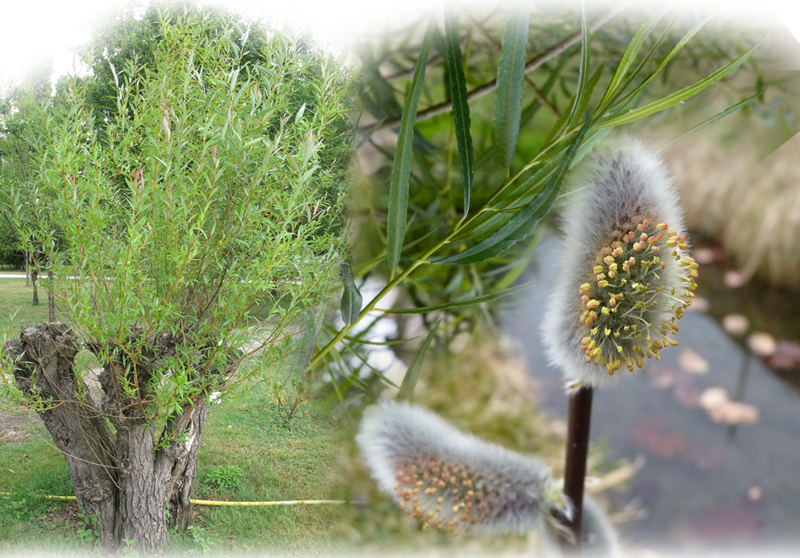
Common osier
 1
1 8
8 9
9Will it grow where I live?
Common osier is hardy to zone 4 – that covers all of Central Europe and the British Isles, and every USDA zone from 4 upwards.
Or check it for your location right here:
Profile
- Family
- Salicaceae
- Habit
- Tree
- Height
- 6.5 m
- Spread
- 4 m
- Growth
- very fast
- Lifespan
- 600 years
- First yield
- after 5 years
- Hardiness
- zone 4–8
- Shade tolerance
- light shade
- Soil
- Sand, Silt, Loam, Clay
- Soil moisture
- semi-dry – near water
- pH
- 4.5 – 7
- Synonyms
- Kopfweide
Flowering & harvest
| J | F | M | A | M | J | J | A | S | O | N | D | |
|---|---|---|---|---|---|---|---|---|---|---|---|---|
| Flowering |
Uses
Edible: The inner bark is edible raw or cooked, and can also be dried, ground into powder, and used as flour for baking bread. It has a bitter taste and is mainly consumed as a last resort food option. Young shoots, while edible when cooked, are not very flavorful.
Medicinal: Antirheumatic and antipyretic properties are found in the fresh bark of all members of this genus due to the presence of salicin, which converts to salicylic acid in the human body. Salicylic acid is utilized for pain relief and reducing fever.
Other uses: The plant's stems are highly flexible and utilized in basket making, usually pruned once a year for this purpose. Alternatively, pruning every two years is sufficient when thicker poles are required for support. Each year, approximately 12 tons per hectare can be harvested, with 40% classified as Class 1. Its bark has a tannin content of around 10%. To combat soil erosion, the plant is commonly grown along riverbanks and lakeshores.
Growing
The osier needs light and water — it languishes in shade and stays stunted on dry soils. Ideal are deep, heavy, base- and nutrient-rich, often calcareous soils beside water, including sites flooded regularly; waterlogging does not trouble it. It is insensitive to air pollution. Growth is enormous: in short-rotation coppice it yields five to ten tonnes of dry matter per hectare per year and is cut in winter every three to six years, three to six times over twenty years. For weaving rods it is cut annually or every two to three years. Grown as a pollard it must be cut back regularly, or the heavy crowns split apart. The root system seeks moisture and can block drains and pipes — keep well clear of buildings.
Propagation
Hardly any woody plant propagates more easily. Hardwood cuttings from one-year-old rods taken in early spring — twenty to thirty centimetres long, pushed two-thirds into the ground — root within days to weeks; the bark contains rooting compounds, which is why willow rods are also used as a rooting aid for other species. Whole setts one to two metres long take just as readily, which makes living fences, woven structures and bank revetments possible; for short-rotation coppice the cuttings are set by machine. Seed propagation is of no practical importance: the osier is dioecious, flowers in March and April before the leaves, and its hairy seed germinates only on open, moist bare ground and often stays viable for just a few days.
Value for wildlife
The osier is among the most valuable woody plants for insects anywhere. It flowers early, before the leaves unfold, and then supplies both nectar and pollen in quantity — for wild bees emerging in late winter this is often the first reliable forage of the year. Around 33 wild bee species use it, ten of them willow specialists, including several mining bees. Its importance as larval food is greater still: some 154 moth and butterfly species feed on willow foliage, 33 of them on willows alone. Add roughly 33 beetle species, many of them leaf beetles and longhorns, and close to twenty hoverfly species. Densely planted or regularly coppiced osier also forms thickets in which warblers and shrikes find cover for nesting.
Notable
Special features: wind+pollutant+flood tolerant; wicker fence; threshold between land/fire and water; 4 meters of growth per year possible; root system can attack pipes and walls → keep sufficient distance; better to topple above ground than to prune; rich in insect life; contains a root growth hormone → easy to take cuttings.
Origin & habitat
Continental Europe and northern Asia: from the Pyrenees to the Urals and on across Siberia to eastern Asia. The osier is native in Central Europe and widespread in the lowlands, reaching about 800 metres. In north-western Europe and Scandinavia it was introduced for basketry and is naturalised there. Its natural stronghold lies along the major river systems, where together with purple and almond willow it builds the softwood floodplain forest and forms plant communities of its own. Centuries of cultivation in withy beds and as pollards mean that natural occurrence and planting can no longer be told apart in many places.
Typically found in mountainous terrain on nutrient-rich soils, as well as on gravelly and sandy nutrient-poor soils. It thrives along streams and marshes, roadsides, railway embankments, and forest edges.
⚠️ Hazards
The osier itself poses little danger; its bark contains salicylates, which in larger amounts irritate the stomach and can be a problem for people with salicylate intolerance or those taking blood thinners. More relevant in practice are structural risks: the root system actively seeks moisture and penetrates leaking drains, sewage pipes and soakaways. Pollards left uncut for years split under the weight of their crowns and break apart. Freshly set cuttings and woven structures take root reliably — including where that is not wanted.
Frequently asked questions
Common osier: how big does it get?
Common osier (Salix viminalis) grows as a Tree and reaches roughly 6.5 m in height when mature, with a spread of about 4 m. Growth is very fast.
Common osier: what site does it need?
Common osier tolerates light shade. Suitable soils are Sand, Silt, Loam, Clay. Soil moisture should be in the range semi-dry – near water. The pH may lie between 4.5 and 7.
Common osier: is it hardy?
Common osier is listed as hardy in zone 4–8 and survives normal winters outdoors there.
Common osier: will it grow in Central Europe?
Common osier is hardy to zone 4 – that covers all of Central Europe and the British Isles, and every USDA zone from 4 upwards.
Common osier: when does it flower?
In a temperate northern-hemisphere climate it flowers in April.
Common osier: is it poisonous?
No toxicity is recorded for Common osier. With wild plants, never rely on a database alone — only on a confident identification.
Common osier: what is it used for?
Rated on a scale up to 10: Edible 1/10, Medicinal 8/10, Other uses 9/10.
Plan this plant into your own garden
Permaplans plans your garden to scale on the map — with a site check, harvest calendar and over 1,000 plants. Free for iPhone, Android, Mac, Windows & Linux.
Will this plant grow where you live? → Check your site
Community experience
No first-hand reports for this plant yet.
Growing it? Write in the app what works for you – your post will show up here.
💬 Get the app and join in