
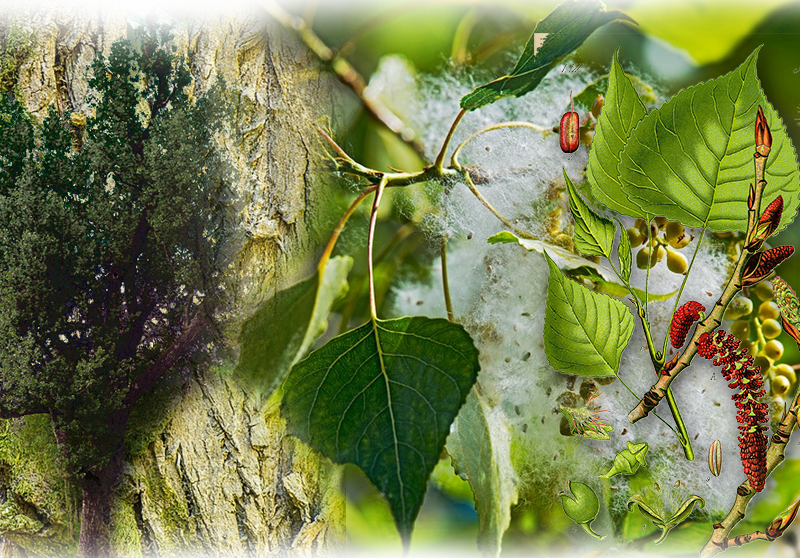
Black poplar
 3
3 8
8 6
6Will it grow where I live?
Black poplar is hardy to zone 4 – that covers all of Central Europe and the British Isles, and every USDA zone from 4 upwards.
Or check it for your location right here:
Profile
- Family
- Salicaceae
- Habit
- Tree
- Height
- 30 m
- Spread
- 16 m
- Growth
- very fast
- Lifespan
- 200 years
- First yield
- after 8 years
- Hardiness
- zone 4–9
- Shade tolerance
- light shade
- Soil
- Sand, Silt, Loam, Clay
- Soil moisture
- semi-dry – near water
- pH
- 5 – 8
- Synonyms
- Schwarzpappel, Pappel
Flowering & harvest
| J | F | M | A | M | J | J | A | S | O | N | D | |
|---|---|---|---|---|---|---|---|---|---|---|---|---|
| Flowering | ||||||||||||
| Fruit harvest | ||||||||||||
| Leaf harvest |
Uses
Edible: Black poplar is not a food plant but a famine food. What can be used is the inner bark, the cambium: peeled fresh in winter and early spring it tastes faintly sweet and was chewed; dried and ground to powder it served to extend bread flour, as recorded from times of hunger across northern Europe. Its tannin content makes it harsh, the nutritional value is low, and peeling damages the tree permanently. A second and more practicable use is the resinous buds, which smell strongly balsamic in late winter and can be used sparingly as a flavouring. As a crop it is of no use.
Medicinal: Bear's foot root was traditionally utilized by indigenous peoples of North America as a stimulant and laxative. It is recognized for its effectiveness as a hair tonic and for its internal use in treating non-cancerous swollen glands, especially mastitis. The root possesses analgesic, laxative, and stimulant qualities, believed to positively impact the liver, stomach, and spleen. It can aid in alleviating indigestion and liver issues when ingested. Externally, it is reputed to promote hair growth and is a common ingredient in various hair tonics and ointments. Additionally, a poultice made from the crushed root has been applied as a remedy for burns, inflammations, and cuts.
Other uses: The wood of black poplar is very soft, light and tough, neutral in smell and taste, hard to ignite and not durable outdoors — a combination that makes it irreplaceable for particular purposes: matches, chip boxes and fruit crates, chopping boards, clogs, plywood, furniture core stock and pulp. Among all poplars its timber is held to be the best. The resin of the buds has been worked into poplar ointment for centuries, and bees collect it to seal the hive. The bark contains tannins and served as a cork substitute for floats on fishing nets. An extract of fresh shoots in cold water acts as a rooting aid for cuttings of all kinds. Most important in practice today is its vigour: as a short-rotation crop it yields fuel wood, as a pollard it yields weaving rods, and in living bank revetment driven setting poles stabilise slopes and watersides.
Growing
Site: Black poplar is a tree for large spaces, not for domestic gardens — forty metres with a correspondingly wide crown is the norm. It is markedly light- and warmth-demanding and must stand free. Two traits decide its placing: it throws strong, far-running root suckers that travel into paving, lawn and neighbouring plots and seek out drains and pipes, and it is brittle — falling branches must be expected over paths, seating and parking. Female trees release large quantities of seed fluff in June. As a fast-growing wind and visual screen along water, on embankments and in open farmland it is hard to replace. Anyone planting near native wild populations should use only provenance-certified material and no hybrid poplars, or the wild form will be hybridised further. Care: It is usually raised from hardwood cuttings, which take very easily; in the first years it needs steady moisture and open growing room, and no feeding. Young plants are at risk from browsing game and, near water, from beavers, and should be protected. It tolerates hard cutting back and is the classic pollard: cut every five to ten years it yields rods and at the same time develops the gnarled, cavity-rich trunks that make up its ecological value. On older trees regular inspection for deadwood and breakage is essential. Poplar rust and leaf spot occur but are usually harmless; the cultivar 'Italica' is additionally known for basal rot and brittle twigs and is therefore the poorer choice for shelter planting. Unwanted suckers are mown off as they appear.
Propagation
In nature black poplar reproduces from seed, which flies in May and June with its white fluff. The seed is extremely short-lived — viable for only days to weeks — and germinates solely on freshly deposited, moist, bare ground. In practice this hardly matters. Propagation is vegetative instead, and it succeeds remarkably easily: one-year-old, well-ripened rods are cut in winter, divided into cuttings twenty to thirty centimetres long and pushed into the ground in early spring so that only one or two buds show; on moist soil almost all of them root. The same method works with metre-long setting poles for living bank revetment. Root suckers can also be severed and grown on. For conservation work the provenance is decisive: only genetically verified, native material is used for propagation.
Value for wildlife
Black poplar is among the most valuable insect trees in Central Europe. Ninety-seven butterfly and moth species feed on it, 29 of them exclusively — including eight native hawkmoths, led by the poplar hawkmoth — along with 19 wild bee species, four of them specialists, and 15 beetle species. It flowers early, in March and April, wind-pollinated, and delivers abundant pollen exactly when little else is available; its sticky, resinous buds are collected by honeybees as raw material for propolis. Birds use the seed fluff to line their nests, and hawfinch and crossbill take the seed. Its greatest contribution comes with age: the soft wood is easy for woodpeckers to work, old and pollarded trunks develop large cavities and beds of wood mould, and so carry bats, hole-nesting birds and a whole guild of deadwood beetles.
Notable
Special features: +for all extreme locations +fast-growing windbreak - very wind-resistant, strong root sucker (wide runners + root formation); buds and bark are dried for later use; original form on the red list, as it has been displaced/crossed by hybrids; best wood of all poplars; 1,200 kWh/rm, 40,000 kWh/ha/a;
Origin & habitat
Europe, the Near East and North Africa: black poplar occupies the temperate parts of Europe along the great rivers — Rhine, Elbe, Danube and their tributaries — and extends into south-west Asia and the North African coastal belt; it is absent from Scandinavia and Scotland. Its range is not a continuous area but a ribbon: it follows the floodplains and is tied to the river system. That has become its problem. Through channelisation, embankment and the loss of natural flooding dynamics the wild form is classed as endangered in Germany, and because widely planted hybrid poplars (Populus × canadensis) cross with it, genetically pure stock has been displaced almost everywhere. Remaining native populations are now deliberately secured and propagated.
Black poplar is the characteristic tree of the softwood floodplain forest and one of the most light-demanding native trees of all. It grows on well-aerated gravel and sand along river banks that flood periodically, and it tolerates weeks of inundation as readily as the silt deposited afterwards. Its best sites are nutrient-rich and supplied with moving groundwater all year — drought and deep shade rule it out. Its regeneration depends on a narrow ecological window: the seed germinates only on freshly deposited, bare, moist silt, and that window opens only after a flood at the right time of year. Where rivers are regulated, natural regeneration therefore fails. It usually lives 100 to 150 years, individual trees over 300, and reaches up to forty metres.
Frequently asked questions
Black poplar: how big does it get?
Black poplar (Populus nigra) grows as a Tree and reaches roughly 30 m in height when mature, with a spread of about 16 m. Growth is very fast.
Black poplar: what site does it need?
Black poplar tolerates light shade. Suitable soils are Sand, Silt, Loam, Clay. Soil moisture should be in the range semi-dry – near water. The pH may lie between 5 and 8.
Black poplar: is it hardy?
Black poplar is listed as hardy in zone 4–9 and survives normal winters outdoors there.
Black poplar: will it grow in Central Europe?
Black poplar is hardy to zone 4 – that covers all of Central Europe and the British Isles, and every USDA zone from 4 upwards.
Black poplar: when does it flower?
In a temperate northern-hemisphere climate it flowers in April.
Black poplar: when is it harvested?
In a temperate northern-hemisphere climate the fruit ripens in August.
Black poplar: is it poisonous?
No toxicity is recorded for Black poplar. With wild plants, never rely on a database alone — only on a confident identification.
Black poplar: what is it used for?
Rated on a scale up to 10: Edible 3/10, Medicinal 8/10, Other uses 6/10.
Plan this plant into your own garden
Permaplans plans your garden to scale on the map — with a site check, harvest calendar and over 1,000 plants. Free for iPhone, Android, Mac, Windows & Linux.
Will this plant grow where you live? → Check your site
Community experience
No first-hand reports for this plant yet.
Growing it? Write in the app what works for you – your post will show up here.
💬 Get the app and join in