
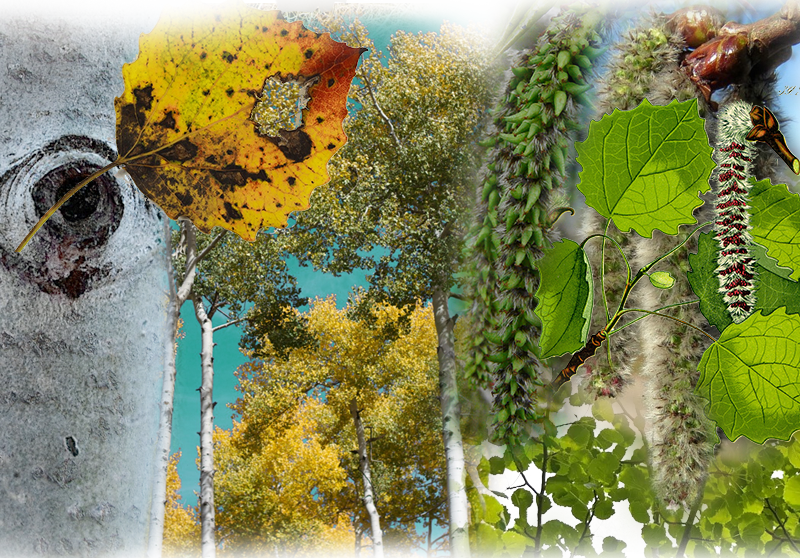
Aspen
 4
4 5
5 8
8Will it grow where I live?
Aspen is hardy to zone 2 – that covers all of Central Europe and the British Isles, and every USDA zone from 2 upwards.
Or check it for your location right here:
Profile
- Family
- Salicaceae
- Habit
- Tree
- Height
- 24 m
- Spread
- 12 m
- Growth
- very fast
- Lifespan
- 80 years
- First yield
- after 7 years
- Hardiness
- zone 2–7
- Shade tolerance
- partial shade
- Soil
- Sand, Silt, Loam, Clay
- Soil moisture
- semi-dry – near water
- pH
- 5 – 8
- Synonyms
- Zitterpappel, Aspe, Pappel
Flowering & harvest
| J | F | M | A | M | J | J | A | S | O | N | D | |
|---|---|---|---|---|---|---|---|---|---|---|---|---|
| Flowering | ||||||||||||
| Fruit harvest | ||||||||||||
| Leaf harvest |
Uses
Edible: Inner bark is dried, ground into a powder, and processed into flour for making bread and other products, typically as a final option after exhausting other alternatives.
Medicinal: Plant ash infusion was traditionally utilized to alleviate heart palpitations due to its effectiveness in treating heart issues.
Other uses: A rapidly growing tree that is resistant to wind can be planted for windbreaks and to enhance dense clay soils in underdeveloped forests. The wood is soft, flexible, easy to split, with a somewhat woolly texture. It is odorless and flavorless, fire-resistant, not long-lasting, but highly resistant to abrasion. Ideal for making top-notch paper and charcoal production.
Growing
A tree that is easy to cultivate thrives in dense, cold, and damp soil, preferably neutral to acidic, and avoids calcareous soil. The subspecies P. tremula davidiana (Dode) Schneid can tolerate highly alkaline soil. It generally prefers deep, fertile, well-drained soil, thriving best in southern and eastern regions. Growth is notably slower in damp, poor acidic, and shallow dry soil. This tree grows effectively in poor soil, likely due to its intolerance to competition. The plants are highly wind-resistant and flourish in cold, exposed areas with adequate moisture. They do not favor shade and struggle with root or branch competition. The aspen is beneficial for wildlife, hosting over 90 insect species and serving as a food source for the green hairstreak butterfly. Ash trees possess extensive and aggressive root systems that can infiltrate drainage systems and cause harm. Particularly on clay soil, they should not be planted within 12 meters of buildings to prevent damage to foundations from soil drying out due to the root system. They can be planted to enhance neglected forests with heavy clay soil. Ash trees are dioecious, requiring both male and female plants for seed production.
Propagation
Seeds should be planted right after they mature in the spring. Poplar seeds have a very short lifespan and should be planted within a few days of maturing. They are planted shallowly or lightly covered in trays in a cold environment. Once the seedlings reach a suitable size, they are moved to individual pots and further cultivated in the cold environment. If they grow sufficiently, they can be planted in their final spot in late summer. Otherwise, they should be kept in the cold environment until the next spring before planting. Most poplar species freely cross-pollinate, so collected seeds may not be true unless gathered from the wild where no other poplar species are present. Take cuttings from mature wood in November/December in a protected outdoor area. This species is challenging to propagate from cuttings. In the spring, propagate through root suckers. In winter, propagate through root cuttings.
Notable
Special features: +Wind, slope and bank protection, renaturation, ...grows into shrub-like thickets, forms stronger root runners than P. nigra.; Constant leaf movement (trembling) causes increased transpiration, which increases the nutrient supply and thus also growth; population can lower the groundwater level by up to 1 m.
Origin & habitat
Europe, from Iceland south and east to North Africa, temperate Asia to Japan.
In offenen Wäldern und buschigen Heidelandschaften zu finden, meist auf ärmeren Böden, wo es manchmal dominant ist.
Frequently asked questions
Aspen: how big does it get?
Aspen (Populus tremula) grows as a Tree and reaches roughly 24 m in height when mature, with a spread of about 12 m. Growth is very fast.
Aspen: what site does it need?
Aspen tolerates partial shade. Suitable soils are Sand, Silt, Loam, Clay. Soil moisture should be in the range semi-dry – near water. The pH may lie between 5 and 8.
Aspen: is it hardy?
Aspen is listed as hardy in zone 2–7 and survives normal winters outdoors there.
Aspen: will it grow in Central Europe?
Aspen is hardy to zone 2 – that covers all of Central Europe and the British Isles, and every USDA zone from 2 upwards.
Aspen: when does it flower?
In a temperate northern-hemisphere climate it flowers from March to April.
Aspen: when is it harvested?
In a temperate northern-hemisphere climate the fruit ripens in August.
Aspen: is it poisonous?
No toxicity is recorded for Aspen. With wild plants, never rely on a database alone — only on a confident identification.
Aspen: what is it used for?
Rated on a scale up to 10: Edible 4/10, Medicinal 5/10, Other uses 8/10.
Plan this plant into your own garden
Permaplans plans your garden to scale on the map — with a site check, harvest calendar and over 1,000 plants. Free for iPhone, Android, Mac, Windows & Linux.
Will this plant grow where you live? → Check your site
Community experience
No first-hand reports for this plant yet.
Growing it? Write in the app what works for you – your post will show up here.
💬 Get the app and join in