
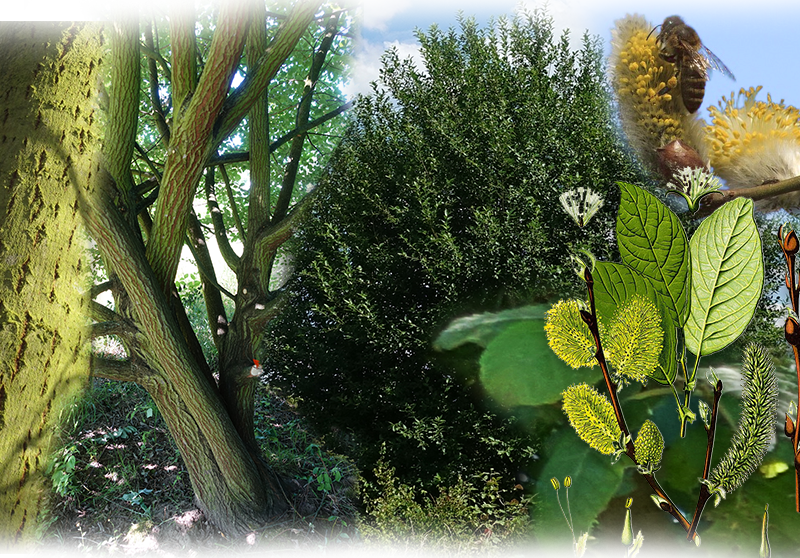
Goat willow
 1
1 5
5 6
6Will it grow where I live?
Goat willow is hardy to zone 4 – that covers all of Central Europe and the British Isles, and every USDA zone from 4 upwards.
Or check it for your location right here:
Profile
- Family
- Salicaceae
- Habit
- Tree
- Height
- 10 m
- Spread
- 10 m
- Growth
- very fast
- Lifespan
- 60 years
- First yield
- after 10 years
- Hardiness
- zone 4–9
- Shade tolerance
- partial shade
- Soil
- Sand, Silt, Loam, Clay
- Soil moisture
- dry – very wet
- pH
- 6 – 7.5
Flowering & harvest
| J | F | M | A | M | J | J | A | S | O | N | D | |
|---|---|---|---|---|---|---|---|---|---|---|---|---|
| Flowering | ||||||||||||
| Fruit harvest |
Uses
Edible: The inner bark is edible raw or cooked, and can be dried, ground into powder for bread flour. It has a bitter taste and is consumed as a last resort food. Young shoots, although not very flavorful, can also be eaten raw or cooked and provide edible manna.
Medicinal: The bark of all plants in this genus contains salicin, which converts to salicylic acid in the body and is utilized for its pain-relieving and fever-reducing properties.
Other uses: Goat willow supplies material and time above all. Its shoots are pliable and can be woven, though they are less prized than the slender rods of the osiers; where it is grown for weaving it is cut annually. The bark is tough and flexible, once served as a leather substitute and contains about ten per cent tannin. The wood is soft, elastic and splits easily, serving for baskets, fencing and stakes, and yields high-quality charcoal. Ecologically more valuable is its role as a pioneer: it grows fast, colonises clear-fells and raw soils and creates within a few years the shade and microclimate under which woodland plants can establish — later it is displaced by the shade-bearing trees, which does not diminish what it did. Catkin branches are traditionally set up as protective decoration.
Growing
Site: Full sun to light partial shade — as a pioneer, goat willow needs light and languishes in shade. Moist to fresh, rather acid soils are ideal, but unlike the riverside willows it is not tied to water and copes with loamy or stony raw ground, staying smaller there. Two things belong in the planning: it seeds itself prolifically in May and should not be set beside gravel areas, green roofs or beds where seedlings are a nuisance. And it is dioecious — only male plants supply the pollen forage that is decisive for wild bees and bumblebee queens in early spring. A large shrub to 10 metres; allow five to seven metres spacing. Care: It takes cutting extremely well. Coppicing every few years prevents senescence and yields fresh catkin-bearing shoots; for basketry it is cut annually. It grows very fast and is short-lived, reaching about 60 years. The wood is soft and breaks easily — check older stems above paths and seating regularly for breakage risk. For pollen allergy sufferers it is far less troublesome than the wind-pollinated early bloomers, being insect-pollinated.
Propagation
Unlike most willows, goat willow can hardly be propagated from hardwood cuttings — it roots poorly from woody material, which sets it apart from osier and riverside willows and regularly causes failures. More reliable are soft tip cuttings taken in early summer under film or mist, rooted suckers with some root attached, and layering of low shoots. Sowing is easy but urgent: the seed ripens in May and stays viable for only a few days, so it must be surface-sown on moist, open substrate as soon as the capsules split, germinating within days. No stratification is needed. Often the simplest route is to let wind-blown seedlings establish themselves on an open patch.
Value for wildlife
Goat willow is the single most important spring woody plant for insects. It flowers in March and April, long before the leaves appear, delivering nectar and pollen in quantity at a moment when almost nothing else is in bloom. Around 41 wild bee species have been recorded on the catkins, ten of them restricted to willows, alongside bumblebee queens founding their colonies and 20 hoverfly species. The value for Lepidoptera is greater still: 207 caterpillar species feed on the leaves, 49 of them only on willows. Thirty-four beetle species are tied to the tree. Old, hollow-bearing goat willows also provide nest sites for tits and woodpeckers. Since the species is dioecious, only male shrubs supply pollen.
Notable
Special features: Grows on fallow land, scree slopes, and clear-cuts on clayey/stony raw soils; initiates forest development; catkin branches are traditionally used as protective decorations... Along with oak, it is the most important plant for the native butterfly fauna: ~100 species feed on the goat willow;
Origin & habitat
Europe and temperate Asia. Goat willow ranges from northern Scandinavia to Spain and Italy and eastwards across Russia into north-eastern Asia; southwards it reaches Asia Minor. In Central Europe it is among the commonest woody plants of all and climbs to about 1800 metres in the Alps. Unlike most willows it is not tied to water but is a plant of woodland edges, clear-fells and waste ground — which is why it turns up far from any stream. It colonises raw soils so quickly that it is regularly among the first woody plants on abandoned ground.
Goat willow is a pioneer of open, disturbed ground. It colonises clear-fells, woodland edges and clearings, waste ground, scree, gravel pits, railway embankments and banks on loamy to stony raw soils, and starts woodland succession there. It demands light and tolerates half shade, but is quickly displaced by shade-bearing trees in closed woodland; correspondingly it is short-lived, at around sixty years. It prefers moist to fresh, nutrient-rich, rather acid soils, yet manages on raw soils with little nutrient supply too. It takes waterlogging and prolonged flooding less well than the riverside willows.
Frequently asked questions
Goat willow: how big does it get?
Goat willow (Salix caprea) grows as a Tree and reaches roughly 10 m in height when mature, with a spread of about 10 m. Growth is very fast.
Goat willow: what site does it need?
Goat willow tolerates partial shade. Suitable soils are Sand, Silt, Loam, Clay. Soil moisture should be in the range dry – very wet. The pH may lie between 6 and 7.5.
Goat willow: is it hardy?
Goat willow is listed as hardy in zone 4–9 and survives normal winters outdoors there.
Goat willow: will it grow in Central Europe?
Goat willow is hardy to zone 4 – that covers all of Central Europe and the British Isles, and every USDA zone from 4 upwards.
Goat willow: when does it flower?
In a temperate northern-hemisphere climate it flowers in March.
Goat willow: when is it harvested?
In a temperate northern-hemisphere climate the fruit ripens in May.
Goat willow: is it poisonous?
No toxicity is recorded for Goat willow. With wild plants, never rely on a database alone — only on a confident identification.
Goat willow: what is it used for?
Rated on a scale up to 10: Edible 1/10, Medicinal 5/10, Other uses 6/10.
Plan this plant into your own garden
Permaplans plans your garden to scale on the map — with a site check, harvest calendar and over 1,000 plants. Free for iPhone, Android, Mac, Windows & Linux.
Will this plant grow where you live? → Check your site
Community experience
No first-hand reports for this plant yet.
Growing it? Write in the app what works for you – your post will show up here.
💬 Get the app and join in