
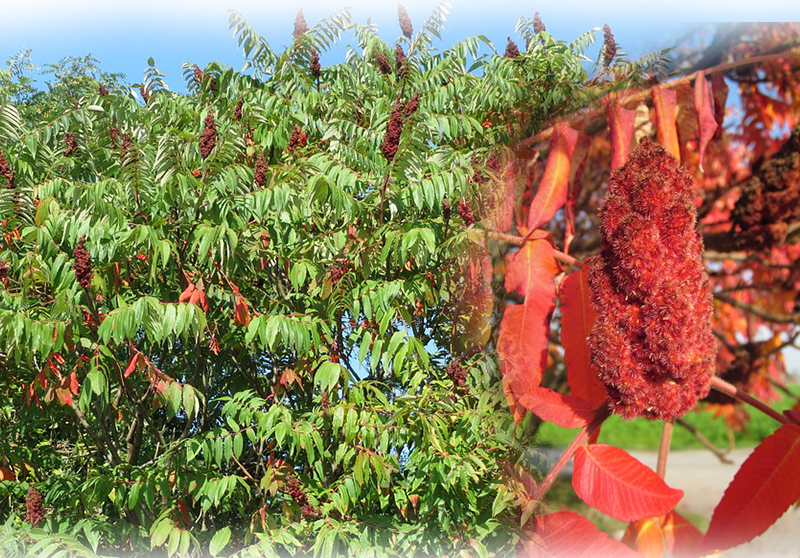
Staghorn sumac
 2
2 9
9 7
7Will it grow where I live?
Staghorn sumac is hardy to zone 4 – that covers all of Central Europe and the British Isles, and every USDA zone from 4 upwards.
Or check it for your location right here:
Profile
- Family
- Anacardiaceae
- Habit
- Shrub
- Height
- 6 m
- Spread
- 6 m
- Growth
- fast
- Lifespan
- 70 years
- First yield
- after 5 years
- Hardiness
- zone 4–8
- Shade tolerance
- light shade
- Soil
- Sand, Silt, Loam
- Soil moisture
- very dry – very moist
- pH
- 4.5 – 7.5
Flowering & harvest
| J | F | M | A | M | J | J | A | S | O | N | D | |
|---|---|---|---|---|---|---|---|---|---|---|---|---|
| Flowering | ||||||||||||
| Fruit harvest |
Uses
Edible: Fruit is cooked to make pies due to its sour taste. The small fruit, with little pulp, grows in large clusters, making it easy to harvest. Soaking the fruit in hot or cold water for 10-30 minutes creates a refreshing drink similar to lemonade. Avoid boiling the mixture to prevent the release of tannins, which would make the drink astringent.
Medicinal: Staghorn sumac was traditionally utilized by indigenous tribes in North America for its astringent properties. While not commonly used in contemporary herbal medicine, various parts of the plant have medicinal benefits. The bark is known for its antiseptic, astringent, galactogogue, and tonic qualities, with applications in treating conditions such as diarrhea, fever, hemorrhoids, and general weakness. The inner bark is particularly esteemed for its efficacy in addressing hemorrhoids. The roots possess astringent, blood-purifying, diuretic, and emetic properties, with historical use in treating venereal diseases and boils. Leaves are recognized for their astringent nature and have been historically used to alleviate asthma, diarrhea, and stomatosis. Fruits, when infused, serve as a tonic to stimulate appetite and alleviate diarrhea, while the berries themselves, known for their astringent and blood-purifying attributes, have been chewed to combat bedwetting and brewed into tea for sore throats. The flowers, valued for their astringent and stomachic properties, were employed in treating stomachaches, and the juice was applied topically to address warts, although caution is advised due to the potential for causing rashes in some individuals.
Other uses: The leaves of the plant contain high levels of tannin, reaching up to 48% in controlled plantations. They can be collected in autumn for making brown dye or mordant. The bark, particularly the root bark, and the fruits also have significant tannin content. Roots yield a yellow dye, while the inner bark and central pith of the stem, when mixed with bloodroot, produce an orange dye. Boiling the leaves and fruits can create black ink. The seeds yield an oil that solidifies into a tallow-like substance, used for making candles that burn brightly but emit strong smoke. Young shoots are crafted into pipes to extract sap from sugar maple trees. The plant's extensive root system makes it suitable for windbreaks and preventing soil erosion. The wood, although soft, light, brittle, and coarse-grained, weighs 27 pounds per cubic foot and is of little commercial value, occasionally used as raw lumber or for turning.
Growing
Thrives in well-drained, fertile soils in full sun, tolerating poor soils and dry conditions. Once established, it becomes drought-resistant and relatively wind-resistant, although branches may break in very strong winds. Highly hardy, it can endure temperatures as low as -25°C when completely dormant, but young spring growth is vulnerable to late frosts. A fast-growing but short-lived tree, it can spread freely, forming dense thickets that may pose issues in small areas. An attractive tree with various named cultivars, it is prone to coral spot fungus but notably resistant to honey fungus. Easy to transplant, Rhus typhina is an excellent bee plant due to its abundant pollen and nectar-producing flowers. While there is uncertainty about its name's validity, Rhus typhina is likely to be retained over Rhus hirta due to its familiarity. This species hybridizes with the closely related Rhus glabra. Some species in this genus are toxic, causing severe skin irritation, but Rhus typhina is non-toxic. Distinguishing toxic from non-toxic species is relatively easy: toxic species have axillary panicles and smooth fruits, while non-toxic species have compound terminal panicles and fruits with acidic crimson hairs. Dioecious, Rhus typhina requires both male and female plants for seed production.
Propagation
Seeds should be sown in a cool environment right after reaching maturity. Prior to planting, it is recommended to soak the seeds in hot water for a day to eliminate any substances that may hinder germination. The water used for soaking is safe to drink and offers a pleasant lemon taste. For stored seeds, a similar hot water treatment is necessary before planting in a cool setting during spring. Once the seedlings are sufficiently developed, they should be moved to individual pots and nurtured in a greenhouse during their initial winter. Transplant them to their permanent spot in late spring or early summer, post the final frost. In July/August, take cuttings from semi-ripe shoots measuring 10 cm with a heel, placing them in a frame. During December, take 4 cm long root cuttings and plant them vertically in a greenhouse for a high success rate. Produce cuttings from late autumn to winter.
Notable
Special features: drought-resistant; loves south-facing slopes; closely related to R. glabra; unlike other sumac plants (e.g., mango, cashew, etc.), the "Rhus poison" (urushiol) does not occur in the sumac; bark, roots, and leaves are also medicinally effective: an important medicinal tree among the Native Americans of North America and used in peace pipe tobacco blends.
Origin & habitat
Eastern North America - from New Brunswick to the southern Appalachians and west to Iowa.
Moist forests bordering mountain streams.
Frequently asked questions
Staghorn sumac: how big does it get?
Staghorn sumac (Rhus typhina) grows as a Shrub and reaches roughly 6 m in height when mature, with a spread of about 6 m. Growth is fast.
Staghorn sumac: what site does it need?
Staghorn sumac tolerates light shade. Suitable soils are Sand, Silt, Loam. Soil moisture should be in the range very dry – very moist. The pH may lie between 4.5 and 7.5.
Staghorn sumac: is it hardy?
Staghorn sumac is listed as hardy in zone 4–8 and survives normal winters outdoors there.
Staghorn sumac: will it grow in Central Europe?
Staghorn sumac is hardy to zone 4 – that covers all of Central Europe and the British Isles, and every USDA zone from 4 upwards.
Staghorn sumac: when does it flower?
In a temperate northern-hemisphere climate it flowers in June.
Staghorn sumac: when is it harvested?
In a temperate northern-hemisphere climate the fruit ripens in October.
Staghorn sumac: is it poisonous?
No toxicity is recorded for Staghorn sumac. With wild plants, never rely on a database alone — only on a confident identification.
Staghorn sumac: what is it used for?
Rated on a scale up to 10: Edible 2/10, Medicinal 9/10, Other uses 7/10.
Plan this plant into your own garden
Permaplans plans your garden to scale on the map — with a site check, harvest calendar and over 1,000 plants. Free for iPhone, Android, Mac, Windows & Linux.
Will this plant grow where you live? → Check your site
Community experience
No first-hand reports for this plant yet.
Growing it? Write in the app what works for you – your post will show up here.
💬 Get the app and join in