
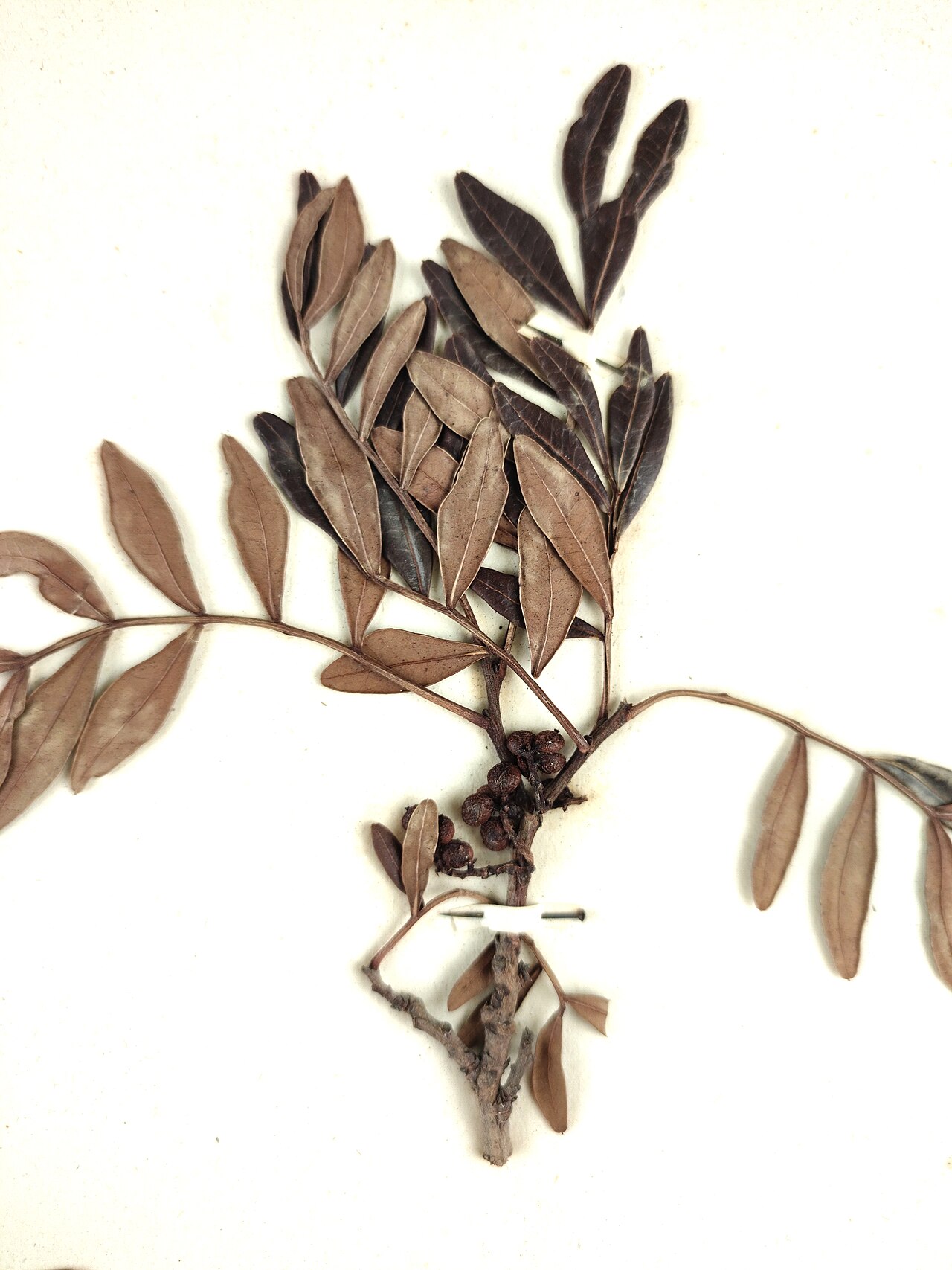
Mastic tree
 3
3 7
7 5
5Will it grow where I live?
Mastic tree is not winter-hardy in Central Europe (zone 9): outdoors from spring to autumn only, otherwise a container plant overwintered frost-free. It also needs warm summers – in Central Europe that means wine-growing regions, cities or a sheltered south-facing wall.
Or check it for your location right here:
Profile
- Family
- Anacardiaceae
- Habit
- Shrub
- Height
- 4 m
- Spread
- 3 m
- Growth
- very slow
- Lifespan
- 90 years
- First yield
- after 6 years
- Hardiness
- zone 9–11
- Shade tolerance
- full sun
- Soil
- Sand, Silt, Loam
- Soil moisture
- very dry – very moist
- pH
- 6.5 – 8.5
- Synonyms
- Mastiche
Flowering & harvest
| J | F | M | A | M | J | J | A | S | O | N | D | |
|---|---|---|---|---|---|---|---|---|---|---|---|---|
| Flowering | ||||||||||||
| Fruit harvest |
Uses
Edible: Durch Einschnitte in die Rinde des Baumstamms, jedoch nicht in das Holz, wird ein süßes, nach Lakritz schmeckendes Harz namens „Mastix“ gewonnen. Der Geruch ist angenehm, der Geschmack mild und harzig. Beim Kauen wird das Harz weich und kann so leicht zerkaut werden. Es wird gekaut, um das Zahnfleisch zu stärken und den Atem zu verbessern. Es wird auch als Aromastoff in Puddings, Süßigkeiten (einschließlich „Türkischem Honig“), Kuchen usw. verwendet. verwendet. verwendet . Es ist auch die Grundlage einer griechischen Süßware namens „Masticha“ und eines Likörs namens „Mastiche“. Aus den Samen wird ein Speiseöl gewonnen.
Medicinal: Mastic was once commonly used in herbal medicine, with the resin obtained from the tree (see below for more details) being utilized. In modern herbal medicine, it is rarely used, although it can be used as an expectorant for bronchial issues and coughs, as well as for treating diarrhea. The resin has analgesic, antitussive, carminative, diuretic, expectorant, dental, sedative, and stimulant properties. It is mixed with other substances and used as a temporary filling for decayed teeth. Internally, it is used to treat diarrhea in children, and externally for boils, ulcers, ringworm, and muscle stiffness.
Other uses: The resin, known as "mastic," is harvested from incisions in the bark (not the trunk) of the tree during late summer to autumn. It can be dried and used as a powder or distilled into oil and essence. The resin is utilized in high-quality varnishes, as a fixative in perfumes, toothpaste, adhesives (especially for fake beards), embalming, and temporary dental fillings, among other applications. It is also used to seal the edges of microscope slides and chewed to preserve teeth and gums. The oil extracted from the seeds is employed for lighting purposes, soap making, etc. The leaves contain up to 19% tannin and are frequently used as an adulterant for sumac (Rhus coriaria).
Growing
Landscaping and gardening: flower beds, pots, erosion control, privacy screens, individual plants. Thrives in any regular garden soil and prefers a warm, dry location in full sun. Prefers well-draining to dry, sandy or rocky, alkaline soil. This species is not very winter-hardy. It usually requires the protection of a south-facing wall but can also thrive in warmer, drier locations in milder regions. The mastic tree is cultivated in Southern Europe for its resin. It is a highly variable plant, with a form of broad leaves that yield the best resin. Likely needing long, hot, and dry summers to produce resin, it is probably not very common in the country. Any necessary pruning is best done in spring. For seed production, both male and female plants need to be grown. Special features: Not native to North America, inconspicuous flowers.
Origin & habitat
Europe - Mediterranean.
Offene Wälder und Buschland an trockenen Hängen, meist in Küstennähe.
⚠️ Hazards
Low risk of diarrhea in children. Avoid oral intake of essential oil.
Frequently asked questions
Mastic tree: how big does it get?
Mastic tree (Pistacia lentiscus) grows as a Shrub and reaches roughly 4 m in height when mature, with a spread of about 3 m. Growth is very slow.
Mastic tree: what site does it need?
Mastic tree tolerates full sun. Suitable soils are Sand, Silt, Loam. Soil moisture should be in the range very dry – very moist. The pH may lie between 6.5 and 8.5.
Mastic tree: is it hardy?
Mastic tree is listed as hardy in zone 9–11 and survives normal winters outdoors there.
Mastic tree: will it grow in Central Europe?
Mastic tree is not winter-hardy in Central Europe (zone 9): outdoors from spring to autumn only, otherwise a container plant overwintered frost-free. It also needs warm summers – in Central Europe that means wine-growing regions, cities or a sheltered south-facing wall.
Mastic tree: when does it flower?
In a temperate northern-hemisphere climate it flowers in April.
Mastic tree: when is it harvested?
In a temperate northern-hemisphere climate the fruit ripens in October.
Mastic tree: is it poisonous?
Individual parts of Mastic tree are noted as mildly problematic — the plant does not count as poisonous. With wild plants, never rely on a database alone, only on a confident identification.
Mastic tree: what is it used for?
Rated on a scale up to 10: Edible 3/10, Medicinal 7/10, Other uses 5/10.
Plan this plant into your own garden
Permaplans plans your garden to scale on the map — with a site check, harvest calendar and over 1,000 plants. Free for iPhone, Android, Mac, Windows & Linux.
Will this plant grow where you live? → Check your site
Community experience
No first-hand reports for this plant yet.
Growing it? Write in the app what works for you – your post will show up here.
💬 Get the app and join in