
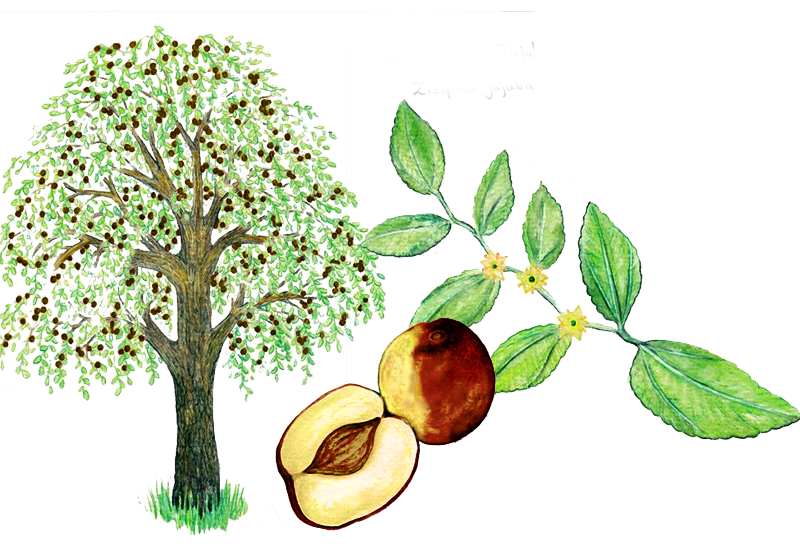
Jujube
 9
9 7
7 6
6Will it grow where I live?
Jujube is hardy to zone 6, which covers nearly all of Central Europe and the British Isles; only harsh upland sites (Alps, high ridges) call for winter protection. It also needs warm summers – in Central Europe that means wine-growing regions, cities or a sheltered south-facing wall.
Or check it for your location right here:
Profile
- Family
- Rhamnaceae
- Habit
- Tree
- Height
- 10.5 m
- Spread
- 7 m
- Growth
- very fast
- Lifespan
- 800 years
- First yield
- after 4 years
- Yield per plant
- up to 100 kg a year
- Yield in cultivation
- up to 10 t/ha
- Energy yield
- 400 kcal per m² a year
- Hardiness
- zone 6–10
- Shade tolerance
- full sun
- Soil
- Sand, Silt, Loam
- Soil moisture
- very dry – moist
- pH
- 5.5 – 8
- Synonyms
- chinesische Dattel,
Flowering & harvest
| J | F | M | A | M | J | J | A | S | O | N | D | |
|---|---|---|---|---|---|---|---|---|---|---|---|---|
| Flowering | ||||||||||||
| Fruit harvest |
Varieties (4)
4 varieties of Jujube are listed in the Permaplans variety finder — each with its own page: taste, ripening time, disease resistance, parentage and use.
Uses
Edible: Fruit can be consumed raw or cooked, offering a starchy and sweet taste with a hint of sourness. It can be enjoyed fresh, dried, or incorporated into various dishes like puddings, cakes, and soups. Dried fruit is particularly flavorful and versatile, often ground into powder for making "kochujang," a fermented paste akin to miso. Each fruit is approximately 13 mm in diameter and typically contains one or two seeds. Wild trees in the Himalayas yield an average of 9.5 kg of fruit annually. The fruit's composition includes around 8.7% sugar, 2.6% protein, 1.4% ash, 1.7% pectin, and 1.3% tannin. While usually 25 mm long, cultivated varieties can grow larger. Additionally, the fruit can serve as a coffee alternative, and in emergencies, the leaves are edible when cooked.
Medicinal: Jujube is a nutritious fruit with medicinal properties that can aid in weight gain, enhance muscle strength, and boost endurance. In traditional Chinese medicine, it is recommended as a liver tonic. Studies in Japan have demonstrated its ability to strengthen the immune system. A clinical trial in China involved 12 individuals with liver issues who consumed a mixture of jujube, peanuts, and brown sugar nightly. Within a month, their liver function showed improvement. Jujube is recognized for its diverse therapeutic properties, including being an antidote, diuretic, expectorant, analgesic, and tonic. It is believed to purify the blood and aid digestion. The dried fruits of jujube contain beneficial compounds like saponins, triterpenoids, and alkaloids. Internally, they are used to address conditions such as chronic fatigue, loss of appetite, diarrhea, and anemia. The seeds contain active medicinal components like saponins, triterpenes, flavonoids, and alkaloids, which are utilized to alleviate issues like palpitations, insomnia, and excessive sweating. Jujube root is employed for digestive problems and as a remedy for fever. It can be processed into a powder for application on wounds and ulcers. The leaves have astringent properties, promote hair growth, and are beneficial for conditions like stranguria. This plant is a popular folk remedy for various ailments such as anemia, hypertension, and nervous disorders. In China, it is commonly used for treating burns.
Other uses: The plants can be trained as hedges; their thorns make such a hedge an effective barrier. The wood is red, dense, hard and markedly durable — it is used for turning and joinery and for agricultural implements, and yields good charcoal and fuel. The leaves serve, like those of the mulberry, as silkworm fodder. In the growing countries the jujube supports a product range of its own: in northern Italy spirits and preserves are made from it, while in northern China entire processing chains run from plantation through drying and packing to sale.
Growing
Site: Lean, dry and sunny all day — heat is its element, waterlogging its end. It requires hardiness zone 8, that is a vine-growing climate; outside such places only a container will do. Two peculiarities belong in the planning: the branches carry stout thorns, which makes it wrong beside paths and seating, and own-rooted plants throw suckers that spread through a bed. Grafted specimens do not. It needs no pollinator, being self-fertile. Care: Winter protection is aimed less at frost than at winter sun, which heats the wood and splits it — brushwood or fleece suffice, and container plants overwinter frost-free. Feed sparingly; generous feeding comes at the cost of fruit set and ripening. Disease is practically a non-issue; only in very hot summers do spider mites appear, usually on container plants kept dry. Harvest from September in several passes, as the fruit ripens in succession.
Propagation
The species can be raised from seed, though with pitfalls: seed from self-fertile large-fruited selections is more than half empty, whereas seed resulting from cross-pollination germinates considerably better. To aid germination the hard stones are opened with secateurs. The seed is then stratified for about two months, but must not be exposed to sub-zero temperatures. Seedlings need around two years before they can be grafted; fruit true to type is not to be expected from them. Cultivars are therefore grafted — chip budding, shield budding and whip-and-tongue grafting are usual. Own-rooted cultivars can additionally be propagated from suckers and root cuttings. Young plants begin to bear at three to four years.
Value for wildlife
The jujube flowers from May to July with small, inconspicuous green flowers that carry plenty of nectar — in its countries of origin jujube honey is a variety in its own right. In Central Europe the return is more modest: only two wild bee species have so far been recorded on it, neither of them specialists. Since the species is self-fertile, it needs neither pollinators nor a second cultivar to set fruit. As a northern Chinese crop it has attracted no caterpillars here, so its contribution is limited to early-summer nectar. Anyone aiming specifically to support insects will achieve far more with hawthorn, crab apple or blackthorn.
Notable
Special features: very heat-loving and drought-resistant, needs permeable soil. Yields per tree range from 10-300 kg! Location and variety are likely crucial; the tree forms root suckers for propagation; sprouts late → not susceptible to late frost; often only 4-7 m tall. Cultivated for thousands of years in the semi-deserts of China.
Origin & habitat
Northern and north-eastern China; cultivated in warm regions worldwide. The jujube originates in northern and north-eastern China, where it has been grown for millennia in the semi-desert regions and still ranks among the country's most important fruit crops. From there it reached Korea, Japan, India, Iran and south-eastern Europe. Today it is cultivated throughout China, in north-west India, Vietnam, Georgia, Afghanistan, Sudan, western Asia, the Mediterranean, North Africa and in North and South America. In the Mediterranean it is attested in antiquity: Pliny reports that it was brought to Italy in the last years of Augustus.
In the wild the jujube grows in mountains and hills, in sunny, dry places up to altitudes of 1,700 m. It is a plant of arid and semi-arid country — the semi-deserts of northern China are the heart of its cultivation, and there its real strength shows: it endures heat and drought as hardly any other fruiting woody plant does. Nutrient-poor to average, free-draining and rather dry soils suffice; waterlogging it will not tolerate. In Central Europe it thrives only in a vine-growing climate, and even there the fruit ripens fully only in warm years. It is not summer warmth but winter cold that limits its range.
⚠️ Hazards
The flesh of the fruit is considered harmless; the elongated stone, pointed at both ends, is not eaten. Safety during pregnancy and breastfeeding is not sufficiently documented, and there are indications of a contraceptive effect from bark extracts — medicinal use during this time is therefore not advisable. The branches carry stout thorns; stout gloves are advisable when harvesting and pruning.
Frequently asked questions
Jujube: how big does it get?
Jujube (Ziziphus jujuba) grows as a Tree and reaches roughly 10.5 m in height when mature, with a spread of about 7 m. Growth is very fast.
Jujube: what site does it need?
Jujube tolerates full sun. Suitable soils are Sand, Silt, Loam. Soil moisture should be in the range very dry – moist. The pH may lie between 5.5 and 8.
Jujube: is it hardy?
Jujube is listed as hardy in zone 6–10 and survives normal winters outdoors there.
Jujube: will it grow in Central Europe?
Jujube is hardy to zone 6, which covers nearly all of Central Europe and the British Isles; only harsh upland sites (Alps, high ridges) call for winter protection. It also needs warm summers – in Central Europe that means wine-growing regions, cities or a sheltered south-facing wall.
Jujube: when does it flower?
In a temperate northern-hemisphere climate it flowers in June.
Jujube: when is it harvested?
In a temperate northern-hemisphere climate the fruit ripens in October.
Jujube: when does it start cropping, and how much?
Jujube first crops after 4 years. A mature plant gives up to 100 kg a year, in cultivation up to 10 t per hectare. Figures assume a good site; variety, soil and climate shift them considerably.
Jujube: is it poisonous?
No toxicity is recorded for Jujube. With wild plants, never rely on a database alone — only on a confident identification.
Jujube: what is it used for?
Rated on a scale up to 10: Edible 9/10, Medicinal 7/10, Other uses 6/10.
Which Jujube varieties are there?
The Permaplans variety finder lists 4 varieties of Jujube, including Lang, Li, Parvenec, Provence. Each variety has its own page with taste, ripening time, disease resistance and parentage.
Plan this plant into your own garden
Permaplans plans your garden to scale on the map — with a site check, harvest calendar and over 1,000 plants. Free for iPhone, Android, Mac, Windows & Linux.
Will this plant grow where you live? → Check your site
Community experience
No first-hand reports for this plant yet.
Growing it? Write in the app what works for you – your post will show up here.
💬 Get the app and join in