
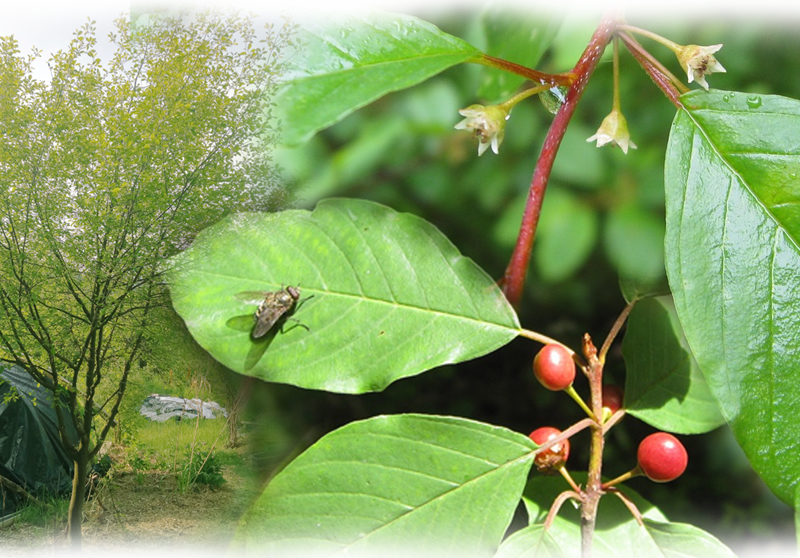
Buckthorn
 5
5 5
5Will it grow where I live?
Buckthorn is hardy to zone 3 – that covers all of Central Europe and the British Isles, and every USDA zone from 3 upwards.
Or check it for your location right here:
Profile
- Family
- Rhamnaceae
- Habit
- Shrub
- Height
- 5 m
- Spread
- 4 m
- Growth
- fast
- Lifespan
- 70 years
- First yield
- after 5 years
- Hardiness
- zone 3–8
- Shade tolerance
- partial shade
- Soil
- Sand, Silt, Loam, Clay
- Soil moisture
- dry – very wet
- pH
- 5 – 7.5
Flowering & harvest
| J | F | M | A | M | J | J | A | S | O | N | D | |
|---|---|---|---|---|---|---|---|---|---|---|---|---|
| Flowering | ||||||||||||
| Fruit harvest |
Uses
Edible: The bark, leaves, and fruit of this plant are toxic, leading to severe vomiting and diarrhea. Consuming 15-20 berries on an empty stomach in the morning results in a milder laxative effect compared to the bark. Caution is advised to prevent ingestion of this plant.
Medicinal: Dried inner bark aged for more than a year can produce a strong smell and result in multiple health issues, including chronic constipation, abdominal swelling, liver-related conditions, and parasitic infections. Additionally, it may contribute to gum problems, scalp issues, and skin reactions. To prevent severe vomiting, it is advised to opt for fresh or premium items.
Other uses: The leaves and bark change color when combined with iron salts. The fruit is green when immature and blue/gray when mature. The wood is utilized for a variety of items like veneer, wooden nails, shoehorns, and talismans. It can also be turned into charcoal or gunpowder. Wood serves numerous purposes.
Growing
An easily cultivated plant that thrives in various soil types, particularly in neutral to acidic conditions, and prefers moist or peaty soils. It grows best in moist, moderately fertile soil under sun or partial shade, avoiding flooded conditions. It is not tolerant of drought or strong winds. The plant can withstand temperatures as low as -15°C. Alder buckthorn, a slow-growing plant, was historically grown for its wood, commonly used for charcoal production. It shows resilience in recovering from forest fires or grazing. Flowering occurs on both one-year-old wood and the current year's growth. Cultivated in southern Europe for its medicinal properties. It often hosts the aecidospore stage of oat crown rust. Species within this genus exhibit notable resistance to honey fungus. A valuable plant for bees and a primary food source for brimstone butterfly larvae.
Propagation
Seeds should be planted in autumn in a cool environment. Seeds that have been stored need 1-2 months of cold treatment at approximately 5°C and should be planted as soon as possible either indoors or outdoors. Germination rates are typically high, reaching at least 80% by the end of spring. Once seedlings are large enough, transfer them to individual pots and cultivate them in a greenhouse or cool setting during the initial winter. By late spring or early summer of the next year, they can be planted outdoors. Take cuttings from semi-mature shoots in July or August and place them in a frame. Take cuttings from mature wood of the current year in autumn and place them in a frame. Perform stratification in early spring.
Value for wildlife
Alder buckthorn is one of the most valuable hedge shrubs in Central Europe, and the reason is its flowering rhythm: it blooms from late May right into September, carrying buds, open flowers and ripening fruit on the same branch at once. That bridges precisely the summer gap in which most shrubs have long finished. Nectar and pollen are plentiful, and the inconspicuous greenish flowers are worked by honey bees and wild bees, bumblebees, ichneumon wasps and beetles, with four wild bee species recorded by name. Its best-known role is as a nursery: the leaves are the most important caterpillar food of the brimstone butterfly, and thirty-three butterfly and moth species use it in all, one of them exclusively. The fruit ripens over weeks from green through red to black and is eaten by thirty-six bird species; fieldfares, mistle thrushes and pheasants carry the seed a long way. If you can plant only one shrub for insects, plant this one.
Notable
Special features: Often grows in wet locations as an irregularly branched, shallow-rooted shrub (2-4m), otherwise a small, deep-rooted tree; valuable for many insects and bird species; long flowering period with ~300 insect visits per flower in 2 weeks; formerly cultivated for gunpowder production, as the coal hardly decomposes to ash.
Origin & habitat
Europe, North Africa and western Asia to Siberia. Alder buckthorn occurs across almost all of Europe, from Scandinavia and northern Russia to the mountains of North Africa, and extends through the Caucasus and Asia Minor into western Siberia and north-western China. In Central Europe it is native throughout, from the coast to the montane zone, absent only from decidedly dry districts. It was introduced to North America in the nineteenth century as an ornamental and hedging shrub; there it has spread strongly in the north-eastern United States and eastern Canada, displacing native understorey species in wet woodland, and is classed as invasive — a mark of its adaptability that implies no restriction in its home range.
Alder buckthorn grows mainly on moist, seasonally wet and waterlogged ground: alder carr, birch bog, floodplain woodland, mire margins, damp woodland fringes and riverside scrub are its core habitats. Towards pH and light it is strikingly indifferent — it thrives on acid peat as readily as on calcareous ground and copes in the part shade of closed woodland as well as in full sun. Hence it is also found away from wet ground on drier sands, in open pine woods, on heaths and along forest tracks. In Central Europe it occurs from the coast to the montane zone and is among the least demanding native shrubs there is.
⚠️ Hazards
Toxicity: toxic
The plant needs to be stored for 12 months before use to remove its poisonous properties. The report probably concerns the bark.
Frequently asked questions
Buckthorn: how big does it get?
Buckthorn (Rhamnus frangula) grows as a Shrub and reaches roughly 5 m in height when mature, with a spread of about 4 m. Growth is fast.
Buckthorn: what site does it need?
Buckthorn tolerates partial shade. Suitable soils are Sand, Silt, Loam, Clay. Soil moisture should be in the range dry – very wet. The pH may lie between 5 and 7.5.
Buckthorn: is it hardy?
Buckthorn is listed as hardy in zone 3–8 and survives normal winters outdoors there.
Buckthorn: will it grow in Central Europe?
Buckthorn is hardy to zone 3 – that covers all of Central Europe and the British Isles, and every USDA zone from 3 upwards.
Buckthorn: when does it flower?
In a temperate northern-hemisphere climate it flowers in May.
Buckthorn: when is it harvested?
In a temperate northern-hemisphere climate the fruit ripens from August to September.
Buckthorn: is it poisonous?
Buckthorn is classified as toxic. With wild plants, never rely on a database alone — only on a confident identification.
Buckthorn: what is it used for?
Rated on a scale up to 10: Medicinal 5/10, Other uses 5/10.
Plan this plant into your own garden
Permaplans plans your garden to scale on the map — with a site check, harvest calendar and over 1,000 plants. Free for iPhone, Android, Mac, Windows & Linux.
Will this plant grow where you live? → Check your site
Community experience
No first-hand reports for this plant yet.
Growing it? Write in the app what works for you – your post will show up here.
💬 Get the app and join in