
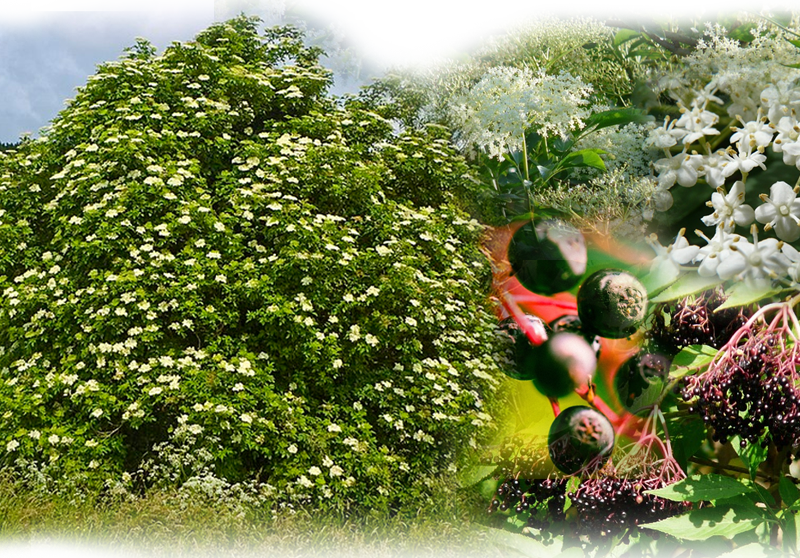
Black elderberry
 7
7 7
7 8
8Will it grow where I live?
Black elderberry is hardy to zone 5 – that covers all of Central Europe and the British Isles, and every USDA zone from 5 upwards.
Or check it for your location right here:
Profile
- Family
- Caprifoliaceae
- Habit
- Shrub
- Height
- 7 m
- Spread
- 6 m
- Growth
- very fast
- Lifespan
- 100 years
- First yield
- after 3 years
- Yield per plant
- up to 40 kg a year
- Yield in cultivation
- up to 10 t/ha
- Energy yield
- 800 kcal per m² a year
- Hardiness
- zone 5–9
- Shade tolerance
- partial shade
- Soil
- Sand, Silt, Loam, Clay
- Soil moisture
- semi-dry – very wet
- pH
- 5 – 7
- Synonyms
- Holunderbaum
Flowering & harvest
| J | F | M | A | M | J | J | A | S | O | N | D | |
|---|---|---|---|---|---|---|---|---|---|---|---|---|
| Flowering | ||||||||||||
| Fruit harvest | ||||||||||||
| Leaf harvest |
Varieties (8)
8 varieties of Black elderberry are listed in the Permaplans variety finder — each with its own page: taste, ripening time, disease resistance, parentage and use.
Uses
Edible: Fruits are versatile and can be consumed fresh, dried, or cooked to enhance dishes with their color and taste. They are also utilized in producing wine, juice, and jam. An average yield of 11 tons of fruit per hectare provides around 600 calories per square meter. Flowers, on the other hand, can be eaten fresh or used in baking, as well as in preparing syrup, sparkling wine, or tea.
Medicinal: Berries aid in intestinal cleansing and enhancing the immune system, cells, and nerves, as well as alleviating flu symptoms and sore eyes. Flowers support the immune system, induce sweating and urination, and thin mucus, and can be brewed into tea. Leaves are effective in preparing ointments for bruises, swellings, and sore nipples. The inner bark serves as a natural laxative and emetic for internal detoxification.
Other uses: Berries can dye leather and hair blue or purple, and the roots and bark yield black dye. The wood, white and fine-grained, is suitable for crafting flutes, whistles, and toys due to its easy cutting and polishing properties. Additionally, pioneers found that the extensive roots of this plant enhance compost heap fermentation.
Growing
Site: Light shade to half shade; elder will grow under trees but flowers and fruits distinctly less well there. In hot positions do not place it in full sun — summer temperatures above 30 degrees with strong radiation cause sunscald on the fruit, which readily invites fungal infection of the cymes. It wants humus- and nitrogen-rich soil and plenty of water but tolerates no waterlogging. Pollution-tolerant and moderately salt-tolerant, so usable in urban settings and near roads. A large shrub or small tree to 7 metres; allow three to four metres in a garden. Care: Pruning is not essential but pays: the cymes form on short shoots of the previous year's wood, so cut branches that have borne back to young shoots arising near the ground — the yield rises considerably. In winter pruning, leave 12 to 15 strong, not over-lush young shoots. Full cropping from the fourth year at 20 to 25 kilograms per bush. Elder aphids are the commonest pest, voles the most serious — a wire basket at planting is worthwhile. Gall mites, cyme wilt, stalk necrosis and botrytis also occur.
Propagation
Elder is one of the easiest woody plants to propagate: hardwood cuttings in winter, softwood cuttings in summer or rooted suckers take almost by themselves. Sowing is worthwhile only when looking for new types — seedlings come out variable and need warm-then-cold stratification. What matters is the origin of the material: wild stands are heavily virus-infected, so only demonstrably virus-free propagation material should be used. Anyone growing for yield should take tested cultivars such as 'Haschberg' or 'Donau'. Most cultivars are self-fertile, though cross-pollination raises yields, and individual selections such as 'Rubin' depend on it. Full cropping begins in the fourth year and can reach 20 to 25 kilograms per bush.
Value for wildlife
Black elder is among the most valuable native food shrubs. Roughly 62 bird species feed on its berries, including blackbirds, thrushes and warblers that seek it out in late summer, and eight mammal species take the fruit as well. The broad flower umbels draw a wide range of insects in June, among them 19 species of hoverfly. As a larval food plant it supports 22 moth and butterfly species, one of which depends on it exclusively. Its dense branching also offers birds cover and nesting sites, which is why elder earns its place twice over in hedges and woodland edges.
Notable
Special features: (sea+)wind+pollutant tolerant; high yield cultivation with special varieties; dedicated to the earth goddess 'Frau Holle'; sacred to the Celts, among other things as a birth+death tree; undemanding nitrogen indicator; supposed to divert negative energies into the earth; blossom marks the beginning of summer, fruit ripening the beginning of autumn; the medicine chest of the rural population+ poor man's wine.
Origin & habitat
Europe and western Asia. Black elder occurs throughout Europe, from southern Scandinavia to the Mediterranean, and extends across North Africa to Asia Minor and the Caucasus. In Central Europe it is among the commonest woody plants of all, growing from the lowlands into the uplands; plantation growing is possible, in Styria at least, up to 1000 metres. It has stood in cottage gardens as a cultivated plant for centuries. Commercial production now centres on Austria with more than 1200 hectares and Hungary with around 1000; Austrian cultivar work at Klosterneuburg has shaped the crop since the 1960s.
Black elder is a nitrogen indicator and settles exactly where nutrients accumulate: woodland edges and clearings, hedges and scrub, riparian stands and floodplain woods, rubble sites, railway embankments, ruderal ground and the margins of farmyards and stables. It is a light to half-shade plant and will still grow under trees, though it flowers and fruits far more weakly there. It prefers moderately fresh, humus- and nitrogen-rich soils in the neutral to slightly acid range; it takes waterlogging badly despite needing plenty of water. As a pioneer it is pollution-hardy and moderately salt-tolerant and colonises disturbed ground quickly.
⚠️ Hazards
The leaves and stems are toxic. Some species may have fruits that cause stomach issues, but there are no reported cases for this particular species. Any toxins in the fruit are minimal and can be eliminated through cooking.
Frequently asked questions
Black elderberry: how big does it get?
Black elderberry (Sambucus nigra) grows as a Shrub and reaches roughly 7 m in height when mature, with a spread of about 6 m. Growth is very fast.
Black elderberry: what site does it need?
Black elderberry tolerates partial shade. Suitable soils are Sand, Silt, Loam, Clay. Soil moisture should be in the range semi-dry – very wet. The pH may lie between 5 and 7.
Black elderberry: is it hardy?
Black elderberry is listed as hardy in zone 5–9 and survives normal winters outdoors there.
Black elderberry: will it grow in Central Europe?
Black elderberry is hardy to zone 5 – that covers all of Central Europe and the British Isles, and every USDA zone from 5 upwards.
Black elderberry: when does it flower?
In a temperate northern-hemisphere climate it flowers in June.
Black elderberry: when is it harvested?
In a temperate northern-hemisphere climate the fruit ripens in September.
Black elderberry: when does it start cropping, and how much?
Black elderberry first crops after 3 years. A mature plant gives up to 40 kg a year, in cultivation up to 10 t per hectare. Figures assume a good site; variety, soil and climate shift them considerably.
Black elderberry: is it poisonous?
Individual parts of Black elderberry are noted as mildly problematic — the plant does not count as poisonous. With wild plants, never rely on a database alone, only on a confident identification.
Black elderberry: what is it used for?
Rated on a scale up to 10: Edible 7/10, Medicinal 7/10, Other uses 8/10.
Which Black elderberry varieties are there?
The Permaplans variety finder lists 8 varieties of Black elderberry, including Black Beauty, Donau, Erfurt, Goldbeere, Haidegg 17, Haschberg, Mammut, Sampo. Each variety has its own page with taste, ripening time, disease resistance and parentage.
Plan this plant into your own garden
Permaplans plans your garden to scale on the map — with a site check, harvest calendar and over 1,000 plants. Free for iPhone, Android, Mac, Windows & Linux.
Will this plant grow where you live? → Check your site
Community experience
No first-hand reports for this plant yet.
Growing it? Write in the app what works for you – your post will show up here.
💬 Get the app and join in