
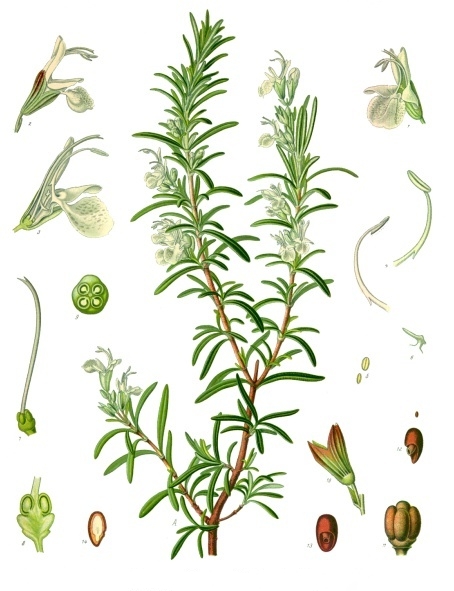
Rosemary
 4
4 8
8 8
8Will it grow where I live?
Rosemary is hardy to zone 7: lowlands, river valleys and cities across Central Europe are fine, harsher continental or upland sites need winter protection or a container.
Or check it for your location right here:
Profile
- Family
- Lamiaceae
- Habit
- Shrub
- Height
- 1.5 m
- Spread
- 1.5 m
- Growth
- medium
- Lifespan
- 15 years
- First yield
- after 3 years
- Hardiness
- zone 7–10
- Shade tolerance
- full sun
- Soil
- Sand, Silt
- Soil moisture
- very dry – very moist
- pH
- 6 – 8
Uses
Edible: Young shoots, leaves, and flowers - raw or cooked. The leaves have a very strong taste, bitter and somewhat resinous, while the flowers are milder. They are used in small amounts as a spice in soups and stews, with vegetables like peas and spinach, and in sweet dishes like cookies, cakes, jams, and jellies. They can be used fresh or dried. The leaves have a firm texture and should be either finely chopped or used in sprigs that can be removed after cooking. A fragrant tea is made from the fresh or dried leaves, believed to taste especially good when mixed with tansy.
Other uses: Steam distillation of leaves and flowering shoot tips yields essential oil of rosemary, a basic material of perfumery and soap making; the classic eau de Cologne and the fourteenth-century Hungary water were both built on it. An infusion of the dried plant is added to hair shampoos, and the leaves give a green-yellow dye. Dried sprigs in the wardrobe keep moths away; the claim that the growing plant draws pest insects away from neighbouring crops is often made but not well supported. What is well supported is the strongly antiseptic action of the oil, which is why rosemary twigs were once burned to disinfect sickrooms. Around the Mediterranean rosemary serves as a low, clippable hedge and for slope stabilisation, while the prostrate forms clothe wall tops and dry stone walls.
Growing
Site: Success is decided not by cold but by winter wet. Rosemary belongs in the warmest, ideally rain-sheltered spot in the garden, against a south wall or on a dry stone wall where water drains away; in heavy garden soil it dies in the first wet winter. As a subshrub of 50 to 200 centimetres it is not a perennial to be cleared away in autumn but needs its place permanently. In the herb bed sage makes a good neighbour, having the same requirements. Let it flower and you get visits from bumblebees and the violet carpenter bee from February and again in autumn. Care: Do not feed, because kept nutrient-poor it develops more essential oil and goes into winter harder. In late winter, after the last hard frost, cut back into young wood to keep it bushy; cut into old, leafless wood and it will not reshoot there, leaving a permanent gap. Harvest year-round, taking whole sprigs rather than single leaves. North of the Alps it is only reliably hardy in mild wine-growing districts; otherwise protect it with brushwood and a cover against wet, or overwinter it in a pot in a bright place at about five degrees. Water sparingly, since waterlogging is the commonest cause of death.
Propagation
Cuttings are the normal route, because seedlings vary widely and cultivars do not come true. From May to August take semi-ripe, non-flowering shoot tips of eight to ten centimetres, strip the lower leaves and insert them into lean, sandy substrate; at 18 to 20 degrees with even but sparing moisture they root in three to four weeks. Kept too wet they rot at once. Layering succeeds almost by itself with the prostrate forms: peg a shoot down, cover it with soil and sever it after a few months. Sowing is only worthwhile for the wild form. The seed needs warmth above 20 degrees, germinates in about four weeks and then unreliably, and the plants take two to three years to reach harvestable size. Always start more cuttings than you need, as losses are high.
Value for wildlife
Rosemary is a neophyte and yet one of the better bee plants in the herb bed. 29 solitary bee species are recorded on it, two of them specialists. It is pollinated by long-tongued species that can reach into the narrow labiate flower: bumblebees, hairy-footed flower bees, leafcutter bees and above all the violet carpenter bee, the largest native wild bee. Timing is what matters. In mild positions rosemary flowers as early as February and again in autumn, filling exactly the gaps in the forage calendar when scarcely anything else is open. Nectar and pollen value each sit at two of four levels, that is to say moderate. As caterpillar food it serves a single species, the beautiful plume moth. In the Mediterranean ants disperse its seeds. Anyone who wants the wildlife value must not harvest everything but leave part of the shoots to flower.
Notable
Special features: evergreen subshrub (50-200cm, ~20-30cm growth/year); harvest year-round whole sprigs rather than single leaves; flowers from February in mild positions + a 2nd time in autumn → fills gaps in the forage calendar; only borderline hardy (~-17°C), cultivar 'Arp' below -20°C; bare frost+winter wet kill it, not cold alone; no feeding → more essential oil + better frost hardiness; upright (officinalis) + prostrate (Prostratus group) forms; dries without loss of aroma;
Origin & habitat
Western and central Mediterranean: from Portugal and Spain through southern France, Italy and the Balkans to Greece and Turkey, together with the North African coast from Morocco through Algeria and Tunisia to Libya and Egypt. Its centre of gravity lies in the coastal regions between Portugal and the Ionian Sea. Rosemary has been cultivated in the eastern Mediterranean since antiquity; north of the Alps it is documented from the time of Charlemagne, who prescribed it for monastery gardens. In Central Europe it is purely a cultivated plant and escapes only briefly if at all. In warm Alpine valleys it holds on at surprising altitudes: to 880 metres in Vorarlberg and to 1500 metres at the Simplon Pass.
Rosemary is a character species of maquis and garrigue, the low aromatic scrub that has taken the place of the cleared holm oak forests around the Mediterranean. It grows on sunny, dry, lime-rich slopes, on rock debris and near the coast, where salt wind and summer drought exclude anything needing more water. In phytosociological terms it is a character species of the Rosmarino-Ericion alliance. Its indicator values give an unambiguous picture: neutral to basic reaction, markedly nutrient-poor and markedly dry. The narrow, leathery leaves with their felted undersides are the answer to those conditions. What limits it is not drought but winter: its range ends where bare frosts below about minus 15 degrees occur regularly.
Frequently asked questions
Rosemary: how big does it get?
Rosemary (Rosmarinus officinalis) grows as a Shrub and reaches roughly 1.5 m in height when mature, with a spread of about 1.5 m. Growth is medium.
Rosemary: what site does it need?
Rosemary tolerates full sun. Suitable soils are Sand, Silt. Soil moisture should be in the range very dry – very moist. The pH may lie between 6 and 8.
Rosemary: is it hardy?
Rosemary is listed as hardy in zone 7–10 and survives normal winters outdoors there.
Rosemary: will it grow in Central Europe?
Rosemary is hardy to zone 7: lowlands, river valleys and cities across Central Europe are fine, harsher continental or upland sites need winter protection or a container.
Rosemary: is it poisonous?
No toxicity is recorded for Rosemary. With wild plants, never rely on a database alone — only on a confident identification.
Rosemary: what is it used for?
Rated on a scale up to 10: Edible 4/10, Medicinal 8/10, Other uses 8/10.
Plan this plant into your own garden
Permaplans plans your garden to scale on the map — with a site check, harvest calendar and over 1,000 plants. Free for iPhone, Android, Mac, Windows & Linux.
Will this plant grow where you live? → Check your site
Community experience
No first-hand reports for this plant yet.
Growing it? Write in the app what works for you – your post will show up here.
💬 Get the app and join in