 3
3 9
9 6
6Will it grow where I live?
Peppermint is hardy to zone 3 – that covers all of Central Europe and the British Isles, and every USDA zone from 3 upwards.
Or check it for your location right here:
Profile
- Family
- Lamiaceae
- Habit
- perennial
- Height
- 0.9 m
- Spread
- 0.2 m
- Growth
- very fast
- Lifespan
- 5 years
- First yield
- after 1 year
- Hardiness
- zone 3–10
- Shade tolerance
- light shade
- Soil
- Sand, Silt, Loam, Clay
- Soil moisture
- semi-dry – very wet
- pH
- 6 – 7
- Synonyms
- M. aquatica citrata, M. citrata
Flowering & harvest
| J | F | M | A | M | J | J | A | S | O | N | D | |
|---|---|---|---|---|---|---|---|---|---|---|---|---|
| Flowering | ||||||||||||
| Fruit harvest |
Uses
Edible: Leaves can be consumed raw or cooked to add flavor to salads or dishes. True Eau de Cologne mint has a strong taste, while the 'Basil' variety is a suitable alternative to basil in pesto due to its excellent flavor. The leaves, whether fresh or dried, are also suitable for brewing herbal tea.
Medicinal: The plant's root is utilized for treating rheumatism and cancer, while the whole plant is used for alleviating skin allergies and in cancer therapy.
Other uses: Lavender oil, extracted from the entire plant, is utilized in perfumes, oral care items, and personal care products. Historically, lavender served as a natural insect and rodent repellent, particularly in granaries due to rodents' aversion to mint scent.
Growing
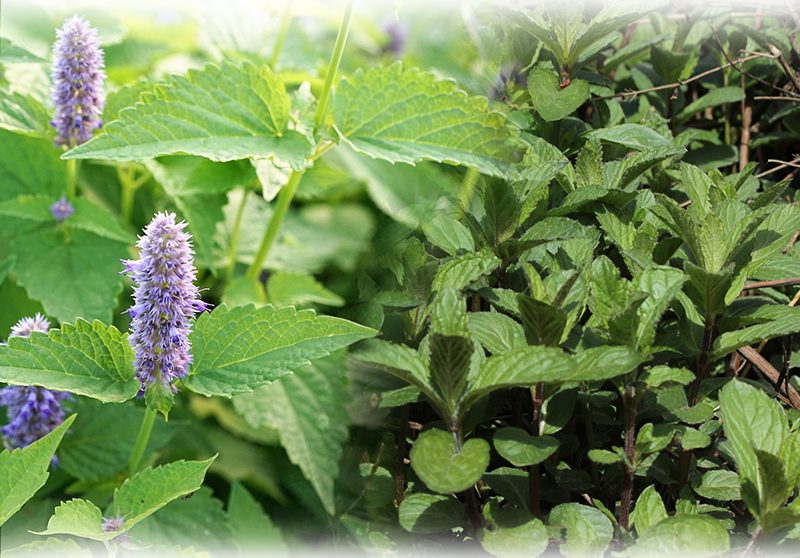
An easily cultivated plant that grows well in various soils and conditions, except very dry soil. It does particularly well in heavy clay soil and prefers a sunny location for optimal essential oil production, although it can also thrive in partial shade. It prefers slightly acidic soil and can withstand neglect, even growing well in tall grass. This plant readily hybridizes with other genus members. Its flowers are highly attractive to bees and butterflies, making it a beneficial companion plant for cabbage and tomatoes to deter insects. To prevent its aggressive spread, mint is best grown in containers alongside other plants. The entire plant emits a strong minty scent with a hint of ginger. Better quality essential oil is produced when the plant is grown in dry soil. Plants in this genus are seldom or never targeted by deer.
Propagation
Peppermint is sterile and sets no viable seed — sowing is out, and anything sold as mint seed will give other species or random crosses. Propagation is entirely vegetative, and it could hardly be easier: the plant throws out numerous runners above and below ground, and virtually any piece carrying a node will take. In spring or autumn, cut off a length of rhizome and lay it shallowly in its new place; shoot-tip cuttings root in a glass of water within a fortnight. That vigour is precisely the catch: the runners thread through a bed quickly and crowd out neighbours. To keep the mint from travelling, grow it in a container, or in a bottomless pot standing ten centimetres proud of the soil.
Value for wildlife
Peppermint flowers from July to September, at a time when many spring nectar sources have long dried up. Its nectar value is high and its pollen value moderate; around 29 wild bee species visit it, from the violet carpenter bee through the buff-tailed bumblebee to the wool carder bee, none of them specialists. Five butterfly and moth species have been observed at the flowers, among them the gatekeeper, the sooty copper and the Jersey tiger. Being a sterile cross between water mint and spearmint, peppermint sets no seed and has no caterpillar fauna of its own. Anyone wanting to support insects should let part of the planting flower rather than cutting it continuously for harvest.
Notable
Special features: Perennial plant that forms roots, either in the ground or in pots. Avoid mixing with different herbs or types of mint. Peppermint produces more essential oil when exposed to increased sunlight and dry conditions. The hybrid variety is sterile and can be propagated by dividing the rhizome at any time.
Origin & habitat
A cultivated hybrid with no natural range; origin England, 1696. Peppermint is not a wild species but a chance cross between water mint (Mentha aquatica) and spearmint (Mentha spicata), found by John Ray in an English garden in 1696. Because one parent is itself a hybrid, the result is a sterile triple cross with no distribution area of its own — every stand today traces back to vegetative propagation. It is recorded in Germany from about 1780. Commercial growing now centres on Michigan and New York, Spain, the Balkans, South America and Asia; the German areas lie in the peatlands around Munich, especially near Eichenau, and in Franconia.
As a sterile garden hybrid, peppermint has no natural habitat. Where it occurs outside cultivation it is an escape, holding on purely by vegetative growth and usually staying near gardens or former growing ground. Such stands turn up on damp, nutrient-rich ruderal sites: ditch margins, path edges, streamsides and garden dumps. The places it picks reveal the demands of its parents, above all water mint — free-draining to humic, nutrient-rich, fresh soils in sun or partial shade. It avoids markedly dry ground, even though dryness is what raises the essential oil content. It forms no permanently established wild populations in Central Europe.
⚠️ Hazards
Peppermint essential oil should not be used on infants and young children — application near the face can trigger laryngospasm and hence breathing difficulty. According to Plants for a Future, the closely related M. x piperita vulgaris can cause miscarriage in large quantities, above all in the form of the extracted essential oil; pregnant women should therefore avoid concentrated peppermint oil. No such risk is documented for leaf tea in ordinary amounts.
Frequently asked questions
Peppermint: how big does it get?
Peppermint (Mentha x piperita) grows as a perennial and reaches roughly 0.9 m in height when mature, with a spread of about 0.2 m. Growth is very fast.
Peppermint: what site does it need?
Peppermint tolerates light shade. Suitable soils are Sand, Silt, Loam, Clay. Soil moisture should be in the range semi-dry – very wet. The pH may lie between 6 and 7.
Peppermint: is it hardy?
Peppermint is listed as hardy in zone 3–10 and survives normal winters outdoors there.
Peppermint: will it grow in Central Europe?
Peppermint is hardy to zone 3 – that covers all of Central Europe and the British Isles, and every USDA zone from 3 upwards.
Peppermint: when does it flower?
In a temperate northern-hemisphere climate it flowers from July to September.
Peppermint: when is it harvested?
In a temperate northern-hemisphere climate the fruit ripens in September.
Peppermint: is it poisonous?
No toxicity is recorded for Peppermint. With wild plants, never rely on a database alone — only on a confident identification.
Peppermint: what is it used for?
Rated on a scale up to 10: Edible 3/10, Medicinal 9/10, Other uses 6/10.
Plan this plant into your own garden
Permaplans plans your garden to scale on the map — with a site check, harvest calendar and over 1,000 plants. Free for iPhone, Android, Mac, Windows & Linux.
Will this plant grow where you live? → Check your site
Community experience
What Permaplans users wrote about this plant – taken from the app as is. 2 posts.
in Beeten besteht die Gefahr, dass die Pflanze überhand nimmt. Gegen den Rasen kann man sie antreten lassen.
Entgegen gehörten Ratschlägen, helfen die Duftstoffe der Minze nicht gegen Wühlmäuse, z. B. als Unterpflanzung von jungen Obstbäumen. Meine Vermutung: durch die Ausbreitung der Minze entsteht eher Wurzelkonkurrenz bei Flachwurzlern. Im Hochsommer kühlender Tee, zusammen mit Oregano gegen Parasiten und für gute Verdauung.
Growing it? Write in the app what works for you – your post will show up here.
💬 Get the app and join in