
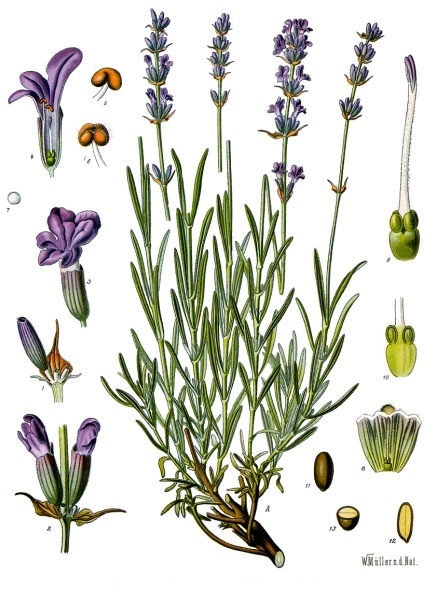
Lavender
 3
3 3
3 7
7Will it grow where I live?
Lavender is hardy to zone 6, which covers nearly all of Central Europe and the British Isles; only harsh upland sites (Alps, high ridges) call for winter protection.
Or check it for your location right here:
Profile
- Family
- Lamiaceae
- Habit
- Shrub
- Height
- 1.2 m
- Spread
- 1.2 m
- Growth
- slow
- Lifespan
- 10 years
- First yield
- after 2 years
- Hardiness
- zone 6–9
- Shade tolerance
- full sun
- Soil
- Sand, Silt, Loam
- Soil moisture
- very dry – moist
- pH
- 6.5 – 8
- Synonyms
- Lavandula officinale, Lavendel
- Planned in gardens
- 4×
Flowering & harvest
| J | F | M | A | M | J | J | A | S | O | N | D | |
|---|---|---|---|---|---|---|---|---|---|---|---|---|
| Flowering |
Uses
Edible: Blätter, Blütenblätter und Blütenspitzen – roh. Sie werden als Gewürz in Salaten, Suppen, Eintöpfen usw. verwendet. verwendet. Sie haben ein sehr aromatisches Aroma und sind zu intensiv, um sie mengenmäßig zu verwenden. Die frischen oder getrockneten Blüten werden als Tee verwendet. Frische Blüten werden auch kandiert oder als Aromastoff in Marmeladen, Eiscreme, Essig usw. eingesetzt. Ein ätherisches Öl aus den Blüten wird als Lebensmittelaroma verwendet.
Other uses: The oil extracted from lavender flowers is highly fragrant and versatile, with various uses in households and industries. It is utilized in soap production, high-quality perfumes (including 'Eau de Cologne'), as a cleaning agent, food flavoring, and insect repellent. Harvesting the flowering stems immediately after the flowers fade is recommended to achieve oil yields of 0.8 - 1%. The scented leaves and flowers are employed in potpourri and as insect repellents in linen storage. Historically, they were scattered in rooms for fragrance and insect deterrence. Adding the leaves to bathwater enhances the aroma and therapeutic benefits, also known for repelling mice. After using the flowers for potpourri, the remaining stems can be bundled and burned as incense sticks. Lavender is suitable for growing as a short hedge, thriving with regular trimming. Varieties like 'Hidcote Variety,' 'Loddon Pink,' and 'Folgate Blue' are ideal for creating dwarf hedges ranging from 30 to 50cm in height.
Growing
Lavender wants full sun and a free-draining, preferably calcareous, low-nutrient soil; light, warm and dry is ideal. On rich, humus-laden ground it makes plenty of leaf but less essential oil, and becomes short-lived. It will not tolerate waterlogging at all, so heavy soils should be lightened with sand or grit. The scent is strongest over chalk. Established plants are markedly drought-tolerant and shrug off salt wind, which also makes them useful for green roofs and coastal sites — the German lists for simple intensive roof planting carry it at 40 to 60 centimetres. Accounts of its frost hardiness diverge: NaturaDB gives minus 28 degrees for English lavender, older cultivation notes considerably less; brushwood protection is sensible in harsh situations. Longevity depends on pruning by the one-third, two-thirds rule — back by a third after flowering, by two-thirds in early spring, never into the old leafless wood, which will not reshoot.
Propagation
Plant seeds in spring in a sheltered environment, covering them lightly. Germination typically occurs within 1 to 3 months at 15°C. Once the seedlings are large enough, transfer them to individual pots and continue growing them in a protected area for their first winter. Plant them outdoors in late spring after the final frosts. Take 7-10cm cuttings of semi-hardwood with a heel in July or August, placing them in a frame. Rooting is usually successful within a few weeks. Keep them in a greenhouse during their first winter and transplant them outside after the last frosts in spring. Cuttings with a heel, measuring 7cm, can be taken successfully at any time of the year. Layering.
Value for wildlife
Lavender is first-rate bee forage: its nectar rating reaches the maximum four out of four, with pollen at two. Twenty-nine wild bee species have been recorded at the violet flower spikes, two of them specialists on it, alongside honey bees, bumblebees and hoverflies working the June-to-August bloom throughout the day. As a larval food plant it matters less — two moth species use it, among them the angle shades (Phlogophora meticulosa), and neither is a specialist. To get the most insect value from it, do not cut before flowering: let the spikes bloom through and shorten them afterwards. As a Mediterranean species it is no substitute for a native dry-grassland perennial, but it delivers nectar reliably through hot spells.
Notable
Lavender is a plant of poor, dry ground — and that is where its success is decided. It demands full sun, free-draining, preferably calcareous soil with no waterlogging whatever, and copes badly with rich, humus-laden or fertilised earth; its deep taproot reaches moisture in lower layers, making it markedly drought-tolerant. English lavender, hardy to around minus 28 degrees, is the toughest species of the genus, though brushwood protection is advisable in harsh situations. Longevity depends on pruning by the one-third, two-thirds rule: cut back by a third after flowering and by two-thirds in early spring — never into the old leafless wood, which will not reshoot. With the highest nectar rating, the flowers are first-rate bee forage.
Origin & habitat
Western Mediterranean: eastern Spain, southern France, Italy. The natural range of English lavender is confined to the coastal and mountain regions of the western Mediterranean. The largest wild populations lie in eastern Spain, with others in south-eastern France, adjoining parts of Italy and as far as the area around Bologna, growing in country too poor for arable farming. It is now cultivated far beyond its native range, most famously in Provence — where the growing area nevertheless halved between 2002 and 2012 under pressure from pests and hard frosts. Commercial production increasingly shifts to lavandin (Lavandula x intermedia). In Central Europe English lavender is purely a garden plant and escapes only exceptionally.
In its homeland English lavender grows on dry, rocky Mediterranean slopes, often at elevations unusable for agriculture, and here and there reaches the tree line. In phytosociological terms it belongs to the Ononido-Rosmarinetea, the Mediterranean dwarf-shrub heaths on limestone. The typical site is fully sunny, hot and markedly dry, the soil sandy to loamy, free-draining, calcareous and low in nutrients. Its long taproot reaches moisture in deeper layers, which makes it notably drought-tolerant. What it will not take is waterlogging — nor rich, humus-laden, fertilised garden soil, which leaves it soft and short-lived.
⚠️ Hazards
Lavender oil consists largely of linalool (20-45 %) and linalyl acetate (30-50 %). Undiluted it can irritate the skin; undiluted application over large areas raises the risk of lasting contact sensitisation, and case reports of contact-allergic reactions exist. Oxidised oil, or oil left open too long, increases the risk of redness and itching further. Essential oils should be avoided on infants and young children — application near the face can trigger laryngospasm. Dried flowers in tea or cooking are regarded as unproblematic in ordinary amounts.
Frequently asked questions
Lavender: how big does it get?
Lavender (Lavandula angustifolia) grows as a Shrub and reaches roughly 1.2 m in height when mature, with a spread of about 1.2 m. Growth is slow.
Lavender: what site does it need?
Lavender tolerates full sun. Suitable soils are Sand, Silt, Loam. Soil moisture should be in the range very dry – moist. The pH may lie between 6.5 and 8.
Lavender: is it hardy?
Lavender is listed as hardy in zone 6–9 and survives normal winters outdoors there.
Lavender: will it grow in Central Europe?
Lavender is hardy to zone 6, which covers nearly all of Central Europe and the British Isles; only harsh upland sites (Alps, high ridges) call for winter protection.
Lavender: when does it flower?
In a temperate northern-hemisphere climate it flowers from June to September.
Lavender: is it poisonous?
No toxicity is recorded for Lavender. With wild plants, never rely on a database alone — only on a confident identification.
Lavender: what is it used for?
Rated on a scale up to 10: Edible 3/10, Medicinal 3/10, Other uses 7/10.
Plan this plant into your own garden
Permaplans plans your garden to scale on the map — with a site check, harvest calendar and over 1,000 plants. Free for iPhone, Android, Mac, Windows & Linux.
Will this plant grow where you live? → Check your site
Community experience
No first-hand reports for this plant yet.
Growing it? Write in the app what works for you – your post will show up here.
💬 Get the app and join in