
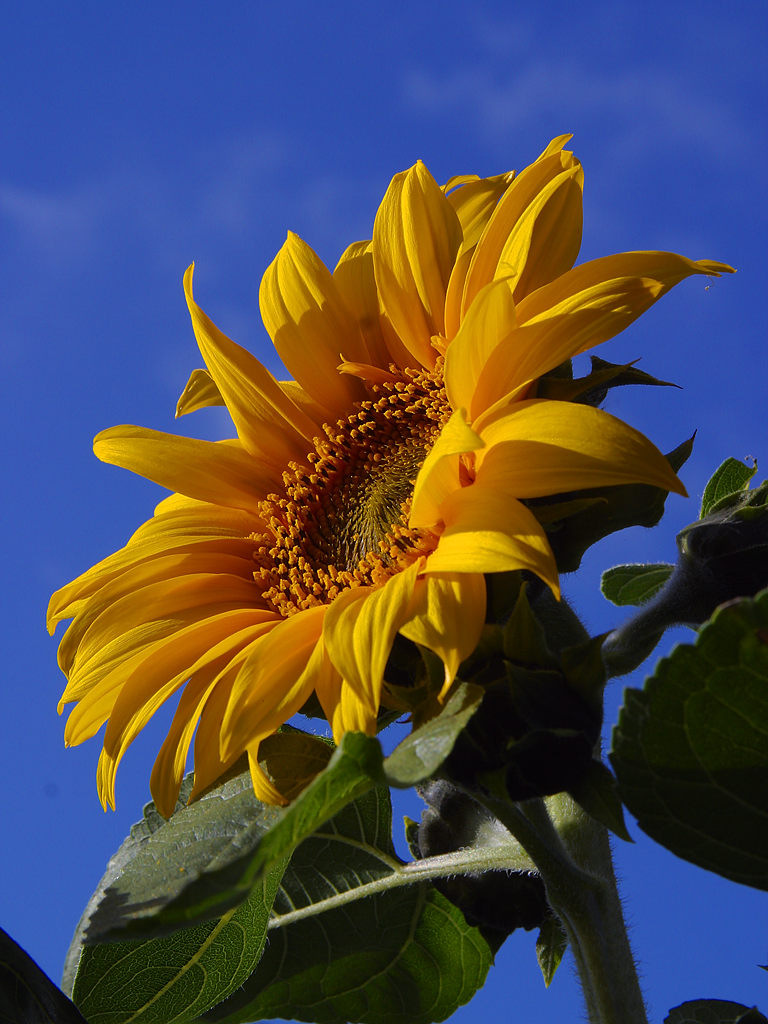
Sunflower
 5
5 2
2 9
9Will it grow where I live?
Sunflower is an annual and grows outdoors across Central Europe – one season from spring sowing to autumn harvest.
Or check it for your location right here:
Profile
- Family
- Asteraceae
- Habit
- annual
- Height
- 2.5 m
- Spread
- 0.8 m
- Growth
- very fast
- Lifespan
- 1 year
- First yield
- after 1 year
- Yield per plant
- up to 0.2 kg
- Hardiness
- zone 7–9
- Shade tolerance
- partial shade
- Soil
- Sand, Silt, Loam
- Soil moisture
- dry – very moist
- pH
- 5.9 – 8.1
Flowering & harvest
| J | F | M | A | M | J | J | A | S | O | N | D | |
|---|---|---|---|---|---|---|---|---|---|---|---|---|
| Flowering | ||||||||||||
| Fruit harvest |
Uses
Edible: Sunflower seeds – raw or cooked. They have a delicious, nutty flavour but are difficult to harvest because of their small size. Specialised machines are available commercially. The fat-rich kernels can be ground into a powder, processed into sunflower butter, or used for sunflower yoghurt. Mixed with cereal flour they make a nutritious bread. In Russia cultivars with an oil content of up to 50% have been developed. The oil contains 44–72% linoleic acid. Sprouted seeds are best for sunflower yoghurt; they are puréed with water and fermented. The sprouted seeds can be eaten raw. A nutritional analysis of the seeds is available. Young flower buds – steamed and served like artichokes. They have a mild and pleasant flavour, but are somewhat laborious to harvest. The average yield is 900–1575 kg/ha, but yields above 3375 kg/ha have also been reported. From the seeds, a high-quality semi-drying edible oil is obtained. It is low in cholesterol and is said to rival olive oil in quality. It is used in salads, margarine or for cooking. The roasted seeds serve as a substitute for coffee and drinking chocolate. According to another report, the roasted seed husks are also used. The leaf stalks are cooked and mixed into other foods.
Other uses: From the seeds an edible, semi-drying oil is obtained. Some cultivars contain up to 45% oil. This oil, often mixed with a drying oil such as linseed oil (Linum usitatissimum), is used for the production of soap, candles, varnishes, paints etc. as well as for lighting purposes. It is regarded as an unsurpassed lubricant. From the seed capsules blotting paper is made. From the inner stem high-quality writing paper is obtained. The pith of the stems, with a density of 0.028, is one of the lightest substances known. It has many uses, for example for the manufacture of life jackets and microscope slides. The dried stems are an excellent fuel; the ash is rich in potash. Both the dried stems and the empty seed capsules are excellent for kindling. From the fibres of the stem, paper and fine fabrics are produced. From the flowers a yellow dye is obtained. From the seeds of certain cultivars grown by the Hopi Indians of southwest North America, a purple-black dye is obtained. Sunflowers are suitable as green manure in spring and yield a good quantity of plant material. Root secretions of the plant can inhibit the growth of neighbouring plants.
Propagation
Sowing – sow in spring directly outdoors. Alternatively you can sow 2–3 seeds per pot in spring in the greenhouse. Use a nutrient-rich potting compost. Thin the seedlings to the strongest one, feed them occasionally with liquid fertiliser to prevent nutrient deficiency, and plant out in late spring or early summer. Seed harvested and stored at a moisture content of 12% retains its germination capacity for several years.
Origin & habitat
Western North America. Occasional escapes from British gardens.
Open, dry or moderately moist soils on the plains.
⚠️ Hazards
The growing plant can accumulate nitrates, especially when fed on artificial fertilizers. The pollen or plant extracts may cause allergic reactions.
Frequently asked questions
Sunflower: how big does it get?
Sunflower (Helianthus annuus) grows as a annual and reaches roughly 2.5 m in height when mature, with a spread of about 0.8 m. Growth is very fast.
Sunflower: what site does it need?
Sunflower tolerates partial shade. Suitable soils are Sand, Silt, Loam. Soil moisture should be in the range dry – very moist. The pH may lie between 5.9 and 8.1.
Sunflower: is it hardy?
Sunflower is listed as hardy in zone 7–9 and survives normal winters outdoors there.
Sunflower: will it grow in Central Europe?
Sunflower is an annual and grows outdoors across Central Europe – one season from spring sowing to autumn harvest.
Sunflower: when does it flower?
In a temperate northern-hemisphere climate it flowers from July to August.
Sunflower: when is it harvested?
In a temperate northern-hemisphere climate the fruit ripens from September to October.
Sunflower: when does it start cropping, and how much?
Sunflower crops in its first year. Expect up to 0.2 kg per plant. Figures assume a good site; variety, soil and climate shift them considerably.
Sunflower: is it poisonous?
No toxicity is recorded for Sunflower. With wild plants, never rely on a database alone — only on a confident identification.
Sunflower: what is it used for?
Rated on a scale up to 10: Edible 5/10, Medicinal 2/10, Other uses 9/10.
Plan this plant into your own garden
Permaplans plans your garden to scale on the map — with a site check, harvest calendar and over 1,000 plants. Free for iPhone, Android, Mac, Windows & Linux.
Will this plant grow where you live? → Check your site
Community experience
No first-hand reports for this plant yet.
Growing it? Write in the app what works for you – your post will show up here.
💬 Get the app and join in