
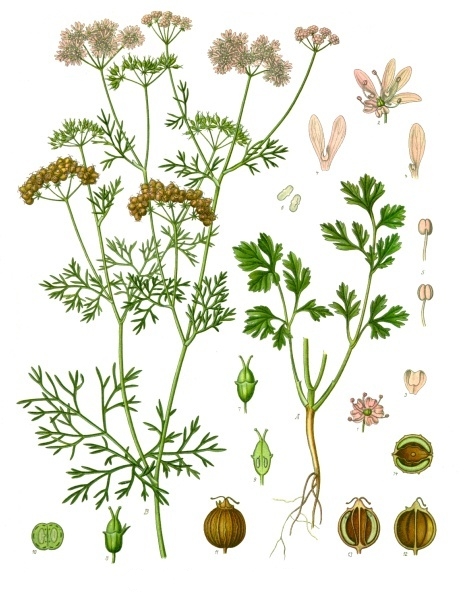
Coriander
 7
7 7
7 7
7Will it grow where I live?
Coriander is an annual and grows outdoors across Central Europe – one season from spring sowing to autumn harvest. It also needs warm summers – in Central Europe that means wine-growing regions, cities or a sheltered south-facing wall.
Or check it for your location right here:
Profile
- Family
- Apiaceae
- Habit
- annual
- Height
- 0.3 m
- Spread
- 0.5 m
- Growth
- medium
- Lifespan
- 1 year
- First yield
- after 1 year
- Hardiness
- zone 7–11
- Shade tolerance
- light shade
- Soil
- Sand, Silt
- Soil moisture
- dry – moist
- pH
- 6 – 7.5
Varieties (1)
1 varieties of Coriander are listed in the Permaplans variety finder — each with its own page: taste, ripening time, disease resistance, parentage and use.
Uses
Edible: Herb and fruit taste so different that they cannot stand in for one another. The fresh leaf carries a strong, musky to lemony aroma which a proportion of people perceive as soapy for genetic reasons — in Southeast Asia and Latin America it is an everyday herb, in Central Europe it remains a matter of taste. Chopped, it goes into salads, sauces and cheese, meat and fish dishes, and forms the basis of Canarian mojo verde and Chilean pebre. The dried fruit smells quite different: warm, sweetish, faintly orange. It should be briefly toasted and ground only just before use, otherwise the less volatile bitter compounds take over and the dish turns bitter rather than aromatic. It seasons bread and gingerbread, cabbage, pulses and squash, makes up the main part of many curry powders and of harissa, and flavours beers such as gose and witbier. In Thailand the root is used as well, like parsley root.
Medicinal: Coriander has been used in herbal medicine since ancient Egypt; the dried fruit is the part used as a drug. The essential oil is credited with appetite-stimulating, digestive and antispasmodic properties in stomach and intestinal complaints, which is why coriander is a component of corresponding tea blends and preparations. The effect is considered weaker than that of caraway or fennel. For the oils to pass into an infusion at all, the fruit has to be crushed or ground first — whole grains give up almost nothing. Traditionally coriander was also used in livestock keeping against flatulence. Recorded in folk medicine, without evidence of efficacy, is its use as "pilgrimage grains": coriander seeds baked in sugar and brought home from places of pilgrimage — popular belief credited coriander, like other strongly scented umbellifers, with warding-off powers.
Other uses: Beyond the kitchen coriander has two technical uses. The fruit yields an essential oil distilled for perfumery, where its warm, spicy scent serves less as a note in its own right than to round off and harmonise other components. The fruit also contains 13 to 23 percent fixed oil, whose unusually high petroselinic acid content makes it technically interesting: it is a candidate substitute for palm and coconut oil and a feedstock for detergents, cosmetics and leather processing. In the garden the third use is the most practical: a flowering row of coriander along a sunny bed edge feeds hoverflies and parasitic wasps, and permaculture design places it deliberately as a companion at the edge of fruit tree guilds.
Growing
Site: Coriander wants sun and warmth on free-draining, rather light soil; it will not take heavy wet ground or waterlogging. It roots with a taproot and therefore transplants badly — direct sowing in place is the norm, raising in soil blocks the exception. At 30–90 cm tall and 20–30 cm wide it fits gaps in beds, borders and the herb garden, and does well in pots and window boxes. As an umbellifer in flower it draws hoverflies and parasitic wasps, which makes it a good neighbour for vegetables and young fruit trees. It makes no great demands on crop rotation. The smell of the foliage is strong and not to everyone's liking — if it is not to yours, keep it away from the seating area. Care: What matters is even moisture while the plants are young: drought stress in the first growth phase triggers premature bolting, and the leaf harvest is over. For a continuous supply, sow successionally every two to three weeks. Feed sparingly; in pots a liquid feed helps. Disease appears mainly in damp weather: bacterial umbel blight, powdery mildew and leaf spot caused by Ramularia; animal pests are rare, with the occasional capsid bug. Very warm, dry weather slows growth and costs yield. The fruit is cut from July to early August shortly before full ripeness, because otherwise it shatters from the umbel, and dried off in an airy place. Shed seed often germinates by itself the following year.
Propagation
Coriander is propagated by seed alone and grown as an annual. Fresh seed germinates readily and independently of light; it is covered only thinly with soil so that it stays evenly moist. The favourable temperature range is 5 to 25 °C, though some seed lots germinate only between 10 and 20 °C. Sow in rows 20 to 25 cm apart; without precision sowing, thin after emergence to 15 to 20 cm. The seedlings take light frost, so sowing can start early in the year. For leaf harvest, successional sowings every two to three weeks are worthwhile. From sowing to fruit harvest takes about 20 to 28 weeks. Home-saved seed stays true to type as long as several varieties are not flowering side by side.
Value for wildlife
The white compound umbels are a generous nectar source: NaturaDB rates nectar value at 4 out of 4 and counts 18 wild bee species, while pollen value is a low 1 out of 4 — coriander is a filling station rather than a larder. The USDA report on crop pollination rates it consistently as attractive under certain conditions for honeybees, bumblebees and solitary bees alike. Its greater garden value lies with beneficial insects: like other umbellifers with openly accessible flowers it feeds hoverflies and parasitic wasps whose larvae consume aphids and caterpillars. That is why permaculture guilds place it deliberately along the sunny edge of fruit tree plantings. As a non-native annual it is a host plant for no Central European caterpillar.
Notable
Special features: herb and fruit taste completely different and do not substitute for each other; the soapy taste of the leaf is genetic and only some people perceive it; fruit becomes aromatic only after drying; harvest shortly before full ripeness or the seed shatters; taproot -> direct sowing rather than transplanting; drought stress when young triggers premature bolting; magnet for beneficial insects at the edge of fruit tree guilds
Origin & habitat
Western Asia: Turkey, the Levant, the Sinai Peninsula, the Arabian Peninsula and on to Pakistan. One of the oldest spice plants of all, coriander was already used in pharaonic Egypt and spread early across the whole Mediterranean along the trade routes; it reached Central Europe with the Romans and has been grown in monastery gardens here since the Middle Ages. Today it is cultivated worldwide in temperate and subtropical regions, with centres in India, Morocco, eastern Europe and Canada. In Central Europe it escapes from cultivation occasionally but rarely persists; in Switzerland an escaped plant has been recorded as high as 1730 m.
Coriander is a plant of warm, open and regularly disturbed ground. In its native range it grows on dry, warm ruderal sites, field margins and open slopes; in Central Europe it appears almost only as an escape on arable land, waste ground and path edges. It prefers warm, moderately dry, nutrient- and base-rich but humus-poor loam and loess soils, and avoids waterlogging as much as heavy shade. As an annual with a short season it occupies gaps before perennial competition closes them, and disappears again once the ground grows over. By Landolt's indicator values it is a light-demanding plant of very warm sites on slightly acid to neutral ground.
⚠️ Hazards
Skin irritation on contact In sensitive people the plant sap can trigger skin reactions under the influence of sunlight. When harvesting larger quantities or cutting back flowering stands on hot days, gloves and long sleeves are the simple remedy; wash sap off the skin before going into direct sun.
Frequently asked questions
Coriander: how big does it get?
Coriander (Coriandrum sativum) grows as a annual and reaches roughly 0.3 m in height when mature, with a spread of about 0.5 m. Growth is medium.
Coriander: what site does it need?
Coriander tolerates light shade. Suitable soils are Sand, Silt. Soil moisture should be in the range dry – moist. The pH may lie between 6 and 7.5.
Coriander: is it hardy?
Coriander is listed as hardy in zone 7–11 and survives normal winters outdoors there.
Coriander: will it grow in Central Europe?
Coriander is an annual and grows outdoors across Central Europe – one season from spring sowing to autumn harvest. It also needs warm summers – in Central Europe that means wine-growing regions, cities or a sheltered south-facing wall.
Coriander: is it poisonous?
No toxicity is recorded for Coriander. With wild plants, never rely on a database alone — only on a confident identification.
Coriander: what is it used for?
Rated on a scale up to 10: Edible 7/10, Medicinal 7/10, Other uses 7/10.
Which Coriander varieties are there?
The Permaplans variety finder lists 1 varieties of Coriander, including Pokey Joe. Each variety has its own page with taste, ripening time, disease resistance and parentage.
Plan this plant into your own garden
Permaplans plans your garden to scale on the map — with a site check, harvest calendar and over 1,000 plants. Free for iPhone, Android, Mac, Windows & Linux.
Will this plant grow where you live? → Check your site
Community experience
No first-hand reports for this plant yet.
Growing it? Write in the app what works for you – your post will show up here.
💬 Get the app and join in