
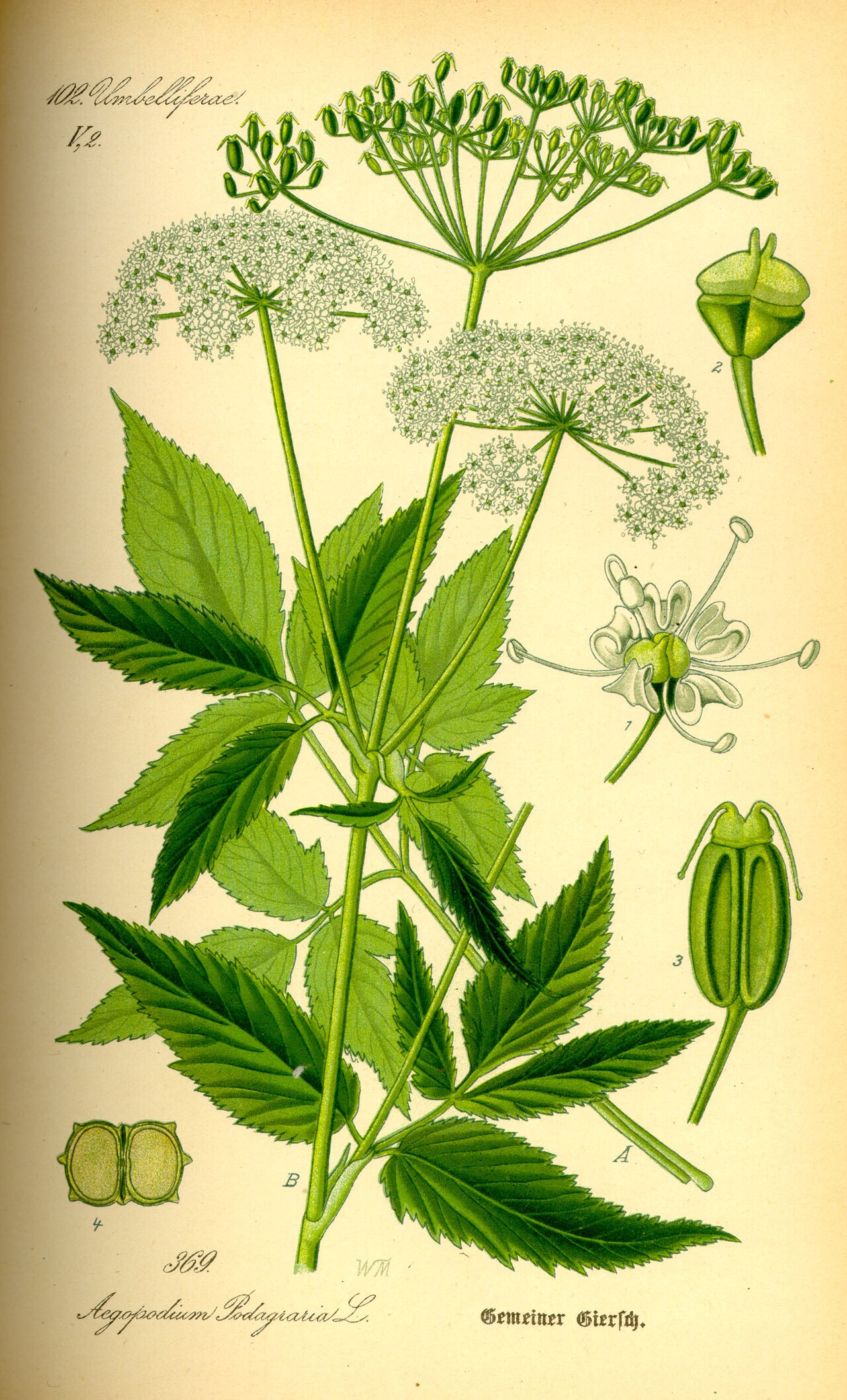
Ground elder
 6
6 3
3 1
1Will it grow where I live?
Ground elder is hardy to zone 5 – that covers all of Central Europe and the British Isles, and every USDA zone from 5 upwards.
Or check it for your location right here:
Profile
- Family
- Apiaceae
- Habit
- perennial
- Height
- 0.5 m
- Spread
- 0.4 m
- Growth
- very fast
- Lifespan
- 20 years
- First yield
- after 1 year
- Hardiness
- zone 5–8
- Shade tolerance
- full shade
- Soil
- Sand, Silt, Loam
- Soil moisture
- semi-dry – very wet
- pH
- 5.6 – 7.6
Uses
Growing
Thrives in partial shade and shade on moist to semi-dry, fertile soils, where it quickly forms dense, sheet-like stands via underground runners. It is hardly ever planted deliberately in practice, because it is so hard to contain afterwards. If you have it, regulate it through use rather than weeding: harvesting the leaves regularly weakens the stand, and digging out the roots along with them thins it. Practical accounts report that a stand in a densely planted area stayed in balance for years through the surrounding perennials alone, while being harvested regularly. Among gardeners its vigour serves as a yardstick: species that can hold their own against it count as decidedly invasive spreaders.
Notable
One of the most productive wild vegetables there is, because it is permanently available without sowing, cultivation or care and keeps pushing out fresh growth from spring to autumn: what counts as a problem in an ornamental bed is a standing harvest in the kitchen garden. It is also usable in practice as an indicator of site conditions — where it does well, other species of moist, partly shaded understorey will find their conditions too.
Origin & habitat
Most of Europe, eastwards to Western Asia and Siberia.
Hedgerows and cultivated land. A common garden weed.
⚠️ Hazards
It belongs to the umbellifers, a family containing both very poisonous and very edible species — unambiguous identification is mandatory when foraging. Rough chervil (Chaerophyllum temulum), which can cause severe poisoning, frequently grows in the immediate vicinity. The distinguishing features are the leaf divided into three, whose upper group of leaflets is divided into three again, and the distinctly three-angled stem; rough chervil is more finely pinnate, looks altogether softer and has a round, smooth stem.
Frequently asked questions
Ground elder: how big does it get?
Ground elder (Aegopodium podagraria) grows as a perennial and reaches roughly 0.5 m in height when mature, with a spread of about 0.4 m. Growth is very fast.
Ground elder: what site does it need?
Ground elder tolerates full shade. Suitable soils are Sand, Silt, Loam. Soil moisture should be in the range semi-dry – very wet. The pH may lie between 5.6 and 7.6.
Ground elder: is it hardy?
Ground elder is listed as hardy in zone 5–8 and survives normal winters outdoors there.
Ground elder: will it grow in Central Europe?
Ground elder is hardy to zone 5 – that covers all of Central Europe and the British Isles, and every USDA zone from 5 upwards.
Ground elder: is it poisonous?
No toxicity is recorded for Ground elder. With wild plants, never rely on a database alone — only on a confident identification.
Ground elder: what is it used for?
Rated on a scale up to 10: Edible 6/10, Medicinal 3/10, Other uses 1/10.
Plan this plant into your own garden
Permaplans plans your garden to scale on the map — with a site check, harvest calendar and over 1,000 plants. Free for iPhone, Android, Mac, Windows & Linux.
Will this plant grow where you live? → Check your site
Community experience
No first-hand reports for this plant yet.
Growing it? Write in the app what works for you – your post will show up here.
💬 Get the app and join in